
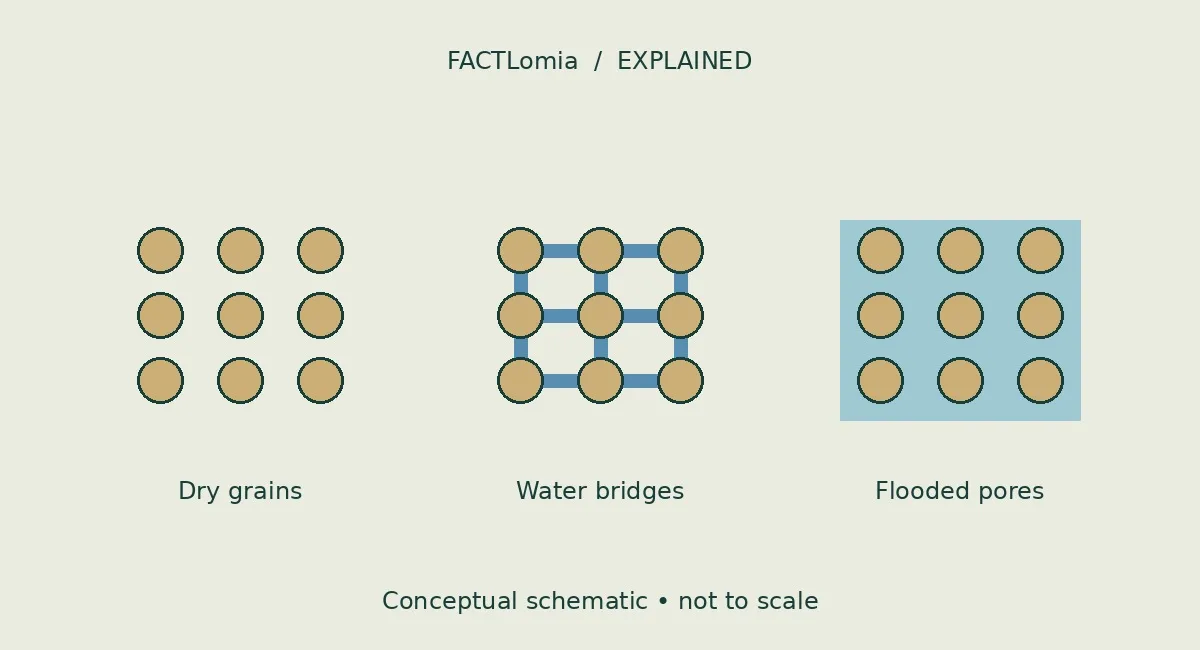
Damp sand holds its shape because small water bridges pull neighboring grains together. These capillary forces add cohesion to a loose pile. Dry sand lacks those bridges, while fully flooded sand loses the same air–water bridge structure.
Water makes temporary connections
At contacts between grains, a small amount of water forms curved surfaces. Surface tension and the pressure difference across those surfaces draw the grains together. A sandcastle is therefore a network of many small connections, rather than a solid block of sand glued by a chemical reaction. [1, 2]
Why more water is not always better
A little water can strengthen the grain network, but filling the pore spaces changes the geometry of the liquid. Individual bridges merge, and the stabilizing mechanism no longer operates in the same way. The best amount depends on grain size, shape, packing, and the structure being built; one universal beach recipe would be misleading. [1]
A beach experiment with three cups
Fill three cups with similar sand. Leave one dry, moisten the second gradually, and saturate the third. Invert them onto a tray and compare what remains standing. Keep the cup shape and packing pressure as similar as possible. Differences show why an appealing castle-building observation is also a materials-science problem.
Is the water acting like glue?
Only as an analogy. The cohesion comes largely from liquid surfaces and pressure, not from water curing into an adhesive.
Why does a wave ruin a sandcastle?
Moving water can erode grains and flood the pores. Both effects can undermine the structure; losing capillary bridges is only part of a real wave’s impact.
Keep exploring
Continue with Why Do Some Beaches Squeak When You Walk on Them? and Why Do Wet Roads Look Darker but Shine at Night?.
Sources and evidence
- Washington State University — How does sand stick together? ↗
Accessible explanation of liquid bridges.
- Scientific Reports — How to construct the perfect sandcastle ↗
Research on capillary cohesion and sandcastle stability.
Sources consulted: 15 October 2026. Written with AI assistance and checked against the linked references; not independently reviewed by a subject specialist. Sources do not endorse this article. See our editorial policy.
Revision: Initial publication; factual claims checked against linked sources.