
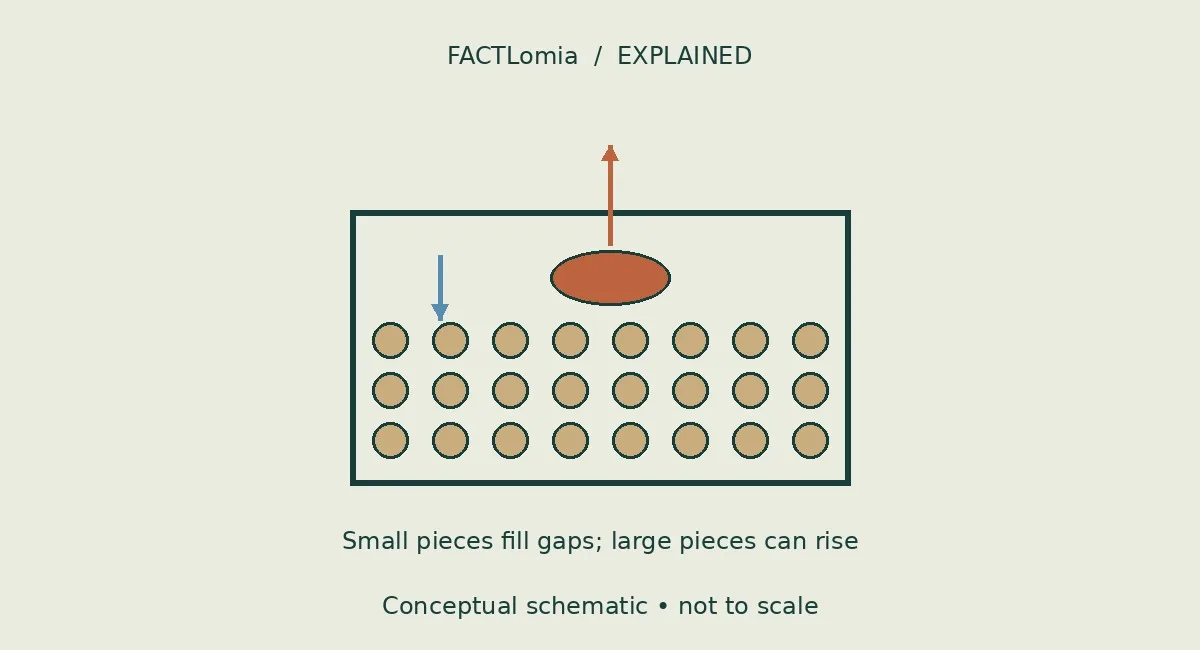
Large nuts can rise in a shaken mix because smaller pieces slip into newly opened gaps while the larger pieces become trapped higher up. Bulk circulation and particle orientation can also contribute. This size sorting is called the Brazil nut effect, but the outcome depends on the mixture and how it is shaken.
Shaking temporarily unlocks the pile
A settled mixture supports itself through many contacts. Shaking rearranges that network and creates openings. Smaller pieces can fit through gaps that exclude a larger object, helping them move downward relative to it. A simple “heavy things sink” rule does not describe all granular materials because a pile is not a uniform liquid. [1]
Shape can determine which nut escapes
In a three-dimensional imaging study of real mixed nuts, researchers observed smaller peanuts moving downward as some Brazil nuts rose. Rotation toward a more upright orientation helped larger nuts find routes upward, but it did not guarantee escape: some remained trapped. The evidence supports a geometry-dependent process rather than an automatic elevator for every large nut. [2]
Why another jar may behave differently
Experiments also show regimes in which circulation of the grain bed carries an object upward. Container walls, vibration speed, particle density, and friction can change which mechanism dominates. That is why pouring, tapping, and shaking the same mix need not produce identical results. A household demonstration illustrates one set of conditions, not a universal sorting law. [3]
Do heavier objects always rise?
No. The name refers to a common size-segregation pattern. Mass alone does not predict the result.
Can the large pieces end up at the bottom?
Yes. Reverse segregation can occur in some mixtures and vibration regimes. Size, density and forcing must be considered together.
Is this relevant to industry?
Yes. Any process that needs a uniform granular blend must consider segregation during handling. A snack mix makes an invisible processing problem easy to see.
Keep exploring
Continue with Why Does Wet Sand Hold Its Shape but Dry Sand Falls Apart? and Why Does a Spinning Hard-Boiled Egg Stand Up?.
Sources and evidence
- Scientific Reports — Multiscale Brazil nut effects ↗
Gap filling and size segregation in granular materials.
- Scientific Reports — 3D imaging of irregular granular materials ↗
Real-nut orientation and time-resolved observations.
- Physical Review E — Convection-driven Brazil nut effect ↗
Experiments on a convection-dominated regime.
Sources consulted: 15 October 2026. Written with AI assistance and checked against the linked references; not independently reviewed by a subject specialist. Sources do not endorse this article. See our editorial policy.
Revision: Initial publication; factual claims checked against linked sources.