
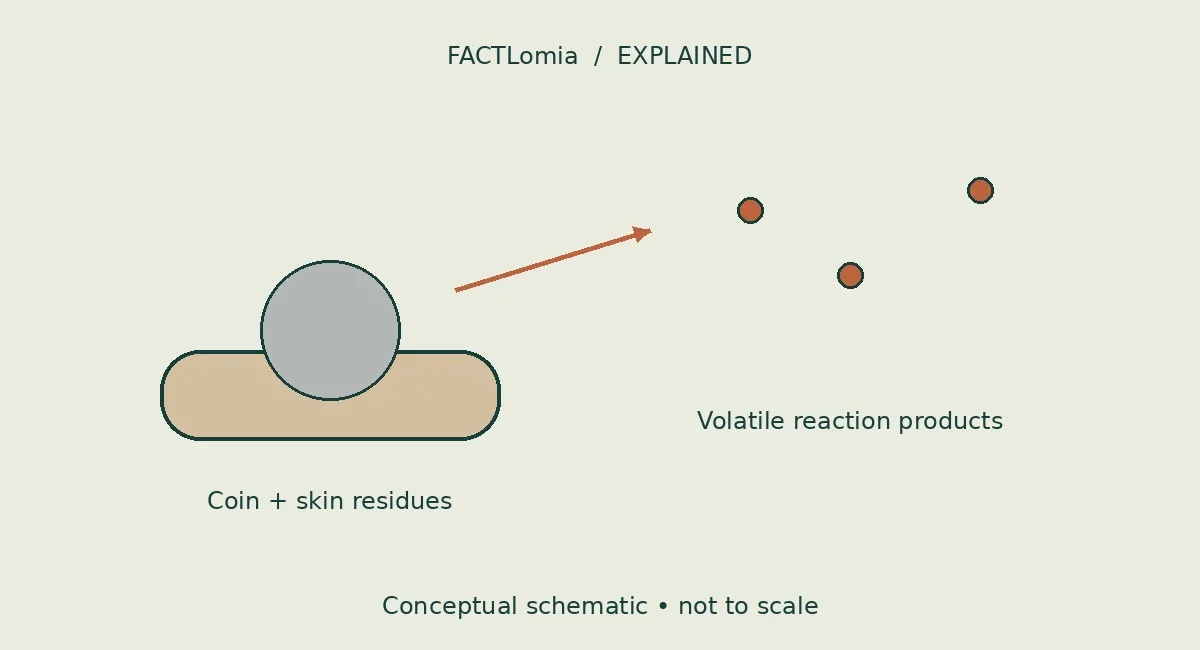
The familiar metallic smell after handling iron or copper-containing objects comes largely from volatile compounds produced when the metal reacts with skin substances. Your nose is detecting reaction products, not a cloud of metal atoms evaporating from the coin at room temperature.
Your skin supplies part of the chemistry
Sweat can help release reactive metal ions from a surface. With iron, those ions promote reactions involving lipid peroxides associated with skin oils. The reactions generate carbonyl compounds, including molecules with strong odors at very low concentrations. The metal helps trigger the smell, while organic material from the skin supplies much of what becomes airborne. [1, 2]
Why a handled object can smell too
Skin residues can remain on a coin, handrail, or tool after it has been touched. The fact that an object smells before your own hand touches it does not establish that the odor is the pure metal itself. Earlier handling can leave the chemical ingredients behind. Object composition, surface condition, and skin chemistry all affect the result. [2]
A better comparison than “metal has no smell”
Think of cutting an apple: contact and damage create conditions for chemistry that changes what you notice. Metal handling is a different reaction, but the comparison makes the same logical point—an object can cause an odor without being the volatile substance you smell. Avoid extending this explanation to every industrial metallic odor, which may involve other materials or processes.
Are all coins made of the same metal?
No. Coin compositions differ by country, denomination, and date. The surface alloy matters more to immediate contact than a casual assumption that every silver-colored coin is silver.
Does a strong smell tell me how dirty a coin is?
No. Odor strength is not a reliable cleanliness or microbial test. Very small quantities of potent odor compounds can be noticeable.
Is metallic taste the same process?
Not necessarily. Taste and smell interact, but an explanation for skin-contact odor does not identify every cause of a metallic taste.
Keep exploring
Continue with Why Does Iron Rust? Oxygen and Water Start an Electrochemical Reaction and Why Can Some People Smell Asparagus Pee While Others Can’t?.
Sources and evidence
- Angewandte Chemie — The two odors of iron ↗
Experimental identification of skin-related iron odor chemistry.
- Helmholtz Centre for Environmental Research — Money does not smell until touched ↗
Research-team explanation of lipid reactions and residues on handled surfaces.
Sources consulted: 15 October 2026. Written with AI assistance and checked against the linked references; not independently reviewed by a subject specialist. Sources do not endorse this article. See our editorial policy.
Revision: Initial publication; factual claims checked against linked sources.