
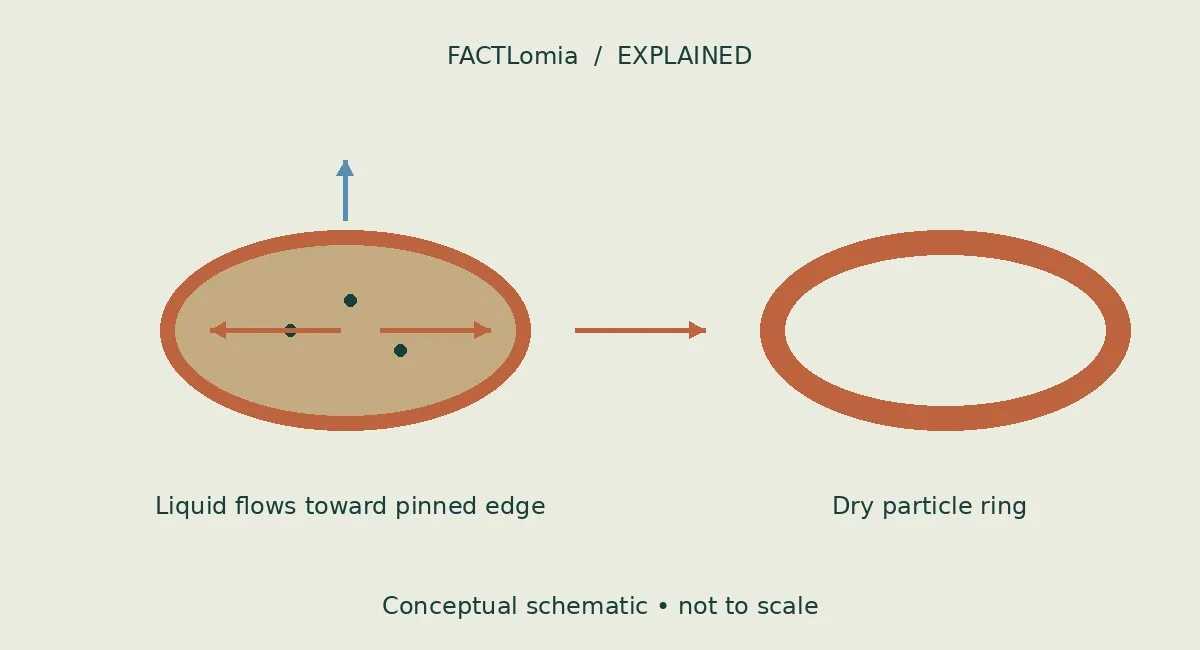
A coffee drop often dries into a dark ring because liquid flows toward its edge and carries suspended particles with it. When the edge stays pinned to the surface, evaporation near that boundary must be replenished from inside the drop. The water leaves, but many particles remain at the perimeter.
The edge acts like a collection zone
A spill contains water and nonvolatile material. In the classic coffee-ring experiment, the contact line—the boundary where liquid, air, and the solid meet—stays in roughly the same place while the drop becomes thinner. Evaporation is especially strong near that edge. Outward flow delivers replacement liquid and transports particles, which accumulate there. [1]
Not every spill leaves the same pattern
The classic mechanism describes a particular drying situation, not a universal rule for every drink and surface. A boundary that slides inward, particles with different shapes, or competing internal flows can produce a more even deposit or another pattern. Absorbent paper introduces additional transport through its pores, so a stain on a napkin is not identical to a drop drying on a countertop. [2, 3]
Watch a small drop instead of a whole puddle
Place a small drop of cooled black coffee on a clean, smooth plate and let it dry undisturbed. Look for a darker edge and a paler center. Compare it with a drop on absorbent paper, keeping the amount similar. You are changing the surface, so differences cannot automatically be attributed to evaporation alone. The useful observation is where the solid material ends up.
Does the coffee move after the water is gone?
The important transport happens while liquid remains. Once the deposit is dry, it records where particles were delivered during drying.
Is the ring caused by the plate being hotter at the edge?
An imposed temperature difference is not required for the classic effect. A pinned edge and the geometry of evaporation can drive the outward flow. [1]
Does this matter outside the kitchen?
Yes. Researchers study drying patterns because uneven particle deposits can complicate coatings and printing. A stain is a small example of a broader materials problem. [2]
Keep exploring
Continue with Why Does Wet Sand Hold Its Shape but Dry Sand Falls Apart? and Why Do Water Drops Dance on a Very Hot Pan?.
Sources and evidence
- Nature — Capillary flow as the cause of ring stains ↗
Original experiments identifying pinned contact lines and outward flow.
- University of Edinburgh — Homogeneous drying patterns ↗
Research on controlling drying deposits.
- Chemical Engineering Science — Coffee stains on paper ↗
How porous paper changes material transport.
Sources consulted: 15 October 2026. Written with AI assistance and checked against the linked references; not independently reviewed by a subject specialist. Sources do not endorse this article. See our editorial policy.
Revision: Initial publication; factual claims checked against linked sources.