
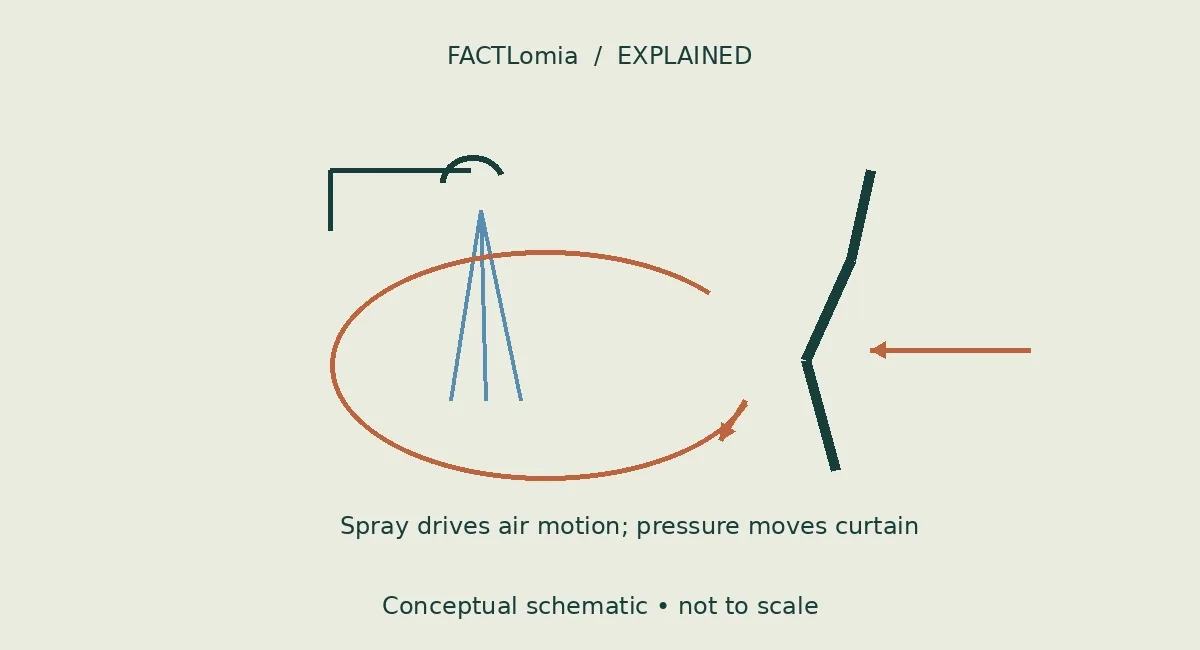
A shower curtain can move inward because the spray drives air motion and creates a pressure difference across the curtain. A computational model found a spray-driven vortex with a lower-pressure center. Warm-air buoyancy can influence a real bathroom, but heat alone cannot explain inward motion during a cold shower.
The water moves the surrounding air
Falling droplets exchange momentum with air. In engineer David Schmidt’s simulation, the spray maintained a circulating flow, rather than leaving the shower air motionless. A lower-pressure region within that circulation produced a net force on a light curtain. The explanation concerns moving air and water together, not water somehow pulling the fabric from a distance. [1]
Why the temperature explanation is incomplete
Hot air rising is a plausible contributor in a warm shower, but a mechanism that requires heating cannot by itself explain the effect in cold water. Bathroom openings, ventilation, curtain position, and the spray pattern change the flow. A successful model of one arrangement is not proof that every enclosure has exactly the same circulation or a single dominant cause. [1, 2]
Small pressure differences act over a large sheet
Imagine a broad sheet of fabric rather than a rigid wall. A small imbalance over that area can be noticeable if the sheet is light and free to move. A heavier liner or a restrained lower edge offers more resistance. That practical comparison follows from force balance; it does not require the shower to create anything close to a vacuum.
Is the air pressure inside the shower zero?
No. The difference is small compared with atmospheric pressure. Describing the enclosure as a vacuum is misleading.
Why does my curtain stay still?
Its weight, stiffness, attachment and local airflow may prevent a noticeable deflection. The effect is not required in every shower.
Does cold-water motion prove that warm air never matters?
No. It shows that heating is not necessary in every case. Several contributions can coexist in a warm shower.
Keep exploring
Continue with How Do Airplane Wings Create Lift? and Why Don’t Raindrops Keep Speeding Up as They Fall?.
Sources and evidence
- Scientific American — Explanation by David Schmidt ↗
First-person account of the spray simulation, vortex and curtain force.
- Institute of Physics — Shower curtains suck ↗
Educational discussion of the airflow explanation.
Sources consulted: 15 October 2026. Written with AI assistance and checked against the linked references; not independently reviewed by a subject specialist. Sources do not endorse this article. See our editorial policy.
Revision: Initial publication; factual claims checked against linked sources.