
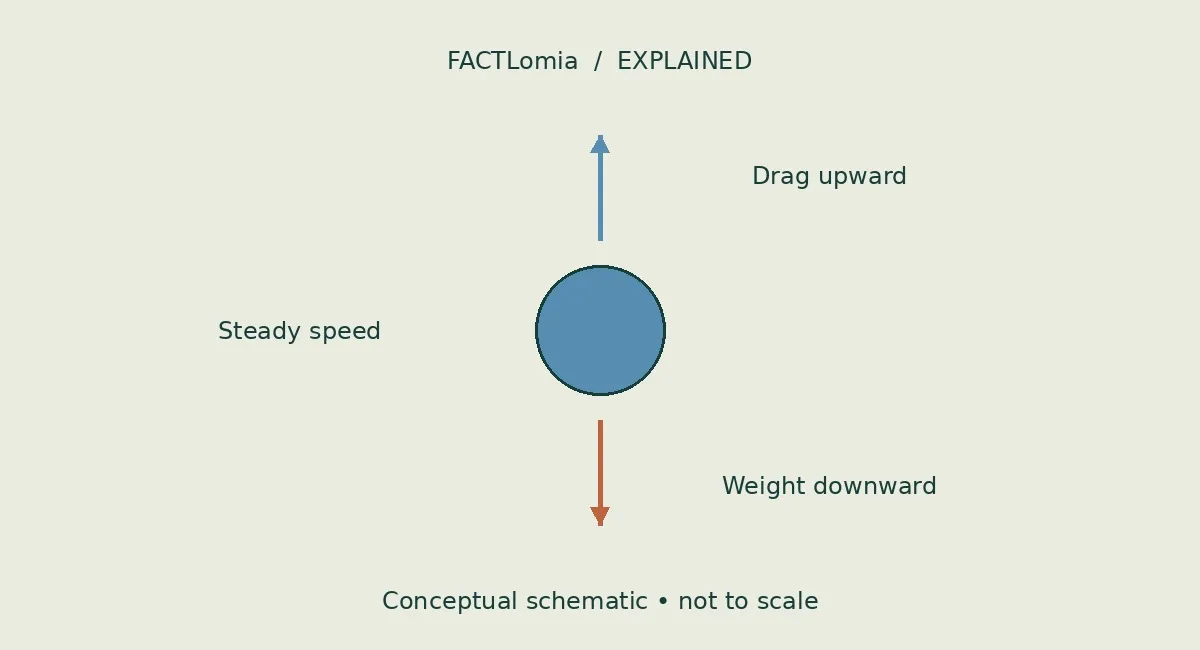
Raindrops stop gaining much speed when upward air resistance balances their downward weight. This balance is called terminal velocity. It is not one fixed speed for all rain: drop size, shape, air density, and wind all affect the motion.
A falling drop pushes air aside
Gravity pulls the drop downward, but moving through air creates drag. As the drop speeds up relative to the air, drag generally increases. When the forces balance, the drop can keep falling without continuing to accelerate. Terminal velocity means steady relative speed, not that gravity has switched off. [1]
Larger drops fall faster, within limits
NASA explains that terminal fall speed generally increases with drop size, reaching roughly 10 meters per second for the largest drops in still air. Small drizzle falls much more slowly. Large drops also deform and can break apart, so rain cannot grow indefinitely into ever-faster, rigid spheres. [2, 3]
Why a tall cloud does not make rain a bullet
A drop falling farther does not gain speed forever once drag is important. Compare the idea with a parachute: changing the area presented to the air changes the balance of forces. The analogy explains the trend, although a water drop changes its own shape and is not a miniature parachute.
Can a raindrop move upward?
Yes. A strong updraft can carry it upward relative to the ground even while it falls relative to the surrounding air. [2]
Are raindrops shaped like tears?
Usually not. Small drops are nearly round, while larger falling drops flatten underneath and may resemble a rounded bun. [3]
Keep exploring
Continue with How Do Airplane Wings Create Lift? and Why Does the Sky Sometimes Turn Green Before a Storm?.
Sources and evidence
- NASA Glenn — Terminal velocity ↗
Force balance and drag.
- NASA GPM — How fast do raindrops fall? ↗
Drop size, approximate speeds and updrafts.
- NASA GPM — Anatomy of a raindrop ↗
Shape changes and breakup.
Sources consulted: 15 October 2026. Written with AI assistance and checked against the linked references; not independently reviewed by a subject specialist. Sources do not endorse this article. See our editorial policy.
Revision: Initial publication; factual claims checked against linked sources.