
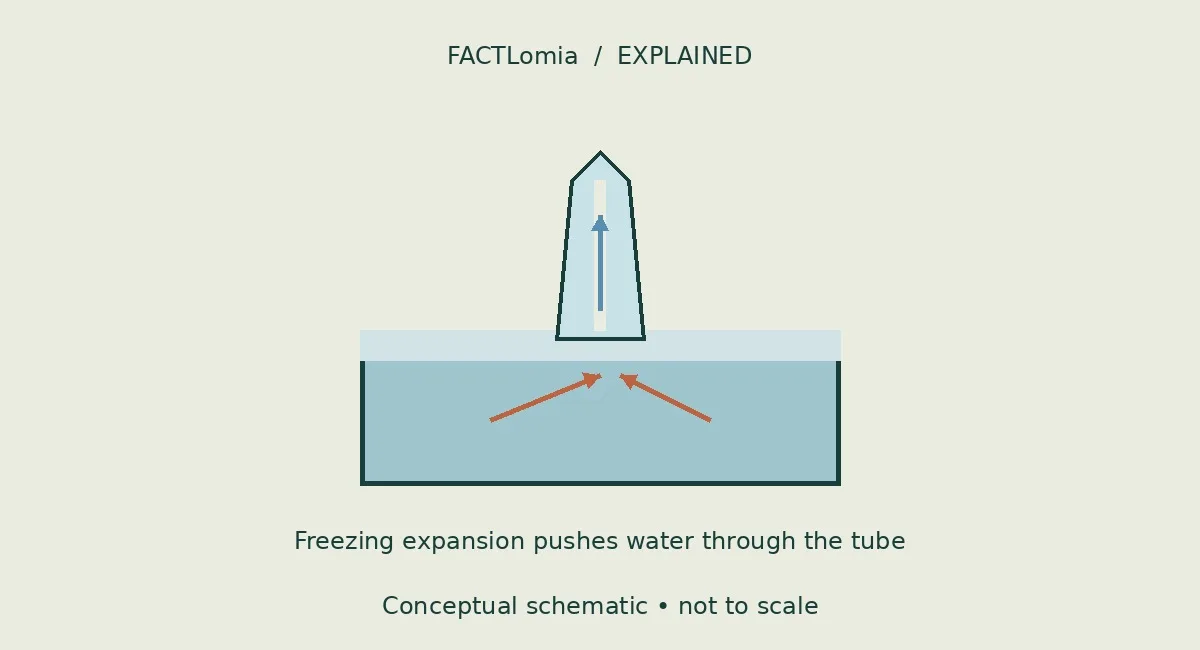
Ice cubes sometimes grow spikes because freezing water expands and squeezes remaining liquid through a small hole in the surface ice. Water freezes around the rim of that opening, building a hollow tube upward until the water supply ends or the tube closes.
The surface closes around a small opening
In the commonly accepted growth model, ice spreads across the surface from the edges, leaving a small unfrozen patch. Ice forming below the surface occupies more volume than the water it replaces. Remaining liquid is forced through the opening instead of being compressed into the same space. [1, 2]
The spike grows at its rim
The protruding water freezes around its edge while more liquid arrives through the center. Repetition lengthens the ice tube. It can lean rather than point straight up, and it stops growing when the liquid route freezes shut or the reservoir is exhausted. A finished spike may hide the hollow structure that existed during growth. [1]
Why distilled water is worth comparing
Caltech experiments found that dissolved salts can strongly suppress spike formation. Distilled water therefore makes a useful comparison with tap water, though it does not guarantee a spike in every tray. Temperature, airflow, the container, and initial crystal formation also matter. Compare water types in similar compartments and record several freezes rather than treating one failed cube as decisive. [2]
Is a spike made by water dripping from above?
Not necessarily. An upward ice spike can form without a leak overhead. The liquid supply comes from within the freezing cube.
Is an ice spike a living growth?
No. This is crystal growth driven by freezing and water movement, not a biological organism.
Does a spike prove my tap water is pure?
No. Spike formation is affected by several variables and is not a water-quality or drinking-safety test.
Keep exploring
Continue with Why Do Ice Cubes Crack When You Put Them in Water? and How Can Water Stay Liquid Below Freezing?.
Sources and evidence
- Caltech — Ice spikes ↗
Illustrated account of tube growth and laboratory observations.
- Journal of Glaciology — Laboratory-grown ice spikes ↗
Experiments on temperature, airflow and dissolved impurities.
Sources consulted: 15 October 2026. Written with AI assistance and checked against the linked references; not independently reviewed by a subject specialist. Sources do not endorse this article. See our editorial policy.
Revision: Initial publication; factual claims checked against linked sources.