
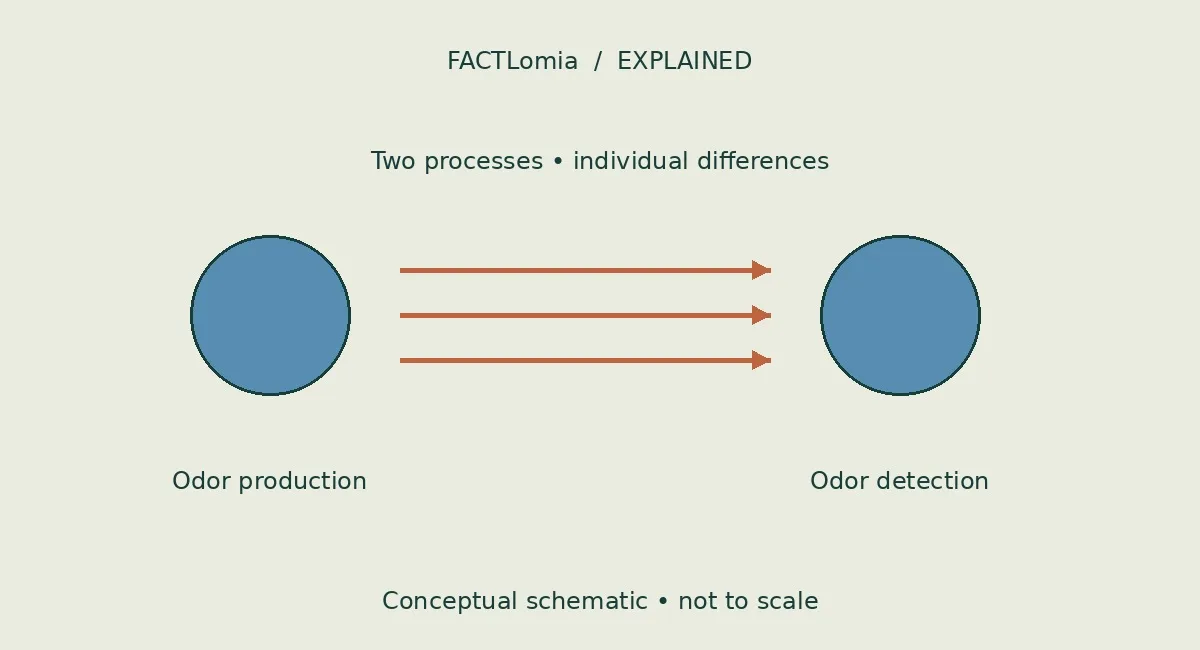
People differ both in the odor compounds they excrete after eating asparagus and in how well they detect those compounds. Genetic variation near odor-receptor genes is associated with the ability to notice the smell. Not smelling it does not by itself show that your body produced none.
Making an odor and sensing it are different
An odor report combines two processes: what is present in the sample and what the observer can detect. Research that compared people’s production and perception found variation in both. Someone can produce an odor that another person notices while failing to detect it personally. That makes a simple yes-or-no question about asparagus pee a surprisingly imperfect biology test. [1]
What genetics can and cannot explain
A genome-wide association study linked reported asparagus-odor perception to variation near several olfactory receptor genes. This supports a genetic contribution to perception. It does not justify saying that one gene acts as an on/off switch for everyone, or that a consumer smell test can reveal a precise genotype. Self-reports and study populations also limit how broadly a result can be generalized. [2]
A familiar comparison
Two people can stand in the same kitchen and disagree about how strong a food smells. The disagreement need not mean one person is mistaken: noses do not respond identically to every compound. Asparagus offers a specific studied example of this distinction, rather than a ranking of whose overall sense of smell is better.
Does not smelling it mean I digest asparagus differently?
Possibly, but it is not enough evidence to tell. Odor production and odor detection need to be measured separately.
Is asparagus anosmia the same as losing all smell?
No. The term refers to difficulty detecting this particular odor, rather than an inability to smell everything. [2]
Keep exploring
Continue with Why Do Some People Sneeze in Bright Sunlight? and Why Do People Have Different Blood Types?.
Sources and evidence
- Chemical Senses — Excretion and perception of asparagus odor ↗
Experimental separation of production and perception.
- BMJ — Genome-wide association study of asparagus anosmia ↗
Genetic associations and study limitations.
Sources consulted: 15 October 2026. Written with AI assistance and checked against the linked references; not independently reviewed by a subject specialist. Sources do not endorse this article. See our editorial policy.
Revision: Initial publication; factual claims checked against linked sources.