
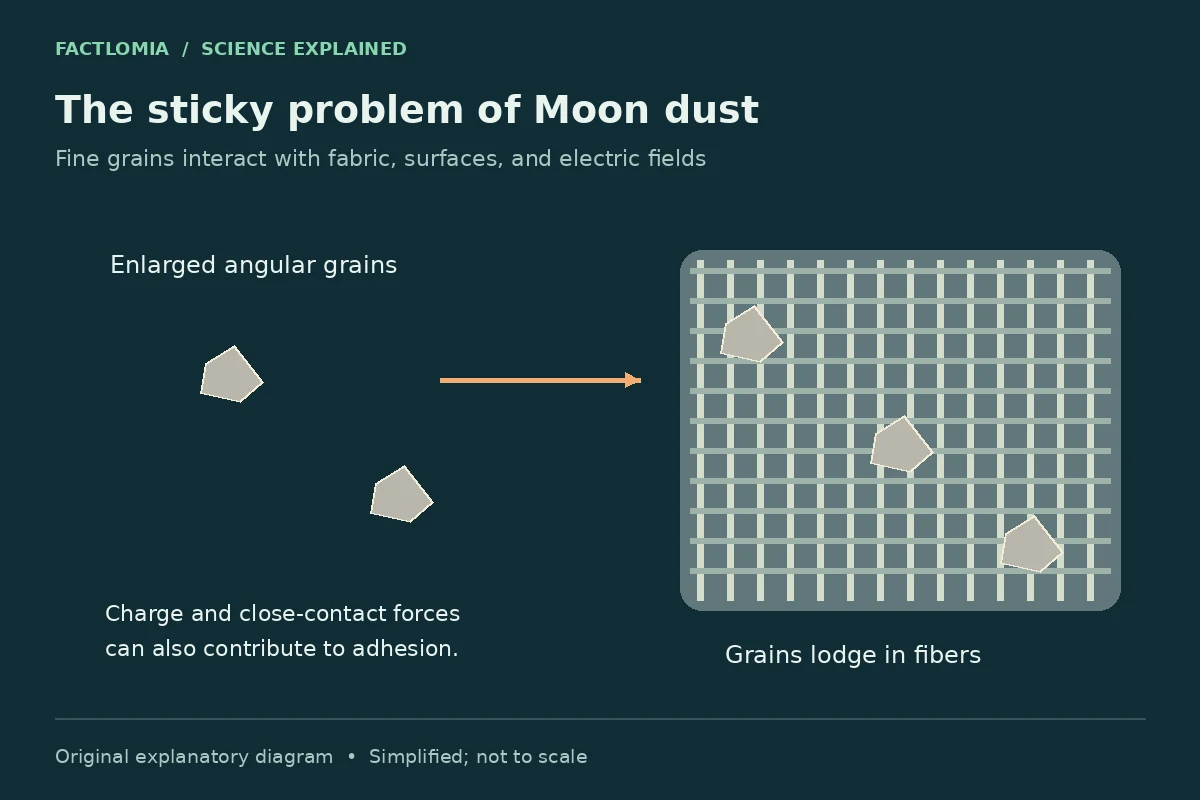
Moon dust clings to spacesuits and equipment because its tiny, irregular grains make close contact with surfaces and can catch in fabrics. Surface adhesion and electrical charging also matter. Its stickiness is a combination of effects, rather than liquid moisture or a coating of glue.
Sharp grains without ordinary weathering
Repeated impacts break and reshape lunar surface material. Unlike many grains on Earth, lunar particles have not been rounded by flowing water and ordinary atmospheric weathering. Their rough edges can lodge in suit fibers and abrade seals. Regolith includes the broader loose surface material; dust is its finer fraction. [1]
Electrical charge adds another complication
Solar radiation and the surrounding plasma can change the charge on dust and equipment. Charged particles interact with electric fields, while close-contact surface forces can also hold small grains in place. The exact contribution depends on particle size, material, illumination, and the local environment. It is misleading to describe all lunar dust as permanently carrying one charge. [1], [2]
Why small amounts cause large problems
Dust can reach joints, scratch surfaces, and interfere with equipment. Apollo astronauts carried it into their cabin on suits. NASA describes irritation of the eyes, nose, and throat reported after exposure. An image of an astronaut covered in gray powder shows the practical problem, but does not tell us which adhesion mechanism dominates each grain. [1]
Does the Moon have dust storms like Earth?
The Moon has no dense atmosphere to blow dust around in ordinary weather systems. Impacts, landing engines, human activity, and electrical effects are different mechanisms that can move particles. They should not be illustrated as an Earth-style windy sandstorm. Compare the surface particles here with the separate population of atoms in the Moon’s sodium tail, and read why its atmosphere is so thin.
Sources and evidence
- NASA — Moon Dust ↗
Lunar dust formation, abrasive grains, suit contamination, and reported irritation.
- Royal Belgian Institute for Space Aeronomy — Charged dust particles ↗
Charging and hazards to instruments and exploration.
Sources consulted: 2026-10-21. Written with AI assistance and checked against the linked references; not independently reviewed by a subject specialist. Sources do not endorse this article. See our editorial policy.
Revision: First published 21 October 2026. Original explanatory diagram and source-linked text.