
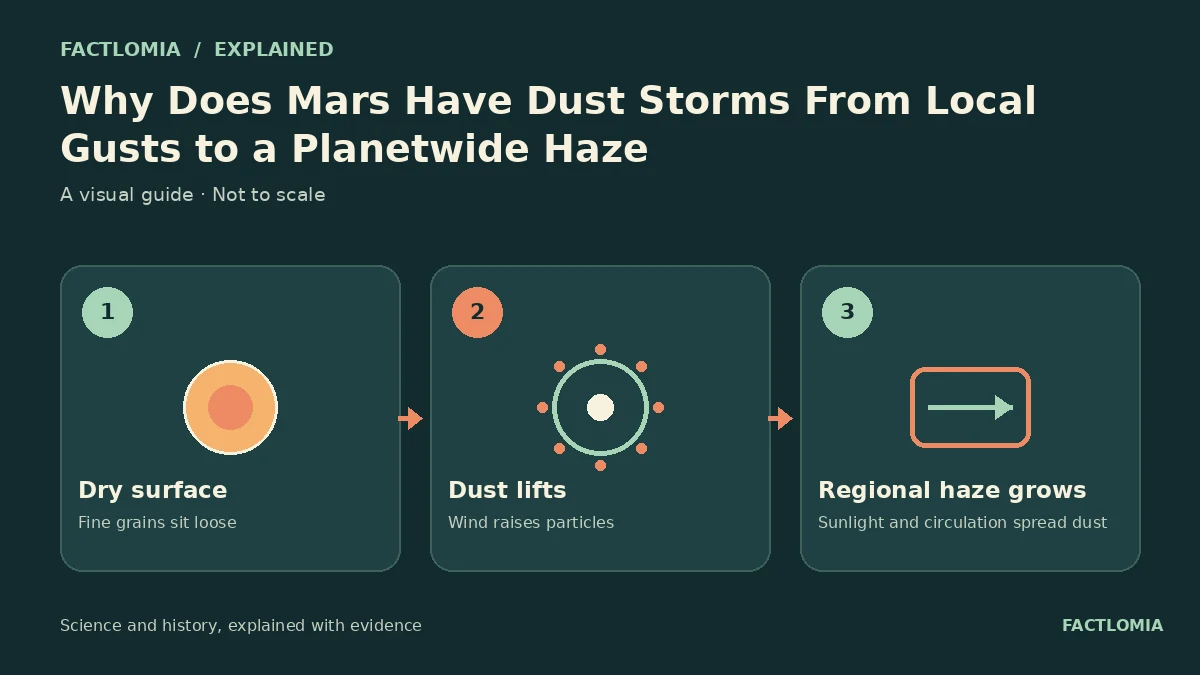
Mars has dust storms because winds lift fine grains from its dry surface into a thin, active atmosphere. Local dust events can grow or merge into regional and sometimes planet-encircling storms. Martian winds are not as forceful as movie scenes suggest, but suspended dust can block sunlight and affect spacecraft observations and solar power.
Fine dust meets an active atmosphere
Mars has a very thin atmosphere, but it still has winds, temperature differences, and weather. Wind can lift loose, small grains; once airborne, dust absorbs sunlight and warms the surrounding air. That heating changes pressure and circulation, which can help transport dust farther. The full chain of processes that starts some large storms is still being studied. [1]
How a storm can grow
Many Martian dust storms remain local or regional. In some seasons, several events can expand and raise enough dust to obscure large portions of the planet. Dust can stay aloft because it is very fine and atmospheric mixing redistributes it. This is a different environment from an Earth hurricane: a planetwide Martian dust storm is visually dramatic, but the thin air exerts much less force on a person or vehicle than dense terrestrial air. [2]
Why rover teams watch the dust
Dust reduces sunlight reaching solar-powered spacecraft and can obscure surface features from orbit. It also changes how the atmosphere heats and circulates. NASA studies dust with orbiters and landers to understand weather, climate history, and how dust might affect future exploration. The 2018 global storm, for example, ended the solar-powered Opportunity rover’s mission after it could no longer recharge. [1]
Frequently asked questions
Can a Mars dust storm blow a person away?
The atmosphere is so thin that even strong Martian winds exert far less force than a comparable wind on Earth, though dust remains an equipment and visibility concern.
Do Mars dust storms happen every year?
Local and regional dust activity is common, but global planet-encircling storms do not occur on a fixed annual schedule.
Are dust devils the same as global storms?
No. Dust devils are small rotating columns of dust; global storms cover much larger areas and involve broader atmospheric circulation.
Sources and evidence
- NASA — Dust in the Wind on Mars ↗
Explains Martian dust, global storms, and the Opportunity mission.
- NASA — The Fact and Fiction of Martian Dust Storms ↗
Compares the thin Martian atmosphere with movie depictions and describes storm effects.
- NASA — Dust Cycle ↗
Describes how dust is lifted, mixed, transported, and settles on Mars.
Sources consulted: 4 November 2026. Written with AI assistance and checked against the linked references; not independently reviewed by a subject specialist. Sources do not endorse this article. See our editorial policy.
Revision: New explainer; avoids equating Martian dust storms with Earth hurricanes.