
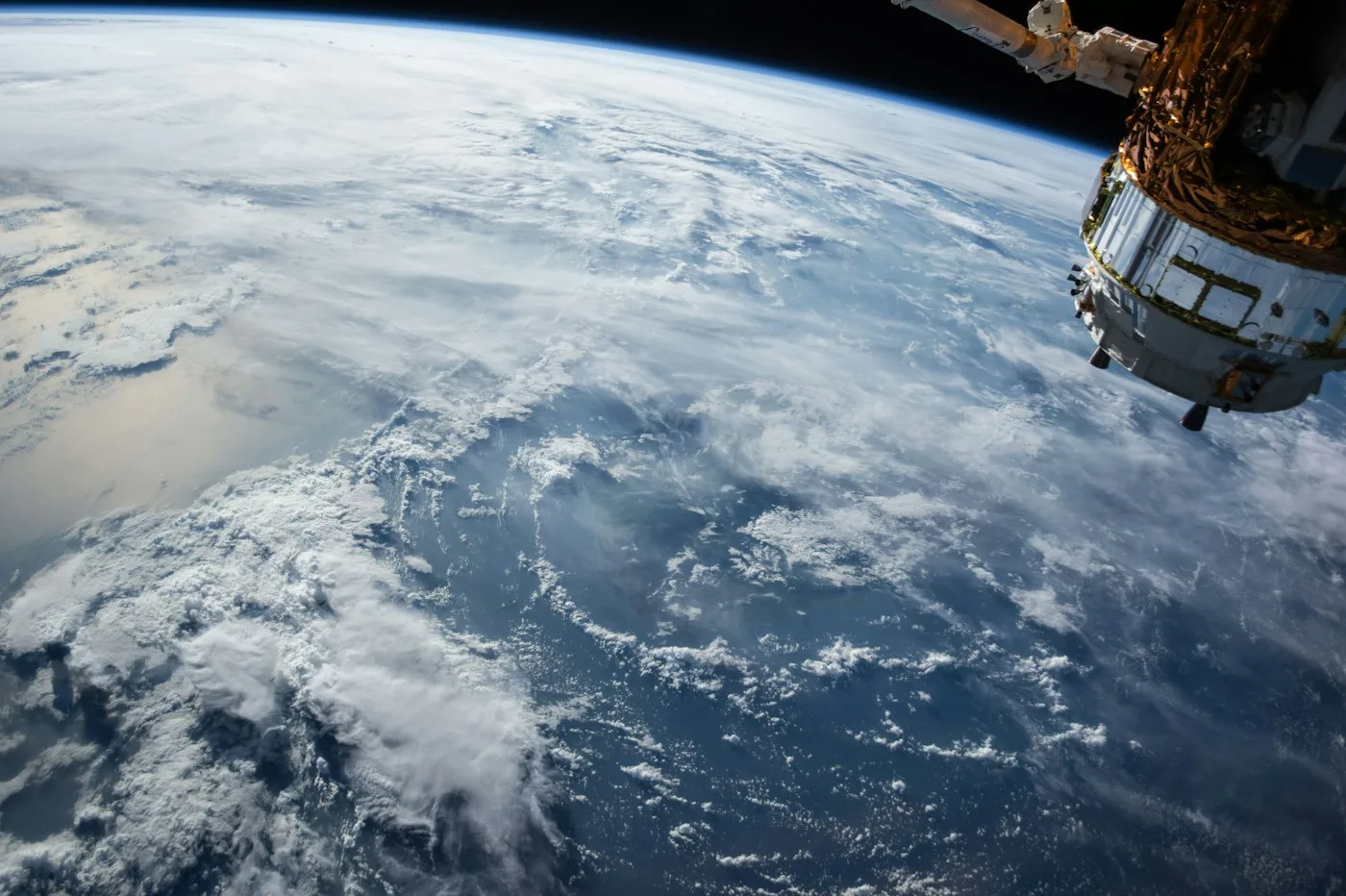
The Moon has almost no atmosphere because its gravity is too weak to hold dense gases for long, while sunlight and solar particles help remove particles from its surface environment.
Gravity controls escape
Gas molecules move at a range of speeds. On a small body, the fastest molecules can reach escape velocity more easily, especially when heated by sunlight. Over geological time, this removes much of a thick atmosphere.
The Moon’s gravity is about one-sixth of Earth’s, so it cannot retain nitrogen and oxygen in a dense, stable envelope as effectively as Earth does.
An exosphere is not empty space
The Moon has an extremely thin exosphere containing sparse atoms and molecules. Particles can come from solar wind implantation, micrometeorite impacts and slow release from the surface. Collisions are so rare that the gas does not behave like ordinary breathable air.
A footprint can remain undisturbed for a long time because there is no wind or rain to erase it, although micrometeorites and radiation slowly alter the surface.
Why Earth kept its air
Earth is larger, has stronger gravity and is replenished by geological and biological cycles. Its magnetic field also reduces some solar-wind erosion, although gravity and atmospheric recycling are central.
The comparison is not simply “the Moon is cold.” Atmospheric retention depends on mass, temperature, composition, sources and the space environment.
Why an astronaut still needs a spacesuit
The Moon’s exosphere is far too thin to provide pressure or oxygen for a human. A spacesuit supplies a controlled atmosphere, removes heat and protects against radiation and dust. The absence of wind does not make the surface safe: vacuum changes how heat, fluids and gases behave around the body.
Sources and evidence
- NASA Science — Moon facts ↗
The lunar exosphere and Moon environment.
- NASA — Lunar atmosphere and dust ↗
Sources and behaviour of the Moon’s extremely thin exosphere.
Sources consulted: 9 October 2026. Written with AI assistance and checked against the linked references; not independently reviewed by a subject specialist. Sources do not endorse this article. See our editorial policy.
Revision: Used “exosphere” precisely instead of saying the Moon has absolutely no gas. Added a subject-specific example or limitation to strengthen reader value.