
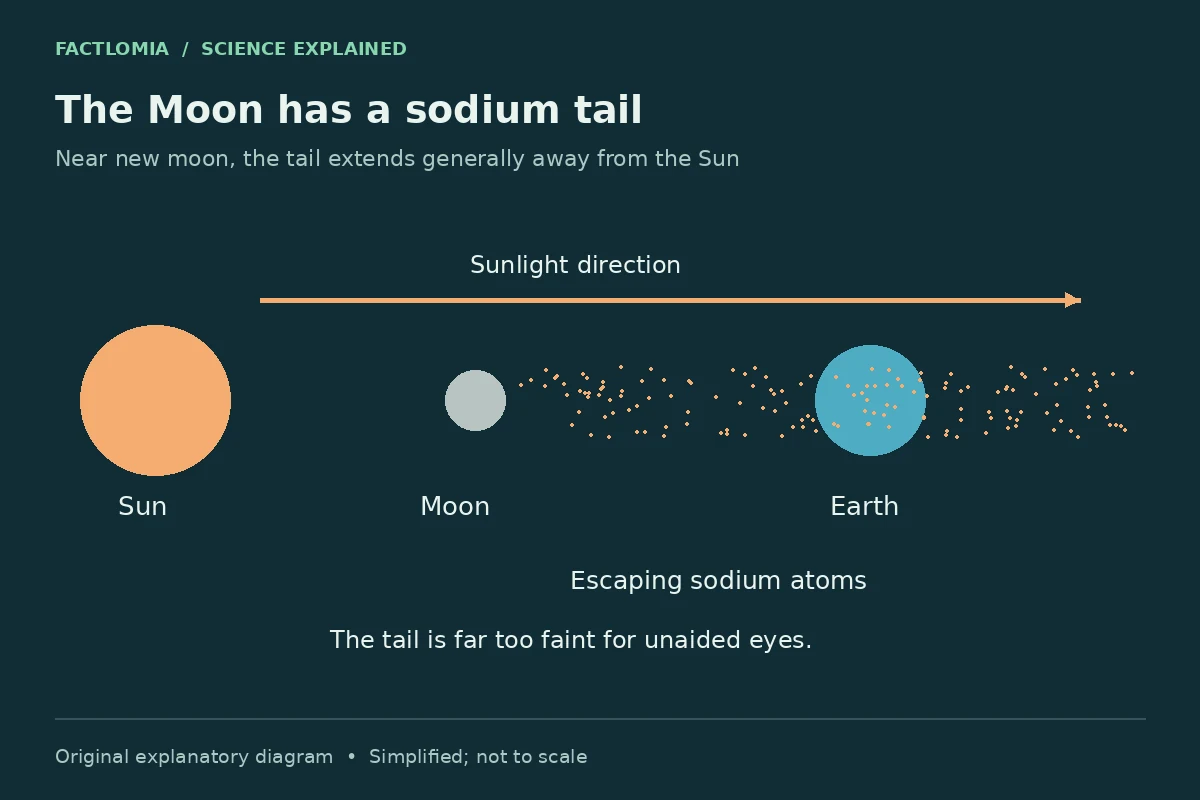
The Moon has a very faint tail of sodium atoms because processes at its surface release atoms into space, and sunlight pushes some of them away from the Sun. The tail is too dim to see with unaided eyes. Astronomers detect its characteristic sodium light with specialized instruments.
How atoms escape the surface
The Moon has an extremely thin exosphere, where atoms rarely collide compared with those in Earth’s atmosphere. Impacts and interactions involving sunlight and solar-wind particles can release surface material. Some sodium atoms escape and become part of an extended population around and beyond the Moon. These are individual atoms, not grains forming a thick ribbon of dust. [1], [2]
Sunlight gives the tail its direction
Light carries momentum. Sodium atoms absorb and re-emit sunlight, and radiation pressure can accelerate them generally away from the Sun. That helps stretch the escaping gas into a tail. A tail pointing away from the Sun need not trail behind an object in its direction of orbital motion; the relevant push comes from sunlight. [1]
Why observers look near new moon
Near new moon, the Moon lies approximately between Earth and the Sun. Its anti-solar tail can extend past Earth, whose gravity focuses atoms into a denser region downstream. From Earth this produces a faint feature called the sodium moon spot, seen in the direction opposite the Sun. Long-term observations track how its brightness changes. The simplified diagram shows the geometry, not the actual width or distances. [2]
Can you photograph it with a phone?
An ordinary bright streak beside the Moon is not evidence of the sodium tail; lens flare, clouds, and exposure artifacts are much easier to record. The scientific observations isolate faint sodium emission and account for other light sources. This tail is separate from sticky lunar surface dust. For the same distinction between orbital motion and sunlight, see why comet tails point away from the Sun.
Sources and evidence
- Matta et al. — The sodium tail of the Moon ↗
Origins of escaping sodium and radiation-pressure-driven tail.
- Baumgardner et al. — Long-Term Observations of the Moon’s Sodium Tail ↗
Sodium moon spot, gravitational focusing, and long-term observations.
Sources consulted: 2026-10-21. Written with AI assistance and checked against the linked references; not independently reviewed by a subject specialist. Sources do not endorse this article. See our editorial policy.
Revision: First published 21 October 2026. Original explanatory diagram and source-linked text.