
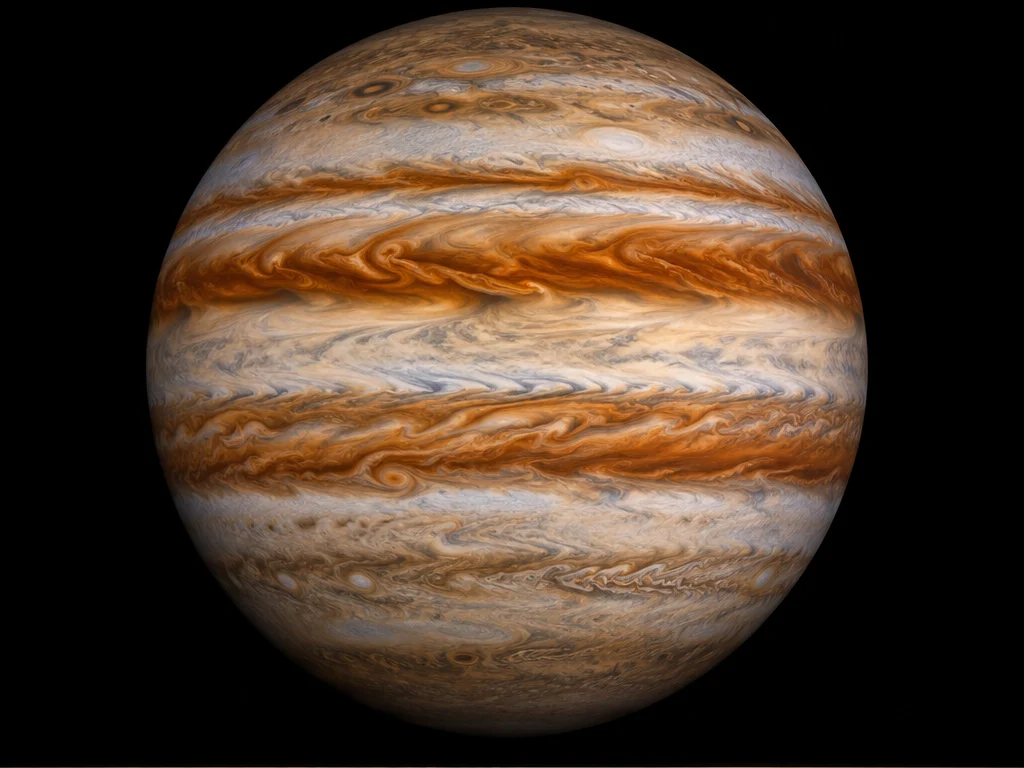
Jupiter’s stripes are belts and zones of clouds organized by powerful winds. Neighboring jet streams flow east and west, separating bright zones from darker belts. Juno found that these winds extend about 1,900 miles (3,000 kilometers) below the visible cloud tops.
Why the bands wrap around the planet
Jupiter spins roughly once every 10 hours. Its rapid rotation helps organize the atmosphere into broad currents that run mainly east or west, following lines of latitude. Where those currents meet, clouds can roll into eddies. From a distance you see long colored ribbons. Up close, their edges are full of smaller swirls. [1]
What makes one stripe lighter than another?
Astronomers call the brighter stretches zones and the darker ones belts. Both are part of the same atmosphere. Jupiter probably has clouds containing different materials at different levels, with ammonia ice likely making up the top cloud layer. The exact chemistry behind the strongest orange and reddish hues remains a subject of study. [1]
How Juno looked beneath the clouds
Jupiter’s cloud patterns tell us how the upper atmosphere moves. Juno used a different clue to estimate the depth of the winds. The movement of vast amounts of gas leaves tiny signatures in the planet’s gravity field. Tracking how gravity perturbed the spacecraft’s motion gave the team enough information to estimate how far the jets reach downward. [2]
Read also why Saturn’s polar jet has six sides.
Frequently asked questions
Is the Great Red Spot one of the stripes?
It is a long-lived storm visible as a reddish oval against the surrounding bands.
Do the stripes mark a solid surface?
The stripes are atmospheric cloud patterns. Jupiter has no solid surface at the level we see.
Sources and evidence
- NASA Science — Jupiter Facts ↗
Jupiter’s rotation, cloud bands and alternating winds.
- NASA Science — Juno ↗
Gravity measurements and the estimated depth of Jupiter’s jet streams.
Sources consulted: 28 November 2026. Written with AI assistance and checked against the linked references; not independently reviewed by a subject specialist. Sources do not endorse this article. See our editorial policy.
Revision: Initial publication.