
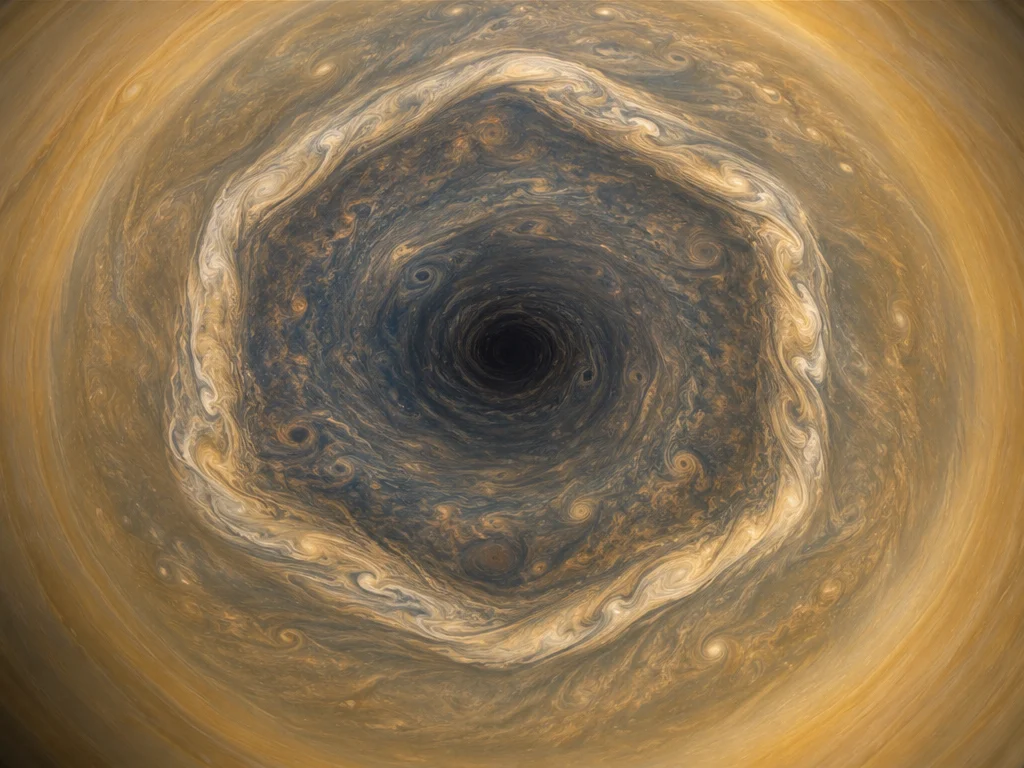
Saturn’s north polar hexagon is the six-sided outline of a fast eastward jet stream. Scientists think a large atmospheric wave may account for the jet’s regular bends. Voyager first observed the feature, and Cassini later tracked it in detail.
Where the six sides come from
Imagine following the jet around the pole from above. At several points the current bends outward, then curves back toward the pole. Six repeating bends give the cloud pattern its distinctive outline. The sides are slightly curved and the corners are rounded, as you would expect from a flowing atmosphere. [1]
How a wave can hold its shape
Scientists have proposed that the pattern is a Rossby wave, a large meander shaped by the way rotation affects a planet’s atmosphere. Gas can keep flowing along a jet while a wave maintains a recognizable shape. The wave interpretation helps explain how Saturn can sustain a polygon in moving air. [2]
How Cassini followed the hexagon
The north pole spent part of Cassini’s mission in winter darkness. Early observations used infrared light, and ordinary images improved as sunlight returned. Researchers also found a hexagonal boundary in the warmer stratosphere during northern summer, evidence that the pattern can influence a layer well above the visible clouds. [1] [2]
Read also how Saturn’s rings formed.
Frequently asked questions
Is there a storm inside the hexagon?
A polar vortex sits near the center. The hexagon describes the jet that surrounds it.
Who first saw the hexagon?
The Voyager missions recorded it in the early 1980s. Cassini later studied it over multiple seasons.
Sources and evidence
- NASA Science — Circles and Hexagons ↗
Voyager and Cassini observations of the northern polar jet.
- Nature Communications — A Hexagon in Saturn’s Northern Stratosphere ↗
Evidence of a similar shape higher in the atmosphere and the Rossby-wave interpretation.
Sources consulted: 28 November 2026. Written with AI assistance and checked against the linked references; not independently reviewed by a subject specialist. Sources do not endorse this article. See our editorial policy.
Revision: Initial publication.