
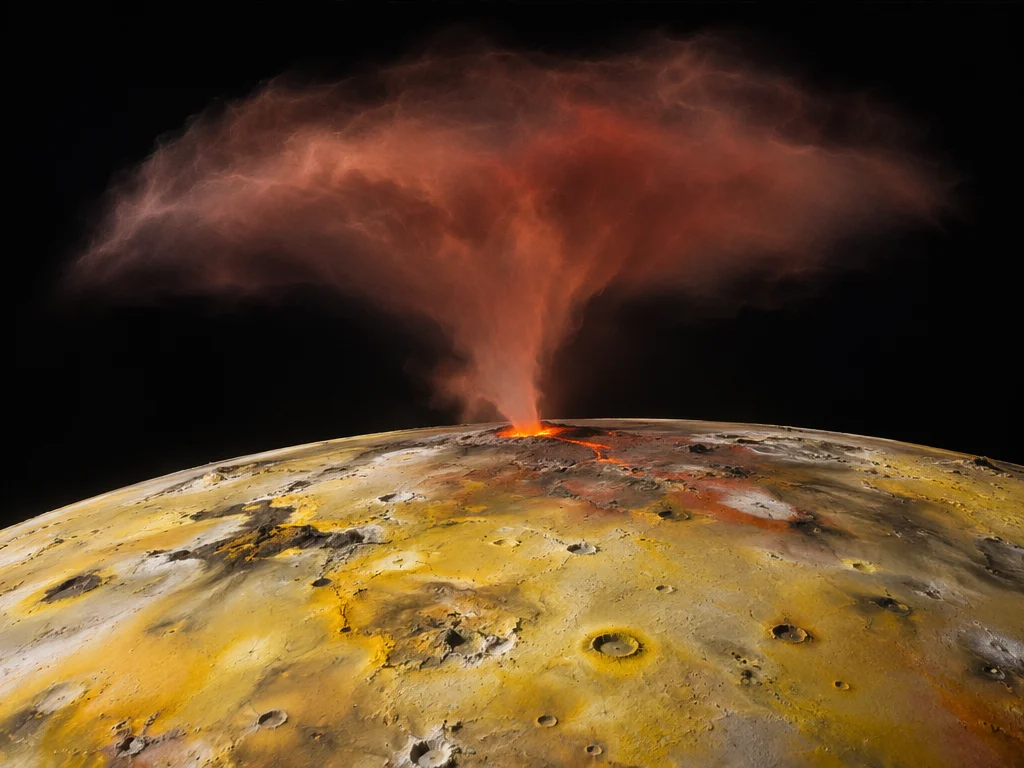
Jupiter’s gravity repeatedly stretches and relaxes Io as the moon moves along a slightly elliptical orbit. That flexing generates heat inside the rock, which helps drive frequent eruptions. Orbital resonances with Europa and Ganymede sustain the cycle.
How a changing tide heats rock
Jupiter’s pull stretches Io slightly toward the planet. Io moves closer to Jupiter and farther away over each orbit, changing the strength of that pull. The solid moon deforms as the tide changes. Some of the mechanical energy spent flexing the rock turns into heat inside it. [1]
Why the orbit stays slightly stretched
Io completes roughly four orbits while Europa completes two and Ganymede completes one. The moons therefore tug on one another in a repeating rhythm. This orbital resonance helps preserve Io’s slightly elongated path, so the tidal pull keeps varying. [1]
What Juno learned about the interior
Frequent eruptions once made a shallow global ocean of magma an appealing explanation. Juno measurements suggest Io flexes in a way more consistent with a mostly solid mantle containing substantial melt. That still allows molten rock to collect and feed volcanoes in parts of the moon. [2]
Read also why Enceladus produces icy plumes.
Frequently asked questions
Why is Io so colorful?
Sulfur and other volcanic deposits help give its surface a yellow, orange and reddish appearance.
Does Io have the most active volcanoes in the solar system?
NASA describes Io as the solar system’s most volcanically active world.
Sources and evidence
- NASA Science — Io Facts ↗
Tidal heating, the orbital resonance and Io’s volcanic surface.
- NASA Science — Io’s Interior ↗
Juno measurements favor a mostly solid mantle with substantial melt.
Sources consulted: 28 November 2026. Written with AI assistance and checked against the linked references; not independently reviewed by a subject specialist. Sources do not endorse this article. See our editorial policy.
Revision: Initial publication.