
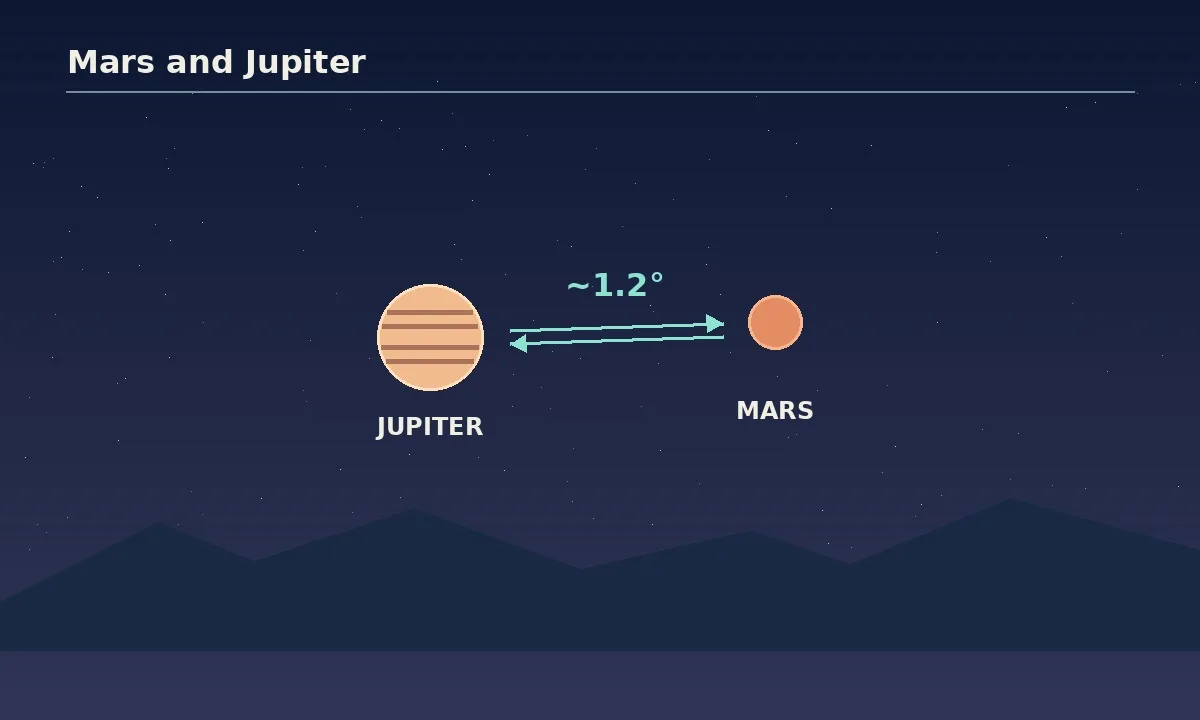
On November 15 and 16, 2026, Mars and Jupiter appeared about 1.2 degrees apart in the southeastern sky before sunrise, with Jupiter brighter. Those viewing dates have passed; this page is a dated observing record.
How the pair was identified
The guide used Jupiter as the brighter reference point in the southeastern sky before sunrise. Mars appeared as the dimmer, warmer-colored point nearby, with Regulus in Leo as another landmark. [1] [2]
How wide was the gap?
The apparent gap was about 1.2 degrees—slightly more than two full-Moon widths. The pair was easy to compare with unaided eyes, while binoculars helped pick out the fainter planet in twilight. [1]
Why did the pairing change?
Earth, Mars and Jupiter follow different paths around the Sun. During the November 15–16 viewing window, our lines of sight toward the two planets pointed nearly the same way. As the planets continued along their orbits, the apparent gap widened. [2]
For another skywatching event from 2026, see the December Geminid meteor shower and its viewing guide.
Frequently asked questions
Could both planets be seen without a telescope?
Yes. Under a clear sky, both planets were bright enough to see without a telescope.
Which morning was best for viewing?
The clearest local forecast mattered most. A blocked horizon could matter more than the small change in separation.
Sources and evidence
- NASA Jet Propulsion Laboratory ↗
Viewing dates, direction and apparent separation.
- Astronomy magazine ↗
Planet positions in Leo and nearby guide stars.
Sources consulted: 13 November 2026. Written with AI assistance and checked against the linked references; not independently reviewed by a subject specialist. Sources do not endorse this article. See our editorial policy.
Revision: The viewing dates have passed. This page is retained as a dated observing record; no new astronomical claims were added.