
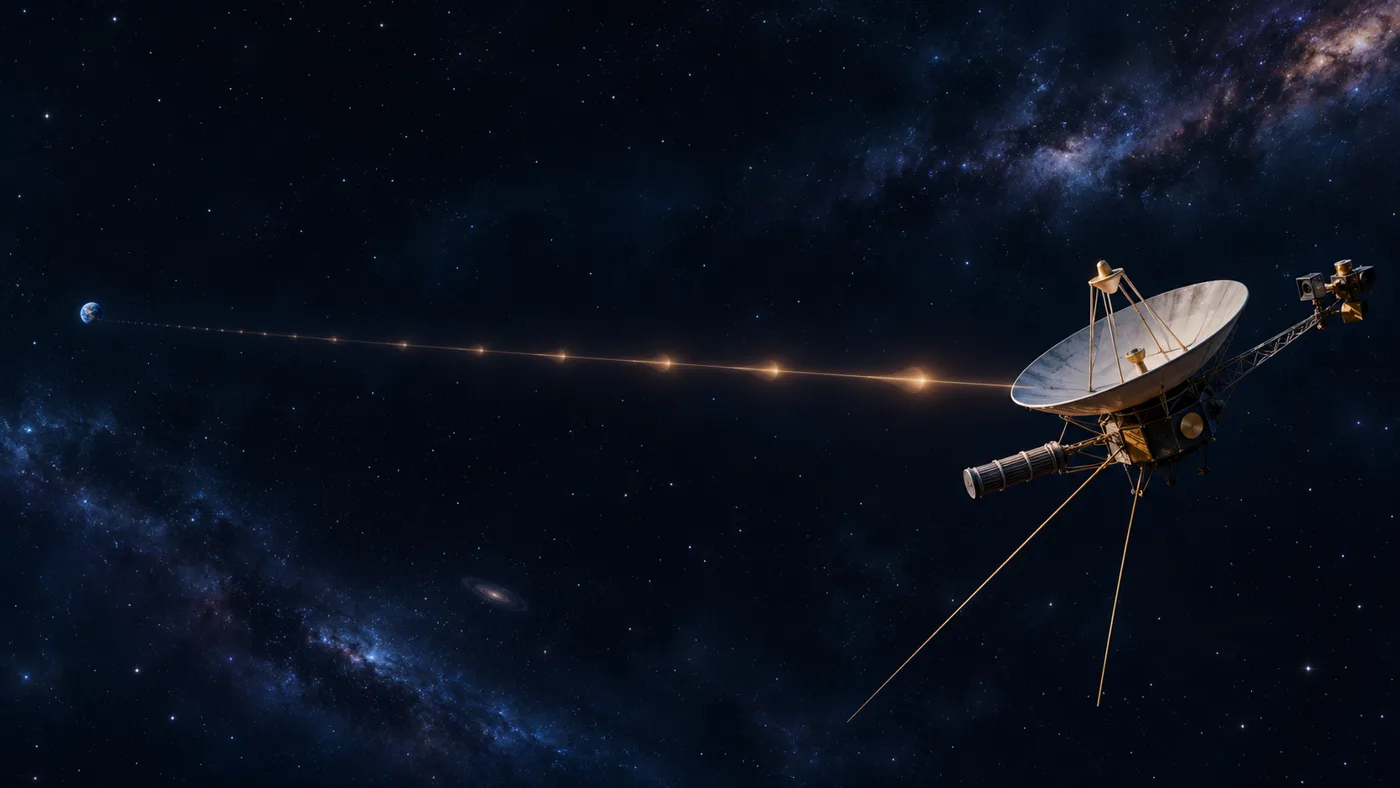
A light-day is the distance light travels in 24 hours: about 16.1 billion miles (25.9 billion kilometers). NASA calculated that Voyager 1 reached this milestone from Earth on November 18, 2026. At that distance, a one-way radio signal takes about a day to travel between the spacecraft and Earth.
A day measured in distance
We usually use “light-year” for cosmic distances, but the same idea works with shorter intervals. Light travels about 186,000 miles (300,000 kilometers) each second. Multiply that speed by 86,400 seconds and the result is roughly 16.1 billion miles: one light-day. It is a distance, not the time it takes Voyager to travel there.
NASA’s current calculation places Voyager 1 about 16.094 billion miles from Earth at 2:16:07 a.m. Pacific Standard Time on November 18, 2026. Because Earth and the probe are both moving, mission distance figures are time-specific and continually updated. [1]
The light-day milestone
NASA calculated that Voyager 1 reached one light-day from Earth on November 18, 2026. The milestone is based on the spacecraft’s distance and speed; because a radio signal now takes about a day to cross the gap, confirmation by a signal necessarily arrives later. [1]
Why does a message take so long?
Voyager 1 communicates using radio waves, which travel at the speed of light. At one light-day away, a signal sent from Earth would need about 24 hours to arrive; a reply would need another 24 hours to get back. A simple “Are you okay?” exchange would therefore take about two days, before counting the time needed to plan and send commands. [1]
That delay is why the spacecraft cannot be flown with joystick-style control. It follows carefully planned commands and sends back stored engineering and science data through NASA’s Deep Space Network.
What makes the milestone remarkable?
Voyager 1 launched in 1977 and flew past Jupiter and Saturn before continuing into interstellar space. Nearly five decades later, it remains the most distant human-made spacecraft. NASA has also been carefully managing its dwindling electrical power so instruments can keep returning measurements. [2]
A light-day is a useful scale for understanding the mission: even the fastest messenger we know needs a full day to cross the distance. For another perspective on planetary motion, see how satellites stay in orbit.
FAQ: Voyager 1 and a light-day
Is Voyager 1 one light-day from the Sun? NASA describes the milestone as a distance from Earth. Earth’s motion makes the Earth and Sun reference points slightly different.
Does Voyager travel at the speed of light? No. Voyager moves far slower than light; the light-day describes the distance, not the spacecraft’s speed.
Sources and evidence
- NASA — Where Are Voyager 1 and 2 Now? ↗
NASA’s predicted date, time and Earth distance for the one-light-day milestone.
- NASA JPL — Voyager 1 Conserves Power, Resolves Brief Communications Pause ↗
Mission age, communications and recent power-management work.
- NASA/JPL — Voyager 1 One-Light-Day Activities ↗
The November 17 public celebration and November 18 milestone date.
Sources consulted: 18 November 2026. Written with AI assistance and checked against the linked references; not independently reviewed by a subject specialist. Sources do not endorse this article. See our editorial policy.
Revision: Updated the SEO title, meta description and original illustration after approval; refreshed the milestone wording to reflect NASA’s calculated November 18 distance.