
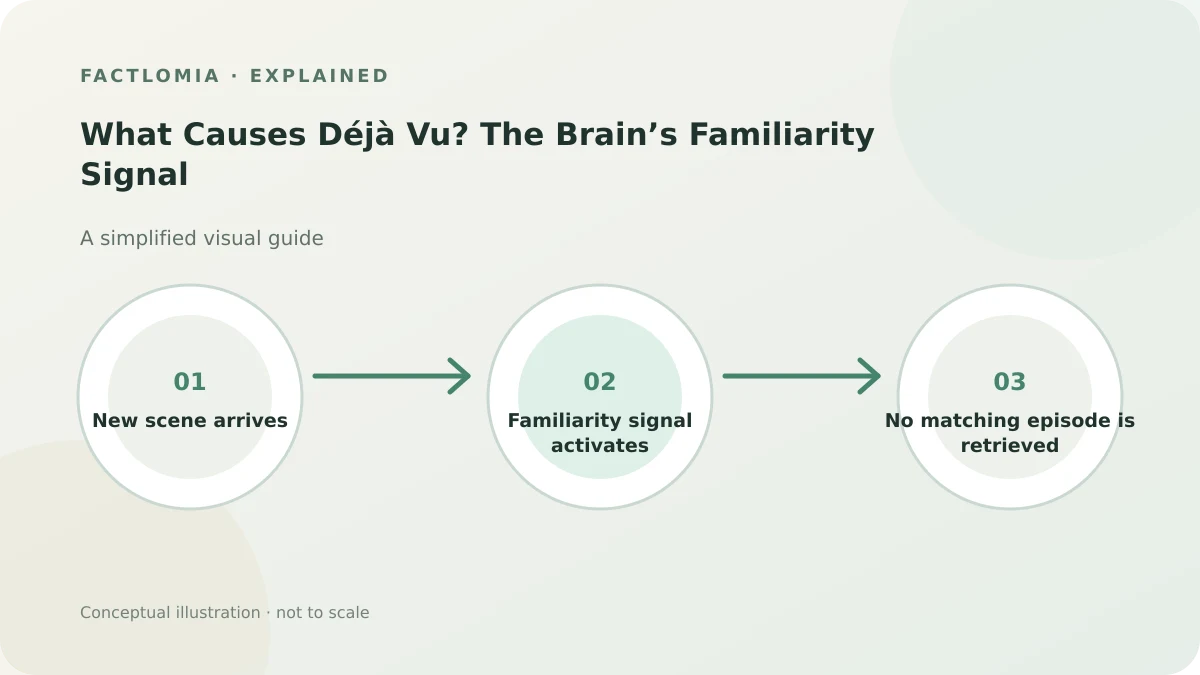
Déjà vu is the brief feeling that a new experience has happened before. Researchers often explain it as a mismatch between familiarity and conscious recollection: the brain flags a scene as familiar even though no matching memory can be retrieved. Occasional déjà vu is common; repeated episodes with other symptoms may need medical assessment.
Familiarity can arrive without a clear memory
Memory involves more than one process. A person can experience a sense of familiarity without retrieving a specific event that explains it. In déjà vu, the present moment feels known even though the person recognizes that it is new. Researchers study how brain networks involved in memory and recognition may produce this short-lived mismatch. [1]
A precise cause is still being studied
One account is that a current scene resembles something encountered before, creating familiarity without a conscious source memory. Other memory-processing explanations are also considered. Déjà vu is difficult to recreate in a laboratory, so the experience and its neural mechanisms are not fully settled. A simple claim that one brain region or a “past life” causes it goes beyond the evidence. [2]
When should someone seek medical advice?
Brief, occasional déjà vu is usually harmless. A sudden or repeated pattern accompanied by symptoms such as altered awareness, unusual sensations or confusion can sometimes occur with temporal-lobe seizures and should be discussed with a health professional. This explainer is not a diagnosis; seek urgent help for a new severe neurological symptom.
For another question about dreams and memory, see why we dream during sleep.
Frequently asked questions
Is déjà vu a false memory?
It is usually described as a false feeling of familiarity, not necessarily a detailed memory of an event that never occurred.
Is occasional déjà vu normal?
Yes. Many people experience it briefly. Recurrent episodes with other concerning symptoms deserve medical advice.
Does déjà vu prove that a moment happened before?
No. The feeling of familiarity is not evidence that the same event occurred in the past.
Sources and evidence
- Cleveland Clinic — Déjà Vu: What It Is and Why It Happens ↗
Definition, memory-familiarity explanations and when episodes may merit medical attention.
- Epilepsy & Behavior — The Neural Basis of Déjà Vu ↗
Review of déjà vu mechanisms and the relationship between familiarity and recollection.
Sources consulted: 1 November 2026. Written with AI assistance and checked against the linked references; not independently reviewed by a subject specialist. Sources do not endorse this article. See our editorial policy.
Revision: Initial publication. Claims and uncertainty checked against the cited references.