
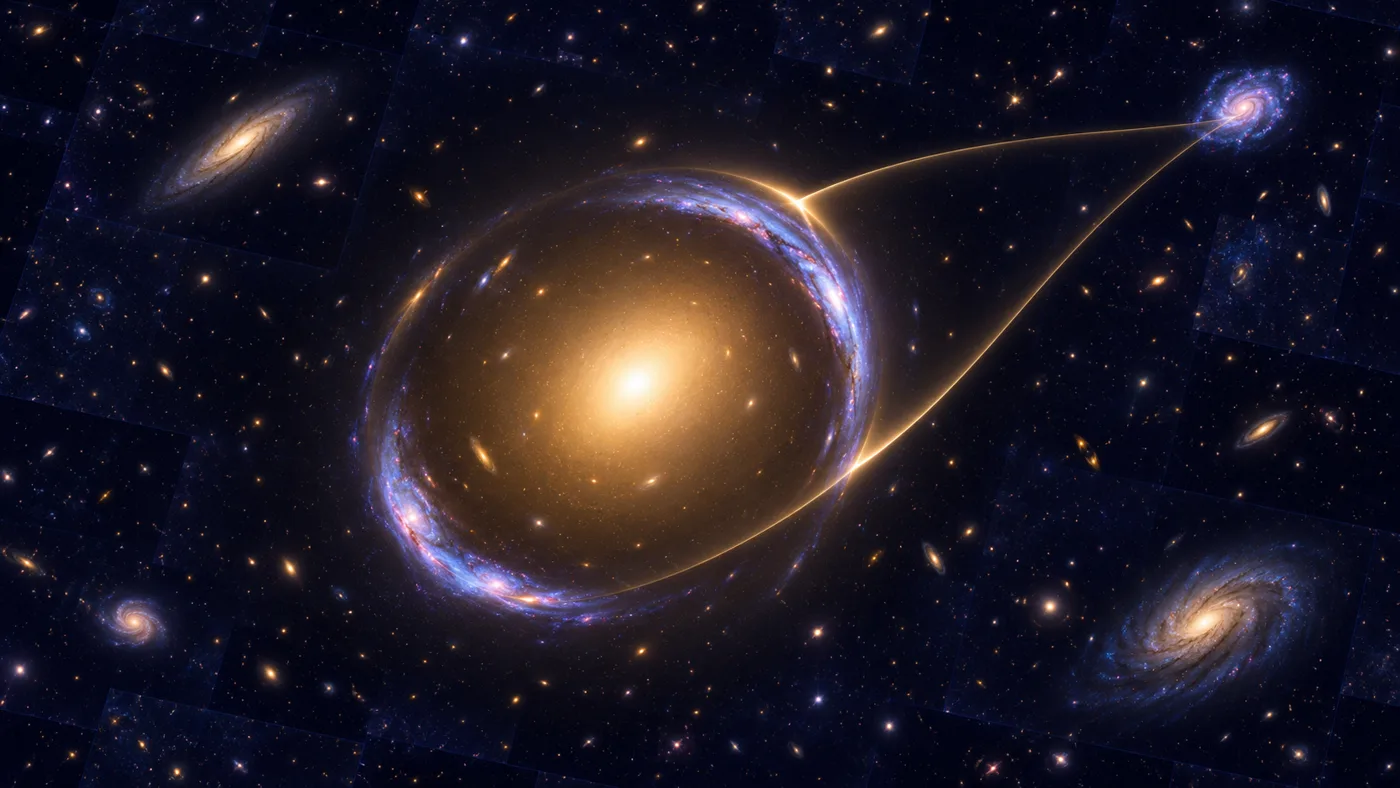
Gravitational lensing happens when the gravity of a massive object, such as a galaxy, bends light from an object behind it. The background galaxy can appear stretched into arcs, magnified, or duplicated. ESA’s Euclid telescope is finding thousands of strong-lensing candidates in its growing survey, giving scientists a way to study galaxy mass, including invisible dark matter.
How gravity bends a galaxy’s light
A massive galaxy changes the geometry of space-time around it. Light from a more distant galaxy travels through that curved region, so its path bends before reaching a telescope. The foreground galaxy acts like a cosmic lens, even though it is not made of glass. [1]
The background object may look brighter or stretched into a curved arc. If the foreground and background galaxies line up closely along our view, the distorted light can form a nearly complete Einstein ring. One background galaxy can also appear in several places in the image.
What a gravitational lens can reveal
The shape and strength of the distortion depend on the distribution of mass in the foreground lens. Astronomers can use that distortion to estimate the galaxy’s total mass, including dark matter that does not emit or reflect light. Strong lenses also help researchers study very distant galaxies that would otherwise be harder to observe. [2]
A lens is not a direct photograph of dark matter. Scientists infer its presence by comparing the observed bending of light with the gravitational effect expected from visible stars and gas.
Why Euclid’s new survey matters
Euclid’s first major data release, published in November 2026, includes more than 900 million galaxies and around 15,000 strong gravitational-lensing candidates. The release covers a portion of the sky observed during the mission’s survey and is a first large step toward a three-dimensional map of the cosmos. [1]
These are candidates for scientists to examine, not 15,000 individually confirmed discoveries. Wider and deeper observations will help researchers check lens shapes, measure distances and build a better picture of how galaxies and dark matter are distributed.
FAQ: gravitational lensing
Does gravity really bend light? Yes. In general relativity, mass curves space-time, and light follows paths through that curved geometry.
Is an Einstein ring a physical ring? No. It is the distorted image of a background source seen around a foreground lens when the alignment is close.
Can lensing show dark matter? It can reveal the gravitational influence of unseen mass, but dark matter is inferred from the bending rather than seen directly.
Sources and evidence
- European Space Agency — Euclid lays the foundation for its best-ever 3D map of the Universe ↗
Euclid DR1-Foundation data totals and the use of strong lensing to study galaxy mass and dark matter.
- European Space Agency — Euclid reveals the largest-ever catalogue of strong cosmic lenses ↗
How gravitational lenses form and why they help researchers study distant galaxies and the dark Universe.
Sources consulted: 18 November 2026. Written with AI assistance and checked against the linked references; not independently reviewed by a subject specialist. Sources do not endorse this article. See our editorial policy.
Revision: Initial publication; scientific claims checked against ESA’s Euclid data-release and lens-catalogue pages.