
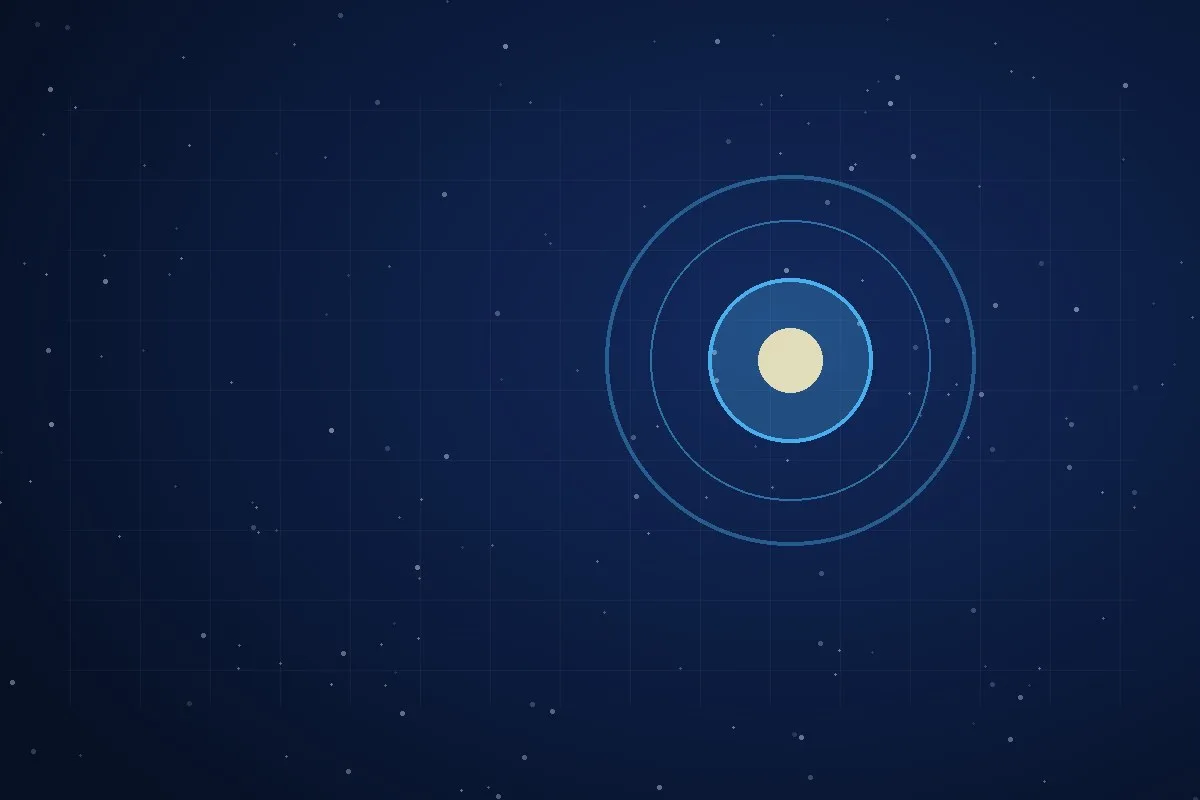
A satellite stays in orbit because it moves sideways fast enough that, as gravity pulls it toward Earth, the curved planet falls away beneath it. Gravity never switches off; it continually bends the satellite’s path. If the satellite moved too slowly, it would descend, while enough extra speed could send it onto a different orbit or escape.
Orbit is continuous falling
Imagine throwing a ball horizontally: it falls as it travels forward. Throw it faster, and it lands farther away. At orbital speed, the surface curves away at roughly the same rate that the object falls, so it keeps circling Earth. NASA describes orbit as the combination of forward momentum and gravity, not as an absence of gravity. [1]
Different heights need different speeds
Low-orbit satellites travel quickly and circle Earth in about an hour and a half. Farther out, gravity is weaker and the orbital speed is lower. A geostationary satellite moves at a rate that matches Earth’s rotation, so it appears to hover over one longitude. That special orbit is useful for communication and weather monitoring.
Orbits can change
The atmosphere extends far above the ground. Even thin air creates drag on low satellites, gradually reducing their altitude unless their orbit is corrected. Spacecraft can also use engines to change orbit, and gravity from the Moon or Sun can perturb their paths. Satellites do not remain aloft by being weightless; they remain in motion under gravity. For another space-motion puzzle, read why Earth’s rotation is hard to feel.
Are astronauts in orbit weightless?
They experience apparent weightlessness because they and their spacecraft are falling together around Earth.
Sources and evidence
- NASA — What Is an Orbit? ↗
NASA explains the tug-of-war between forward motion and gravity that creates an orbit.
- NASA — Catalog of Earth Satellite Orbits ↗
NASA describes geosynchronous, polar and other common Earth orbits.
Sources consulted: 11 October 2026. Written with AI assistance and checked against the linked references; not independently reviewed by a subject specialist. Sources do not endorse this article. See our editorial policy.
Revision: Initial publication; the explanation was checked against the linked institutional and research sources.