
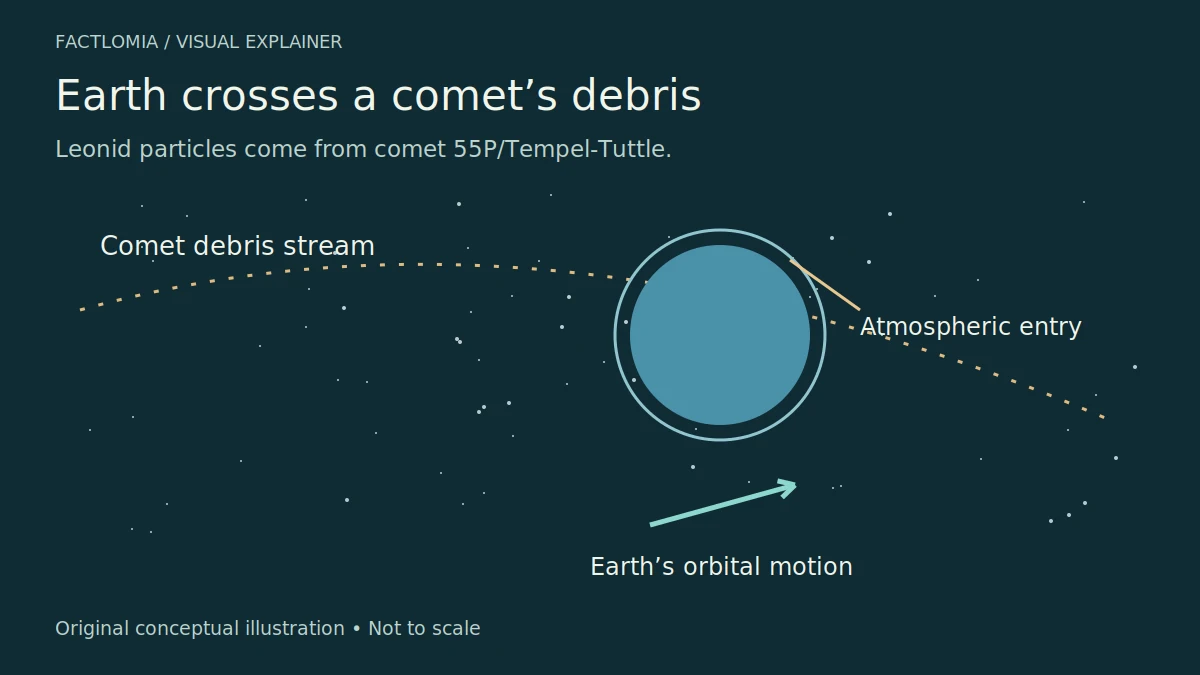
The Leonids happen when Earth crosses debris left by comet 55P/Tempel-Tuttle. Small particles enter the atmosphere at high speed and produce meteors. The shower returns in November because Earth revisits the debris stream along its yearly orbit.
Where do Leonid meteors come from?
The parent object is comet 55P/Tempel-Tuttle. Material shed on earlier passages spreads along its orbit. Earth encounters parts of that stream, and the incoming particles create bright trails in the upper atmosphere. The streaks are not stars falling out of Leo. [1]
Why are they called the Leonids?
If you extend their apparent paths backward, they seem to converge near the constellation Leo. That perspective point is called the radiant. Leo supplies the shower’s name, but its stars do not supply the debris. A shower member can appear far from the radiant in the sky. [1]
When should you watch in November 2026?
NASA lists activity from November 6 through November 30 and highlights the night of November 16–17. Published calendars are not perfectly consistent on the exact peak night, so the surrounding nights matter too. Check an up-to-date local forecast rather than expecting one guaranteed minute of activity. [1]
Does the shower guarantee a meteor storm?
No. The Leonids are famous for exceptional historical storms, but those depend on Earth crossing unusually dense debris. The American Meteor Society distinguishes those rare encounters from ordinary annual activity. A shower name is not a forecast of a sky packed with meteors. Moonlight, cloud and artificial light can reduce what an observer sees. [2]
How is this different from the Taurids?
Both are debris encounters, but they belong to different streams and have different apparent speeds and histories. Compare the Taurids and their Halloween-fireball reputation.
Sources and evidence
- NASA — Leonids ↗
Parent comet, radiant and 2026 activity window.
- American Meteor Society — Meteor Shower Calendar ↗
Annual shower versus historical storm context and 2026 calendar.
Sources consulted: 31 October 2026. Written with AI assistance and checked against the linked references; not independently reviewed by a subject specialist. Sources do not endorse this article. See our editorial policy.
Revision: Initial publication. Checked against cited references; dated event information is identified in the text and uncertainties are stated.