
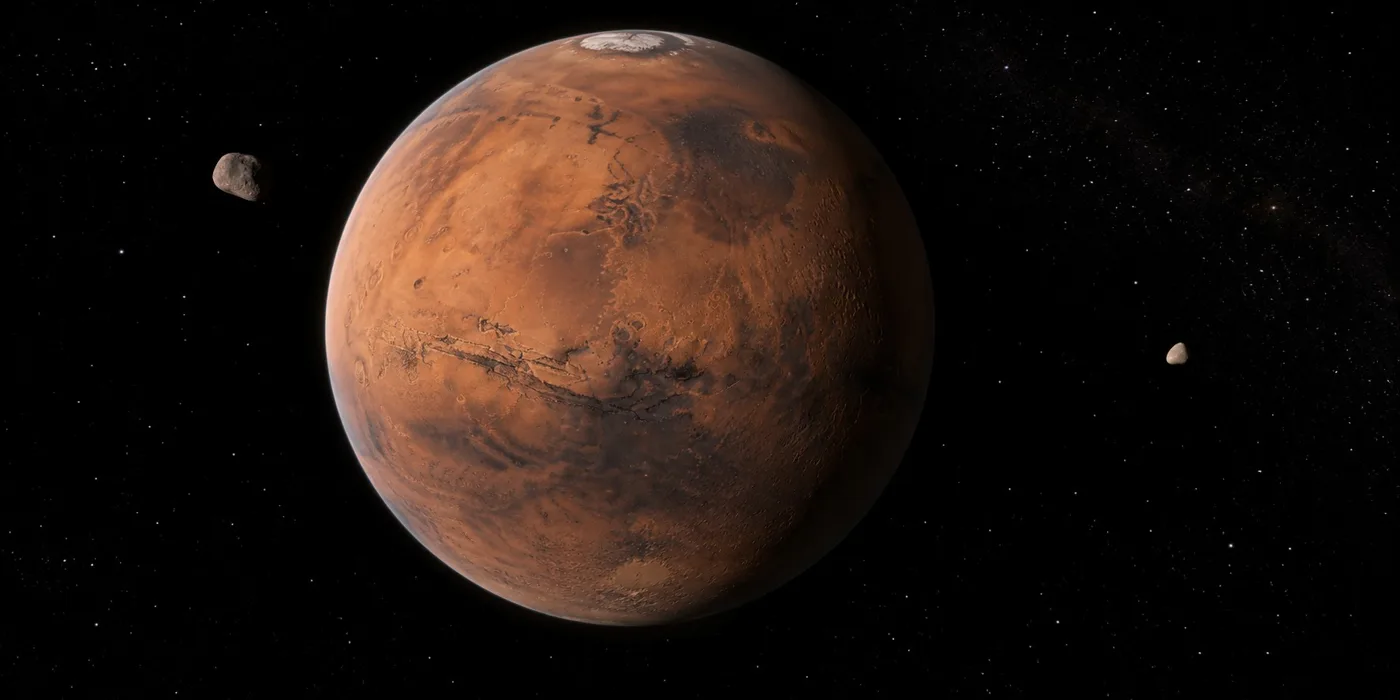
Mars has two small moons, Phobos and Deimos. Scientists have not settled how they formed. One idea is that Mars captured asteroid-like objects; another is that a large impact blasted material into orbit, where it gathered into moons. Their properties and nearly circular paths make the origin puzzle more complex than simply calling them captured asteroids.
Why the moons resemble asteroids
Phobos and Deimos are small, irregular, and dark, features that resemble some asteroids. This motivated the capture hypothesis. But getting passing objects into the moons’ present nearly circular orbits requires a way to remove orbital energy, so capture has challenges. [1]
The impact-debris idea
A large impact could have thrown Martian and impactor material into a disk around the planet. Some debris could then have collected into moons. NASA simulations have explored impact scenarios, while future observations and sample studies may help distinguish theories. This is plausible, not a settled answer. [2]
Why the origin matters
Learning how the moons formed would reveal details about early Mars and how small satellites develop. Phobos is moving inward under Mars’s tidal forces; over a very long time it may break apart or collide with the planet. See why Mars is red and how meteors glow.
Frequently asked questions
Frequently asked questions
What are the two moons of Mars called?
Phobos and Deimos. Both are small and irregularly shaped.
Are they captured asteroids?
That remains one hypothesis; impact debris is another major explanation.
Which moon is closer to Mars?
Phobos orbits closer to Mars than Deimos.
Sources and evidence
- NASA — Mars Moons ↗
Identifies Phobos and Deimos and summarizes their properties.
- NASA — Making Mars’ Moons: A New Explanation ↗
Describes impact simulations and competing hypotheses.
- NASA Technical Reports Server — Origin of Mars’s Moons ↗
Summarizes current work on Phobos and Deimos origins.
Sources consulted: 2026-10-18. Written with AI assistance and checked against the linked references; not independently reviewed by a subject specialist. Sources do not endorse this article. See our editorial policy.
Revision: Initial editorial draft prepared 18 October 2026; claims are tied to linked sources and retain stated limitations.