
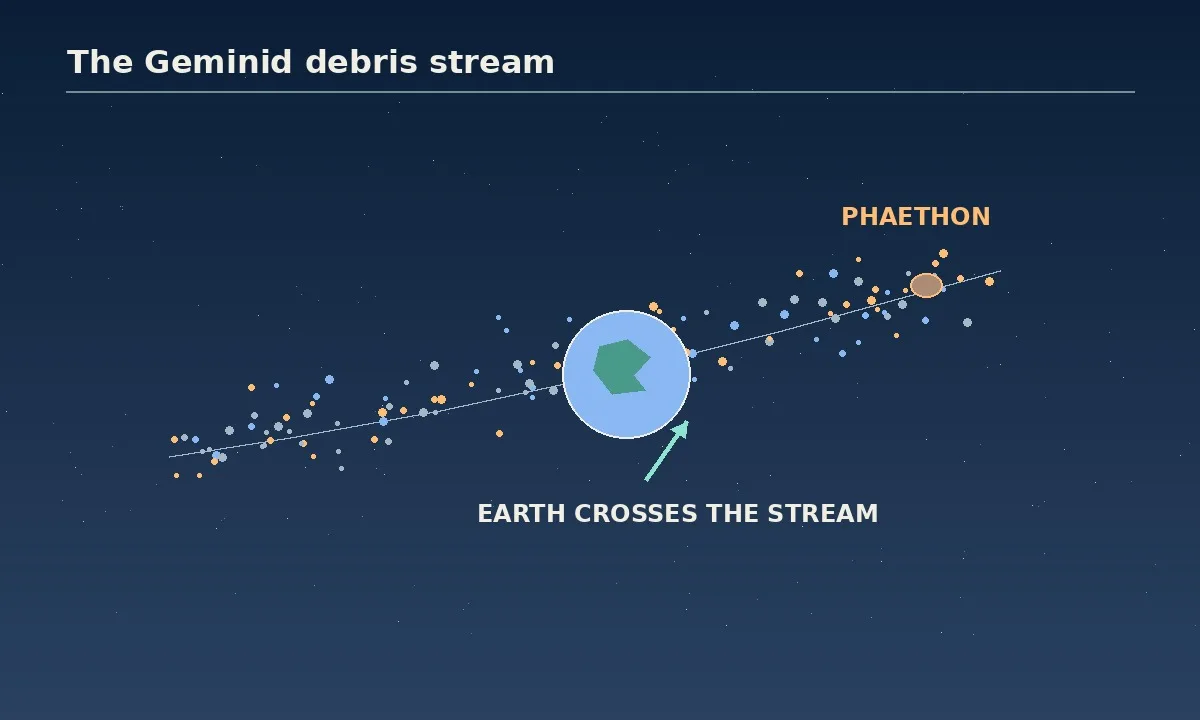
The Geminids come from a stream of debris linked to asteroid 3200 Phaethon. Earth crosses that stream each December; NASA lists the 2026 shower as active December 4–17, with its peak night December 13–14.
Where the streaks come from
A particle from the stream strikes the upper atmosphere at high speed. The collision heats and excites material from the particle and the surrounding air, producing a brief streak. Geminids appear to trace back toward Gemini because Earth is meeting a stream of particles moving in broadly the same direction. [1]
An unusual parent
Many familiar showers originate in comet debris. Phaethon has an asteroid designation and passes very close to the Sun. The association between Phaethon and the stream is well established. How the stream acquired all its material remains a research question. [1]
How to plan a watch
NASA lists the 2026 shower as active from December 4 through 17, with the peak on the night of December 13–14. Its overview estimates roughly 40 to 50 meteors per hour under dark skies, but a local observer may see fewer because of clouds, light pollution, the Moon, radiant height and actual shower activity. Pick a dark site with a wide view, check the local forecast, give your eyes time to adapt, and watch a broad area rather than staring only at Gemini. [1] [2]
Frequently asked questions
Do I need to find Gemini before I can see a meteor?
No. Gemini marks the apparent origin. Streaks can show up across much of the sky.
Could I see a Geminid on another night?
The shower is active on multiple nights around the peak. Rates change as Earth moves through the debris stream.
Sources and evidence
- NASA Geminids overview ↗
Phaethon as the parent body and observing details.
- NASA 2026 skywatching calendar ↗
2026 December peak and viewing window.
Sources consulted: 13 November 2026. Written with AI assistance and checked against the linked references; not independently reviewed by a subject specialist. Sources do not endorse this article. See our editorial policy.
Revision: Reviewed on 13 November 2026 against NASA’s current 2026 shower calendar; dates and viewing-rate estimates are qualified by observing conditions.