
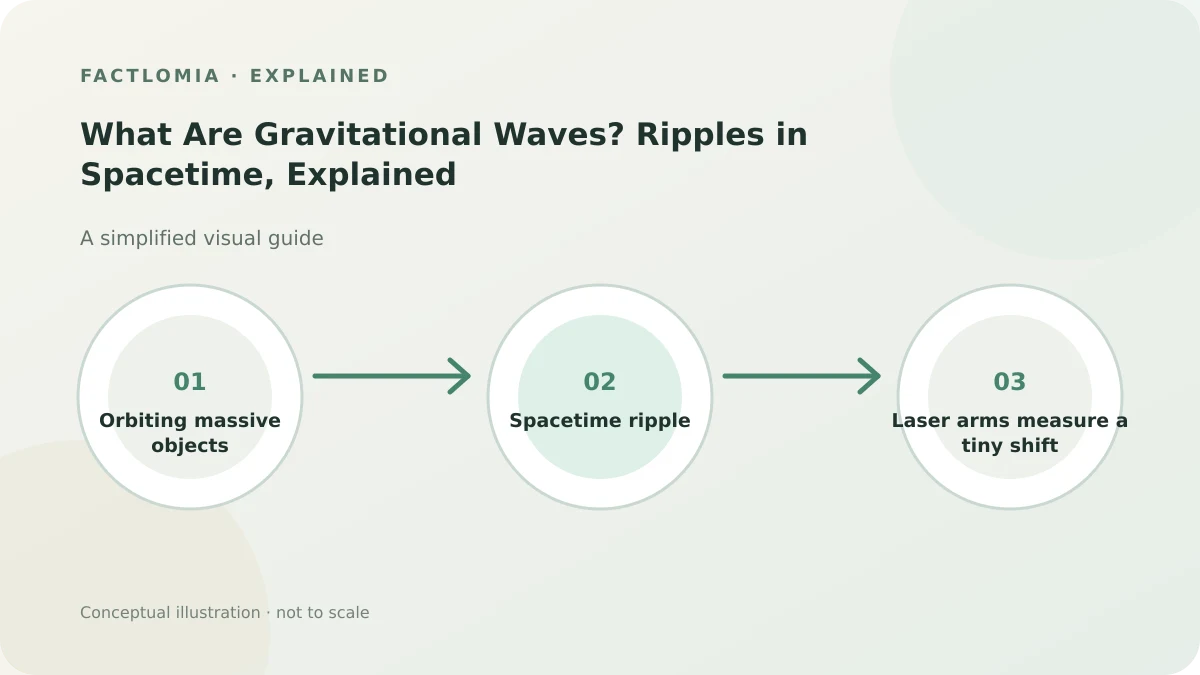
Gravitational waves are ripples in spacetime produced when massive objects accelerate asymmetrically, especially during events such as black-hole or neutron-star mergers. They travel outward at the speed of light and stretch and squeeze distances by an extraordinarily small amount. LIGO detects that change with laser interferometers.
Massive objects can disturb spacetime
In Einstein’s general theory of relativity, gravity is connected to the geometry of spacetime. When massive objects accelerate in an uneven way, they can send disturbances outward as gravitational waves. A pair of compact objects spiraling together—such as black holes—can generate a signal that grows stronger as the orbit tightens and the objects merge. [1]
The waves are not sound traveling through space. They are changes in spacetime itself, so an instrument must measure their effect on distance.
How LIGO measures a passing wave
LIGO splits laser light along two long, perpendicular arms and recombines it. A passing gravitational wave changes the relative lengths of the arms by a minuscule amount, shifting the light pattern. Because ordinary ground vibrations and instrument noise can imitate a signal, researchers compare detectors at widely separated sites and carefully test candidate events. [2]
The measurement is not a picture of the collision. Scientists infer a likely source by matching the signal’s changing pattern to predictions from physics.
What do gravitational waves let us learn?
They provide a way to study some cosmic events that are difficult to observe with light alone. A black-hole merger may emit no bright light, but its gravitational-wave signal can reveal information about the objects’ masses and motion. When different observatories detect the same event, the combined evidence can help narrow down where it occurred.
For another look at extreme gravity, read how a black hole bends light.
Frequently asked questions
Can people feel gravitational waves?
No. The waves reaching Earth from distant mergers are far too small for a person to notice; sensitive instruments are needed.
Do gravitational waves travel faster than light?
They travel at the speed of light according to general relativity.
Are they the same as gravity?
They are propagating disturbances in spacetime associated with changing gravitational fields, not a separate force that replaces gravity.
Sources and evidence
- LIGO Lab — What Are Gravitational Waves? ↗
Physical meaning of gravitational waves and their production by compact-object mergers.
- LIGO Lab — What Is an Interferometer? ↗
How interferometers measure tiny relative changes in arm length and why detector comparison matters.
Sources consulted: 1 November 2026. Written with AI assistance and checked against the linked references; not independently reviewed by a subject specialist. Sources do not endorse this article. See our editorial policy.
Revision: Initial publication. Claims and uncertainty checked against the cited references.