
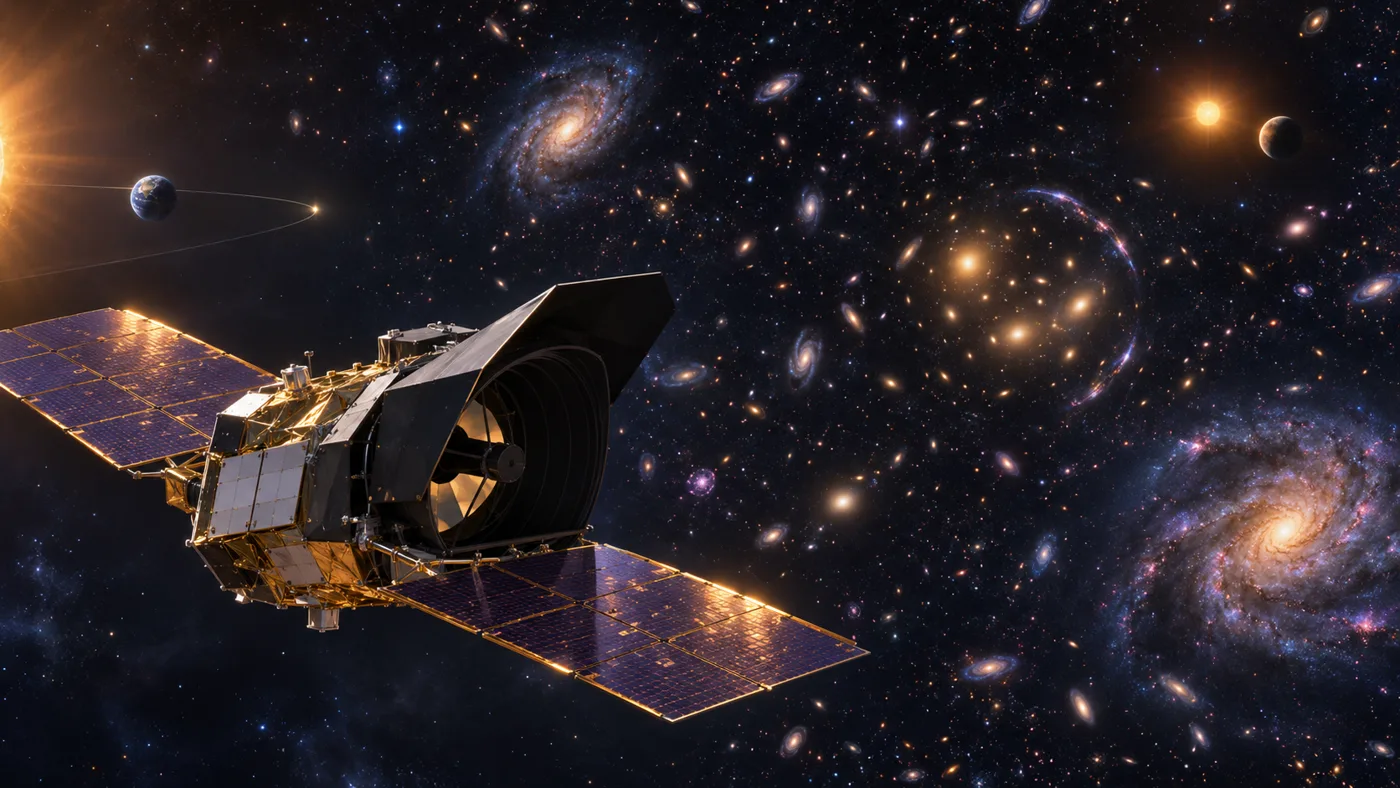
NASA’s Nancy Grace Roman Space Telescope is designed to survey enormous areas of the sky in crisp infrared light. Its observations will help scientists investigate dark energy, map galaxies and dark matter, and find exoplanets. NASA scheduled the observatory’s first public images for December 7, 2026; those early images will demonstrate its capabilities rather than represent the mission’s final scientific results.
A wide view of the universe
Roman combines sharp infrared vision with a field of view at least 100 times larger than Hubble’s. That lets it capture broad sky surveys while preserving detailed views of many distant objects in each observation. Over its mission, NASA says Roman could measure light from a billion galaxies. [1]
A wider field is useful because many questions in astronomy require comparing large populations of stars and galaxies, not just examining one target at a time.
Dark matter, dark energy and cosmic history
By mapping how galaxies are distributed and how their shapes are subtly distorted by gravity, Roman’s surveys are expected to help scientists investigate dark matter and the expansion of the universe. Dark matter does not shine, but its gravity affects visible matter and light. Dark energy is the name scientists give to the still-unexplained process associated with the universe’s accelerating expansion. Roman will collect evidence to test models; it will not photograph either substance directly. [1]
Searching for planets beyond our solar system
Roman will also conduct a statistical census of planetary systems in the Milky Way. Its coronagraph is a technology demonstration that will block much of a star’s glare to test methods for directly imaging nearby planets and planet-forming disks. This is separate from the telescope’s broader survey work, and the demonstration is not a promise that every planet will be directly photographed. [1]
For a closer look at one of Roman’s engineering challenges, read why its coronagraph needs precise optical alignment.
When will Roman’s first images appear?
NASA announced that Roman’s first images will be released on December 7, 2026, during a public presentation at the American Geophysical Union meeting. The images are intended to showcase the observatory’s capabilities as it completes commissioning. They are an early milestone, not a complete survey or final answer to the telescope’s science questions. [2]
FAQ: NASA’s Roman telescope
Is Roman already producing its full science survey? No. It is completing commissioning and preparing for science operations.
Will Roman replace Hubble? No. Roman’s much wider field complements the detailed observations made by Hubble and other observatories.
Will Roman directly photograph dark matter? No. It will study dark matter’s gravitational effects on galaxies and light.
Sources and evidence
- NASA Science — Nancy Grace Roman Space Telescope ↗
Roman’s field of view, planned galaxy survey, exoplanet census, coronagraph demonstration and mission goals.
- NASA — First images from NASA’s Roman Space Telescope scheduled for December 7 ↗
The announced release date and the purpose of Roman’s initial images.
Sources consulted: 18 November 2026. Written with AI assistance and checked against the linked references; not independently reviewed by a subject specialist. Sources do not endorse this article. See our editorial policy.
Revision: Initial publication; mission capabilities and the first-image schedule checked against NASA sources.