
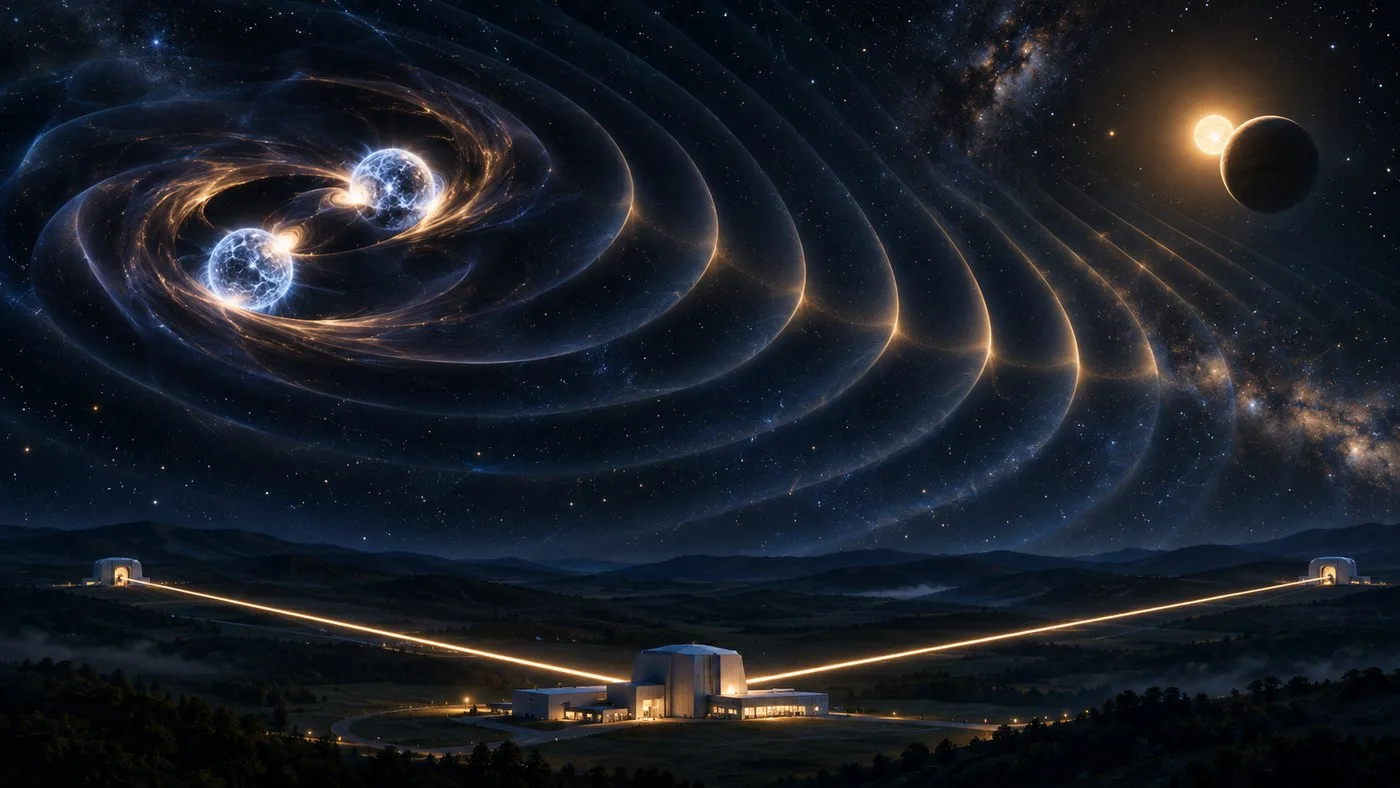
Possibly. A planet orbiting a close pair of white dwarfs could make their nearly steady gravitational-wave signal wobble in a detectable pattern. LISA is planned for the 2030s, so this is a proposed future detection method—not a planet discovery so far.
A different way to look for planets
Many exoplanets are found by watching starlight: a planet can dim its star as it passes in front, or tug the star into a small motion that shifts its spectrum. A proposed LISA search would use gravitational waves instead. Its target is a compact binary: two white dwarfs, the dense remnants of stars like the Sun, orbiting each other closely. NASA expects such binaries to be a common source for LISA. [1]
How a planet could leave a signal
The two white dwarfs emit gravitational waves at a nearly continuous frequency. A planet orbiting the pair makes the system move slightly around a shared center of mass. That motion can add small Doppler sidebands around the main gravitational-wave signal. Researchers modeled which planet masses and orbital periods might be detectable; the threshold depends on the system and future observations. [1]
Why Webb could help confirm a candidate
A signal resembling a planet would need confirmation. NASA describes a possible cross-check with the James Webb Space Telescope: a planet in a double-white-dwarf system may add infrared light beyond the stars’ expected output. LISA is still in development, and no planet has yet been found with this method. Read our gravitational-wave explainer. [1]
FAQ: gravitational-wave planet hunting
Has LISA found an exoplanet? No. The observatory is still being developed.
Would it find planets around Sun-like stars? These studies focus on planets orbiting binary white dwarfs.
What are gravitational waves? Ripples in spacetime produced by accelerating massive objects.
Sources and evidence
- NASA — How Gravitational Waves Can Reveal New Worlds ↗
NASA summary of new LISA exoplanet-detection studies and possible Webb confirmation.
- NASA — LISA Mission ↗
Mission concept and development context.
Sources consulted: 14 November 2026. Written with AI assistance and checked against the linked references; not independently reviewed by a subject specialist. Sources do not endorse this article. See our editorial policy.
Revision: Initial publication. Claims and limitations checked against linked institutional and primary sources.