
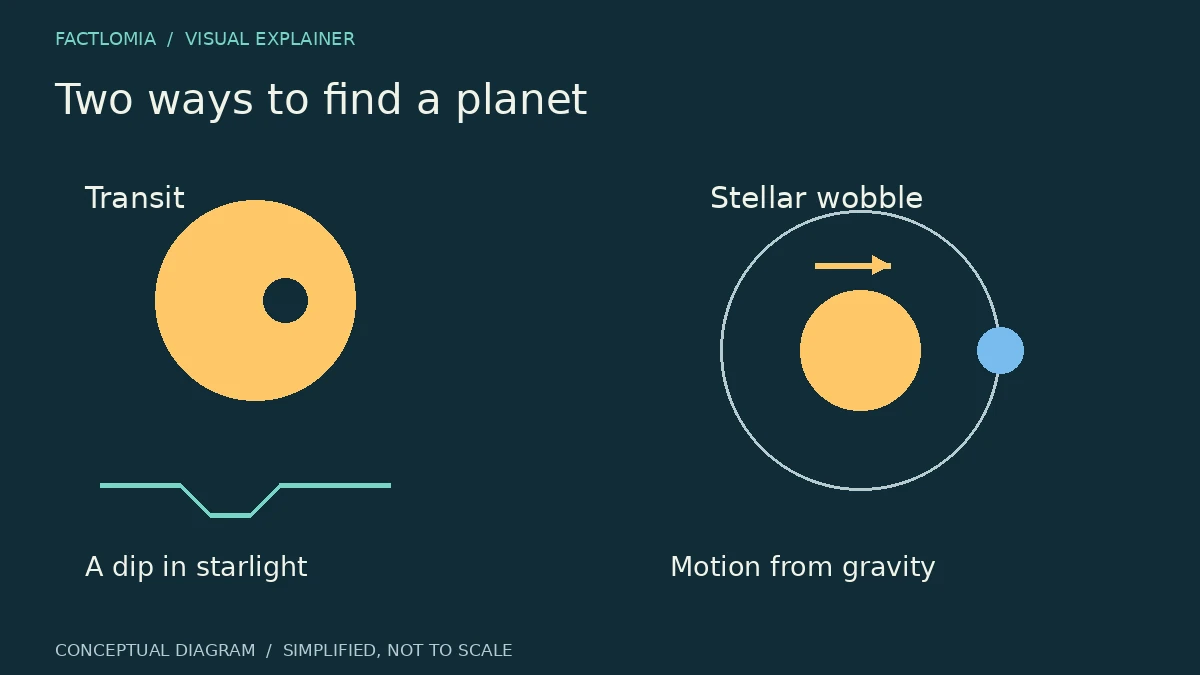
Astronomers usually discover exoplanets by measuring a planet’s effect on its star rather than seeing the planet directly. The transit method detects a small, repeating dip in starlight when a planet crosses the star. The radial-velocity method measures a star’s subtle motion caused by a planet’s gravity. Repeated observations help rule out false alarms and confirm a candidate.
Look for a planet’s effect on its star
A planet is tiny and faint compared with its host star, so most are difficult to photograph directly. Instead, astronomers search for patterns in starlight or stellar motion. These indirect signals can reveal a planet even when its light is lost in the glare of its star. [1]
A transit makes a small dip in brightness
If a planet’s orbit carries it between its star and our line of sight, it blocks a small fraction of the star’s light. A telescope records a repeating dip in brightness, called a transit. The depth of the dip helps estimate the planet’s size relative to the star, while the time between dips gives its orbital period. Most known exoplanets have been found this way. [1][2]
A planet also makes its star move
Planets and stars orbit their shared center of mass. The star’s motion is much smaller, but it shifts the star’s spectrum slightly toward blue as it moves toward us and toward red as it moves away. This radial-velocity signal can reveal a planet and help estimate a minimum mass. When both transit and radial-velocity measurements are available, astronomers can estimate density as well. [1]
Why a signal needs checking
Other effects, including a companion star or changes on the star’s surface, can imitate some planet signals. Researchers check that the pattern repeats and use follow-up observations or another detection method where possible. A candidate is not the same thing as a confirmed planet. Direct imaging and gravitational microlensing provide additional discovery routes. See also how astronomers read starlight.
Frequently asked questions
Can astronomers see exoplanets directly?
Sometimes, but most are found indirectly because the host star is much brighter than the planet.
What does a transit tell us?
The repeating timing gives the orbital period, and the depth of the dip helps estimate the planet’s size relative to its star.
Does every dip mean a planet?
No. Astronomers check for other causes and seek confirmation before treating a candidate as a planet.
Sources and evidence
- NASA Science — In Depth: Exoplanets ↗
Summarizes transit, radial-velocity, direct-imaging, and other exoplanet discovery methods.
- NASA Science — What’s a Transit? ↗
Explains the light-curve dip and what transit timing and depth can reveal.
Sources consulted: 2026-10-27. Written with AI assistance and checked against the linked references; not independently reviewed by a subject specialist. Sources do not endorse this article. See our editorial policy.
Revision: First published 27 October 2026. Original explanatory diagram; claims checked against linked sources.