
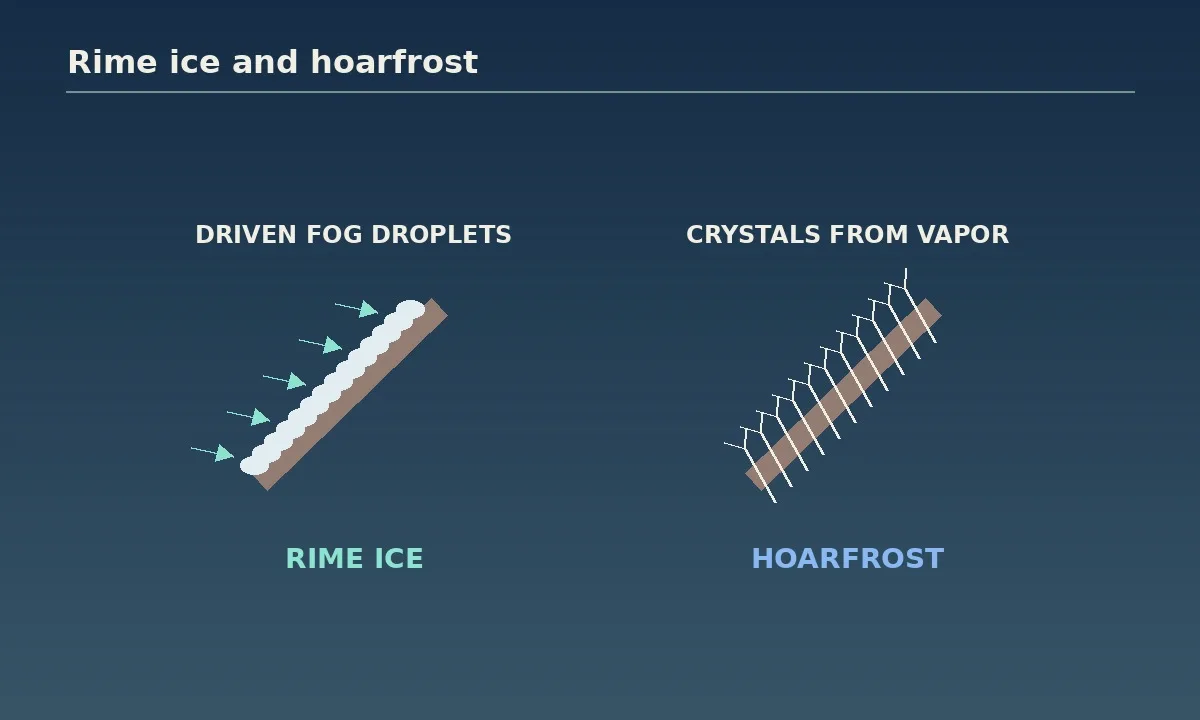
Rime grows when supercooled fog droplets hit an object and freeze. Hoarfrost grows from water vapor on a cold surface. A windy, foggy ridge favors rime, while a calm, clear night often favors hoarfrost.
Look for the direction of growth
Fog can carry liquid droplets below freezing. When wind drives them against a twig or railing, the droplets can freeze on impact. The exposed face receives more droplets, so rime can pile up on one side and take on a rough, opaque appearance. [1] [2]
Look for individual crystals
On a clear, calm night a branch or blade of grass can cool below the surrounding air. If conditions allow water vapor to deposit directly as ice, crystals grow on the surface. Well-developed hoarfrost can show individual needles, plates or feathery edges. [1]
Use weather as a second clue
A white tree by itself can be ambiguous. Think about whether fog and wind were present, and whether the material is concentrated on the windward side. Freezing rain can leave a smoother, often clearer glaze because larger droplets can spread before they freeze. [1] [2]
Frequently asked questions
Can fog stay liquid below freezing?
Yes. Supercooled droplets remain liquid until ice formation is triggered.
Will rime always be hard?
Rime varies with conditions. Some deposits are soft and feathery, and others are dense and hard.
Sources and evidence
- UK Met Office frost and ice guide ↗
Mechanisms and visual clues for hoarfrost and rime.
- National Weather Service surface observation manual ↗
Operational descriptions of rime, glaze and hoarfrost.
Sources consulted: 12 November 2026. Written with AI assistance and checked against the linked references; not independently reviewed by a subject specialist. Sources do not endorse this article. See our editorial policy.
Revision: Initial publication.