
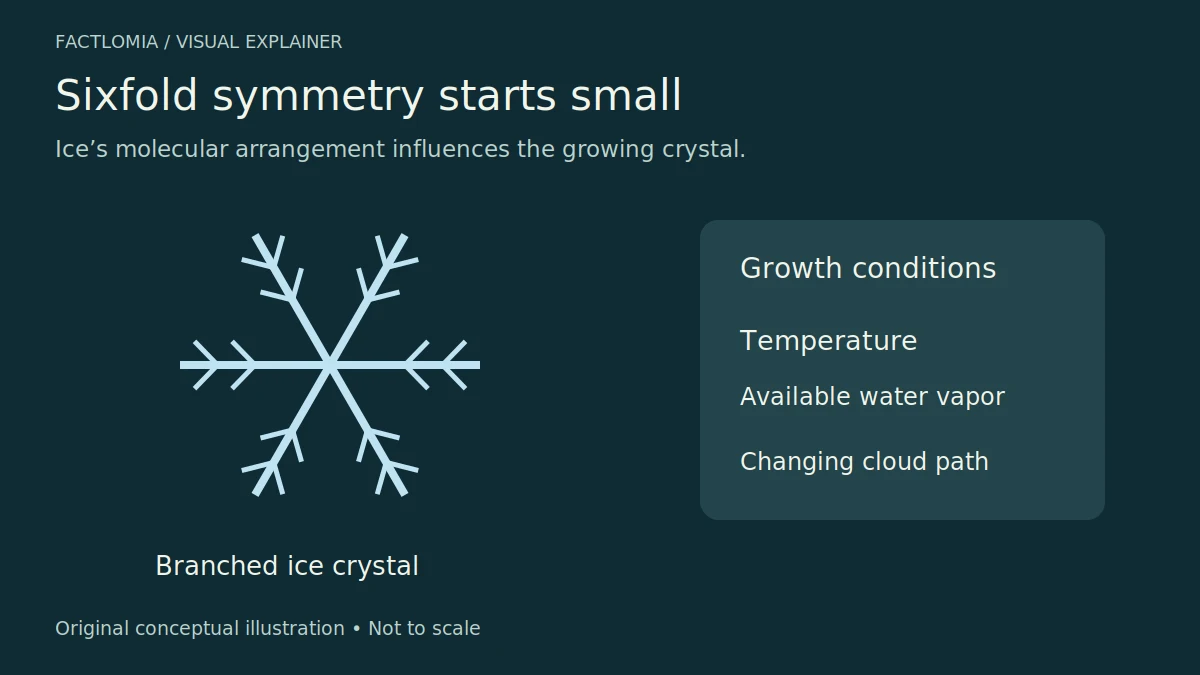
Many individual snow crystals show sixfold symmetry because of the way water molecules arrange themselves in ordinary ice. Temperature and moisture shape the growing crystal, producing plates, columns or branching forms rather than one universal six-pointed star.
Where does the number six come from?
The pattern begins at the molecular scale. The crystal structure of ordinary atmospheric ice favors hexagonal organization. As a crystal grows, that organization influences its faces and the directions in which branches develop. The visible pattern is therefore connected to the structure of the material, not to six wind currents surrounding a falling flake. [1]
How do the delicate branches grow?
Water vapor deposits onto the growing ice. A small protrusion can capture more vapor and grow outward, encouraging branching. NOAA’s educational explanation distinguishes growth of flat crystal faces from growth of branches; both processes can contribute to one developing crystal. [1]
Why do the arms resemble one another?
Nearby parts of the same small crystal encounter similar temperature and moisture conditions. Those shared conditions encourage related growth patterns on its arms. Similar does not mean every detail must match: collisions, uneven growth and changing conditions can produce irregularities. [2]
Why don’t all flakes look like tiny stars?
Temperature and humidity influence crystal shape. NOAA describes a range that includes needles and plates as well as familiar branched forms. A falling snowflake may also be a cluster of several crystals. A decorative six-pointed drawing captures one recognizable pattern, not every piece of snow you might catch. [2]
Are two snowflakes ever exactly alike?
Different paths through a cloud give crystals different growth histories, making detailed matches extremely unlikely. It is more accurate to explain that variety than to suggest every small ice crystal has been individually compared. For a different optical effect, read why snow sparkles.
Sources and evidence
- NOAA / NASA JPL — How Do Snowflakes Form? ↗
Crystal symmetry, face growth and branch formation.
- NOAA — How Do Snowflakes Form? Get the Science Behind Snow ↗
Weather conditions, shape variation and growth history.
Sources consulted: 31 October 2026. Written with AI assistance and checked against the linked references; not independently reviewed by a subject specialist. Sources do not endorse this article. See our editorial policy.
Revision: Initial publication. Checked against cited references; dated event information is identified in the text and uncertainties are stated.