
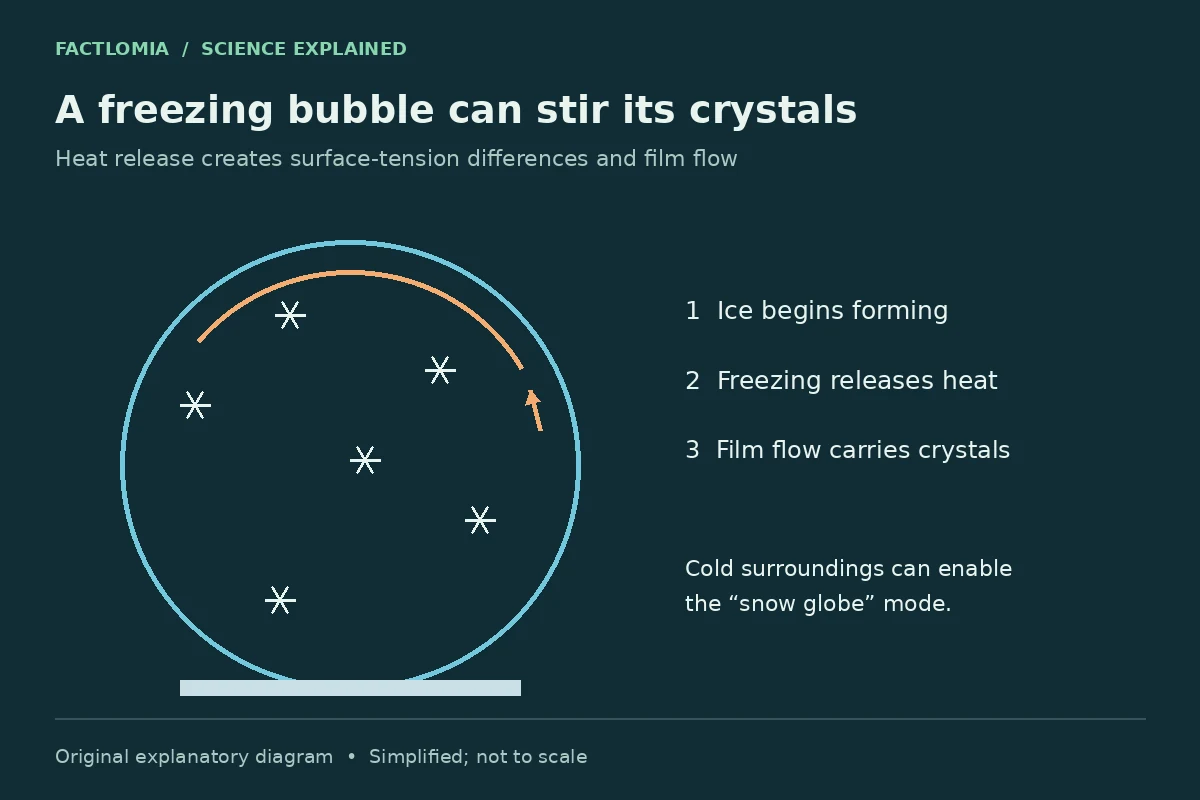
Ice crystals can swirl around a freezing soap bubble because freezing releases heat and creates temperature differences in its thin liquid film. Those differences change surface tension and drive flow along the film. The moving liquid carries small crystals, producing a snow-globe-like effect.
A bubble is a thin liquid shell
The air inside the bubble is not turning into a ball of snow. The water-containing film between surfactant layers is freezing. Its small thickness allows changes in temperature and liquid motion to reshape the freezing pattern quickly. The result is different from the advancing ice boundary familiar in a deep puddle. [1]
Freezing releases heat rather than absorbing it
Liquid water releases latent heat as it becomes ice. At the place where freezing starts, that release can warm neighboring liquid relative to other parts of the bubble. A surface-tension difference then pulls liquid along the film, a process called Marangoni flow. In the studied supercooled bubbles, that flow swept ice fragments around, creating multiple growing crystals. [1], [2]
Why not every bubble becomes a snow globe
A 2019 experimental study identified two modes. With the bubble and surroundings cold, crystals could circulate around the shell. With a cold supporting stage but warmer surrounding air, freezing advanced upward from the base and eventually stalled. The limited ability to conduct heat along the shell mattered. The temperature of the base alone therefore cannot predict the entire pattern. [1], [2]
What should you look for in a video?
Track the film rather than the empty center. Growing branches indicate crystal growth; traveling fragments indicate transport. A time-lapse can make both look much faster than real time, and the exact pattern depends on the solution and environmental conditions. This is different from supercooled water staying liquid or colors produced by a bubble’s thin film.
Sources and evidence
- Ahmadi et al. — How soap bubbles freeze ↗
Research article identifying two freezing modes and Marangoni flow.
- Virginia Tech — Bubble of an idea leads to new research on freezing ↗
Research-team explanation of heat release and crystal-carrying flow.
Sources consulted: 2026-10-21. Written with AI assistance and checked against the linked references; not independently reviewed by a subject specialist. Sources do not endorse this article. See our editorial policy.
Revision: First published 21 October 2026. Original explanatory diagram and source-linked text.