
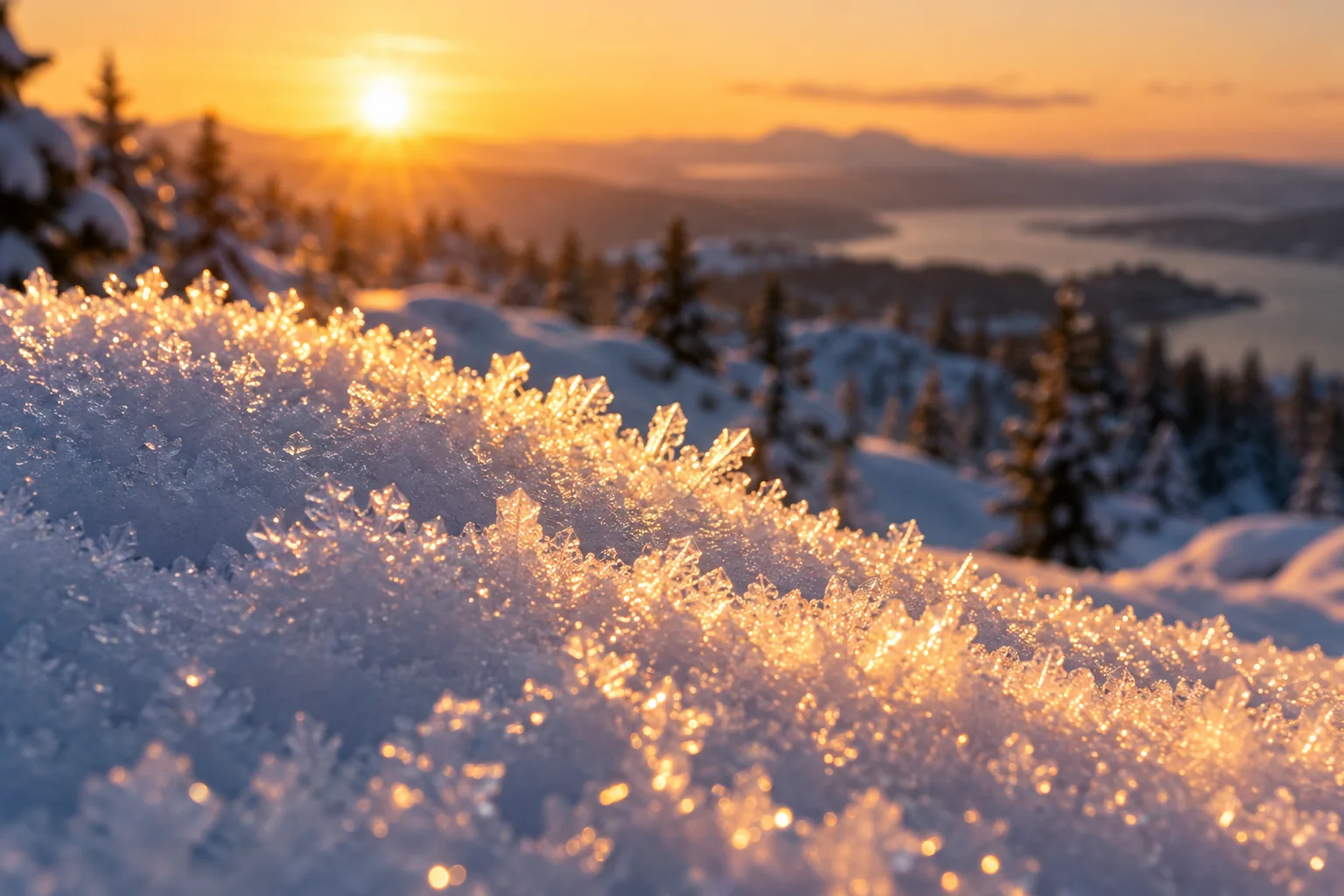
Snow sparkles when sunlight hits tiny facets of ice crystals near the snow surface and some light reflects or refracts toward your eyes. As you or the Sun moves, different crystals line up with the viewing angle, creating brief flashes. This is separate from the broad scattering that makes snow look white.
Snow is a field of different crystals
Snow is not a smooth white sheet. It is a surface of ice grains with different shapes, orientations, and histories. Individual facets can send light in a particular direction. When a facet lines up with the Sun and observer, it produces a pinpoint glint; a small change in angle can make it appear or vanish. [1]
Sparkle differs from snow’s white color
Snow looks white because light scatters and reflects from many ice grains and air spaces. Sparkle is a localized flash from individual crystal surfaces. Wind, melting, refreezing, and dirt alter the surface and its appearance. [2]
Why a few flashes can look colorful
Ice can bend wavelengths slightly differently, so a crystal may create a faint color under some viewing geometry. Most snow sparkles appear white. The effect is directional and distinct from the blue appearance of some dense glacier ice. Read why glaciers can look blue and how ice crystals make halos.
Frequently asked questions
Frequently asked questions
Does snow sparkle because it contains diamonds?
No. Ordinary ice crystals reflect or refract sunlight; the sparkle does not mean gemstones are present.
Why does snow sparkle more when the Sun is low?
The viewing angle may line up with more crystal facets, but the effect depends on snow texture and orientation.
Why is snow white but glacier ice sometimes blue?
Snow scatters light broadly at many air-ice boundaries; dense ice absorbs more red light along longer paths.
Sources and evidence
- Washington State University — What Makes Snow Sparkle? ↗
Explains how surface crystals create flashes of sunlight.
- National Snow and Ice Data Center — Science of Snow ↗
Describes snow optics and its white or blue appearance.
- Montana State University — Brilliant Colours from a White Snow Cover ↗
Analyzes colored glints caused by refraction in surface snow crystals.
Sources consulted: 2026-10-18. Written with AI assistance and checked against the linked references; not independently reviewed by a subject specialist. Sources do not endorse this article. See our editorial policy.
Revision: Initial editorial draft prepared 18 October 2026; claims are tied to linked sources and retain stated limitations.