
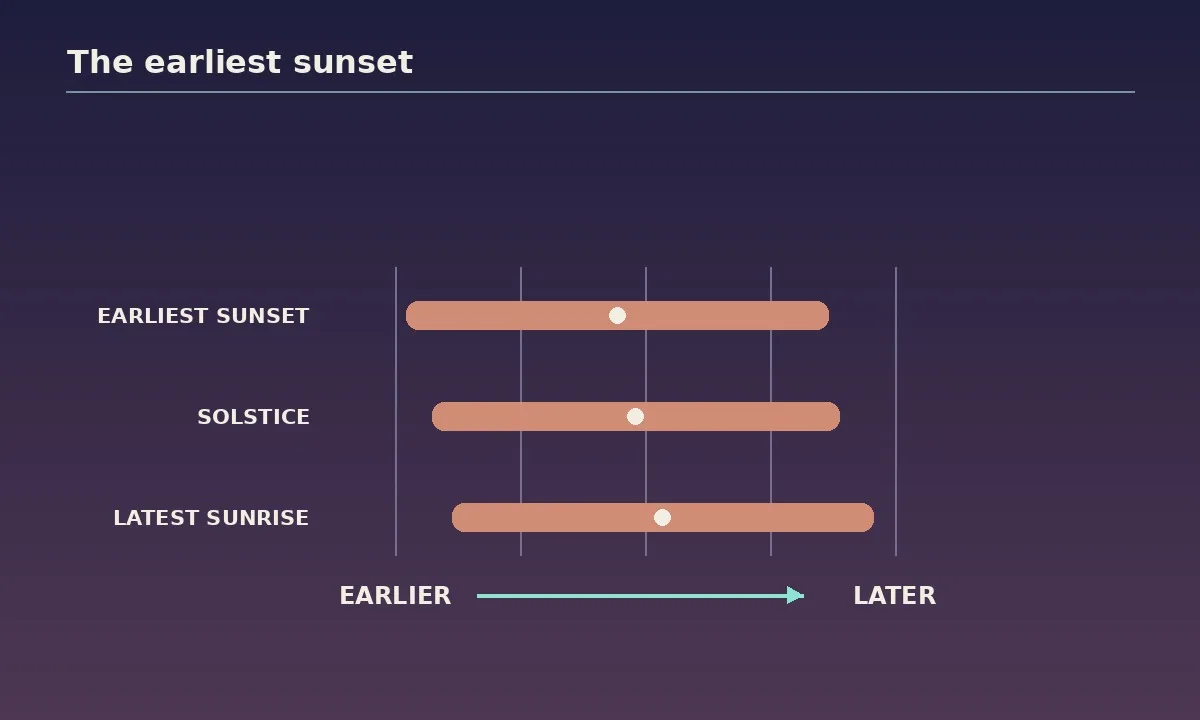
Near much of the United States, the earliest sunset comes before the December solstice because solar noon shifts on the clock as the length of daylight changes. The shortest day still occurs at the solstice.
Start with the middle of the day
Solar noon is the time the Sun crosses the local meridian and reaches its daily high point. A clock splits every day into equal hours, but the interval between successive solar noons varies through the year. Earth’s tilted axis and slightly elliptical orbit together cause that shift. [1]
Sunset combines two effects
Think of sunset as solar noon plus roughly half the daylight interval. Before the December solstice, that interval keeps shortening, which pulls sunset earlier. At the same time, solar noon is drifting later by the clock. Near the solstice, daylight is changing slowly enough that the later noon wins. [1]
Sunrise follows the same arithmetic
Sunrise is solar noon minus roughly half the daylight interval. It can continue moving later after the solstice even as total daylight increases. Around 40 degrees north, the U.S. Naval Observatory puts the earliest sunset near December 8 and the latest sunrise near January 5. [1]
Frequently asked questions
Does everyone in the U.S. get the same dates?
Latitude affects how fast daylight changes. Check a table for your own location.
Is daylight saving time responsible?
Clock changes affect displayed times, but the separation between the dates comes from the Sun’s apparent motion.
Sources and evidence
- U.S. Naval Observatory ↗
Clock time, changing solar noon and the latitude 40° example.
Sources consulted: 12 November 2026. Written with AI assistance and checked against the linked references; not independently reviewed by a subject specialist. Sources do not endorse this article. See our editorial policy.
Revision: Initial publication.