
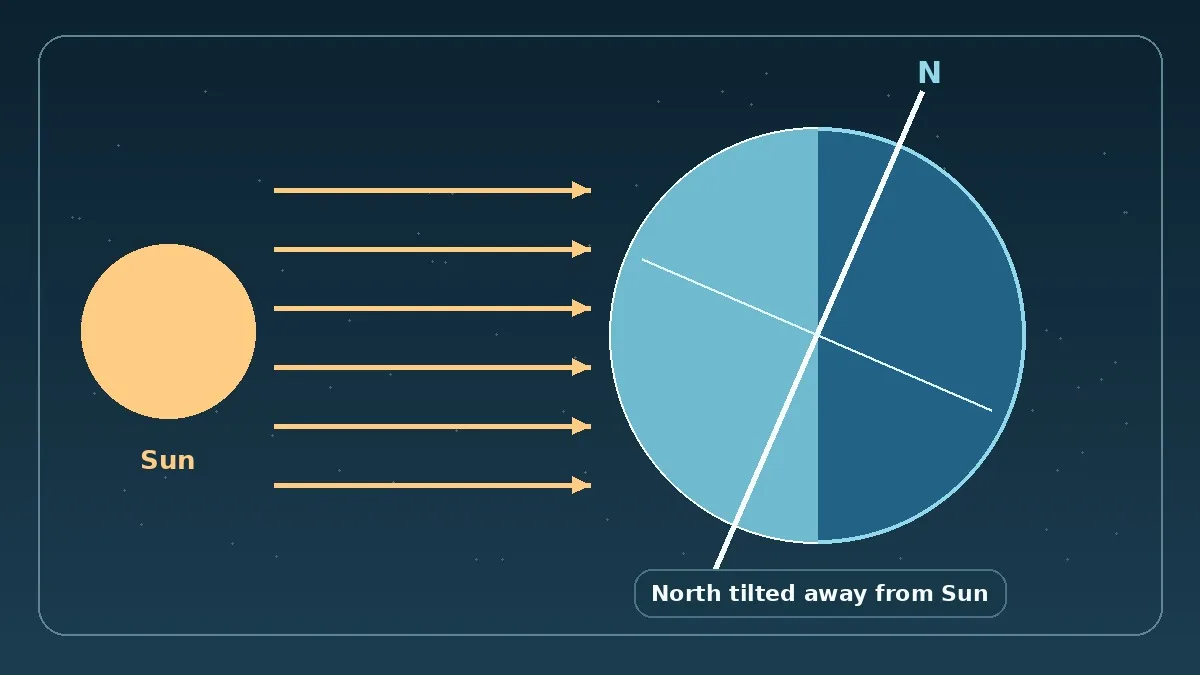
At the December solstice, Earth’s Northern Hemisphere tilts farthest away from the Sun. The Sun follows a lower, shorter apparent path across the northern sky, giving most northern locations their shortest period of daylight or a day tied for shortest. The 2026 December solstice occurs on December 21 at 20:50 UTC (3:50 p.m. Eastern Standard Time).
Earth’s tilted axis creates the seasons
Earth rotates around an axis that is tilted relative to its orbital plane. Over the course of a year, that tilt changes which hemisphere faces the Sun more directly. In December, the northern hemisphere is tilted away from sunlight, and the southern hemisphere is tilted toward it. [1]
Daylight varies with latitude
The effect becomes more dramatic as you travel away from the equator. Near the Arctic Circle, some locations experience an entire day with no sunrise. Near the equator, day length stays close to twelve hours throughout the year. The Southern Hemisphere experiences its summer solstice on the same date. [1]
The exact moment in 2026
The December solstice occurs on December 21 at 20:50 UTC. Local clock times vary by time zone. It marks the turning point in the seasonal trend of daylight at northern latitudes. The earliest sunset may occur before the solstice, since solar noon also shifts relative to clock time. [2]
Frequently asked questions
Is winter caused by Earth being farther from the Sun?
The seasons primarily arise from axial tilt, which changes solar angle and duration of daylight.
Does the solstice always occur on the same date?
The calendar date can vary, most often falling on December 21 or 22.
Sources and evidence
- NASA Earth Observatory — Winter and Summer Solstice ↗
Explains seasonal orientation, daylight and the winter polar night.
- Time and Date — December Solstice 2026 ↗
2026 date and time and relationship of sunset to shortest day.
Sources consulted: 24 November 2026. Written with AI assistance and checked against the linked references; not independently reviewed by a subject specialist. Sources do not endorse this article. See our editorial policy.
Revision: Initial publication. Factual claims checked against the cited sources.