
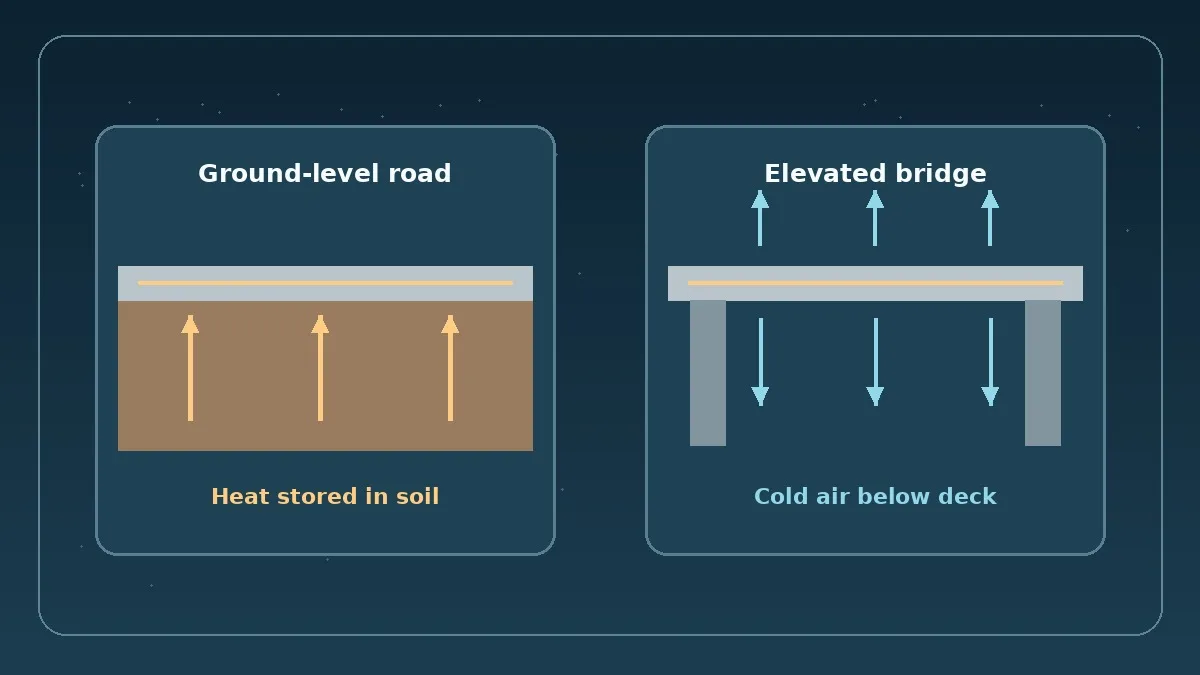
Bridges and overpasses often cool faster than ordinary roads because cold air surrounds the elevated deck, including its underside. Pavement on the ground can exchange heat with the soil beneath it. When moisture reaches a bridge deck that has cooled below freezing, ice can form even while a nearby stretch of road remains unfrozen.
What makes an elevated bridge different
A road over soil has a substantial mass of ground beneath it that stores and releases heat. A bridge deck instead has an exposed underside. It exchanges heat with air above and below, allowing its temperature to respond more quickly to a cold change in the weather. [1]
Air and pavement can have different temperatures
The temperature reported by a weather station measures air, while ice formation depends on conditions at the surface. Recent sunshine, clouds, wind and the deck material influence the temperature of the pavement. Elevated structures are especially vulnerable during freezing precipitation. [1]
Why ice may be difficult to see
A shallow layer of freezing rain can coat a deck in clear ice. It may resemble ordinary wet pavement because light can pass through the ice to the asphalt below. National Weather Service guidance highlights bridges, overpasses and raised roads as particularly susceptible to icing. [1]
Freezing at an exposed edge also helps explain how icicles grow when meltwater drips from a roof.
Frequently asked questions
Do all bridges freeze first?
No. Their temperature depends on exposure, construction and weather.
Can ice form if nearby roads are simply wet?
Yes. Adjacent surfaces can be at different temperatures.
Sources and evidence
- National Weather Service — Freezing Rain and Sleet ↗
Explains why elevated roadways ice more quickly and how freezing rain coats surfaces.
Sources consulted: 24 November 2026. Written with AI assistance and checked against the linked references; not independently reviewed by a subject specialist. Sources do not endorse this article. See our editorial policy.
Revision: Initial publication. Factual claims checked against the cited sources.