
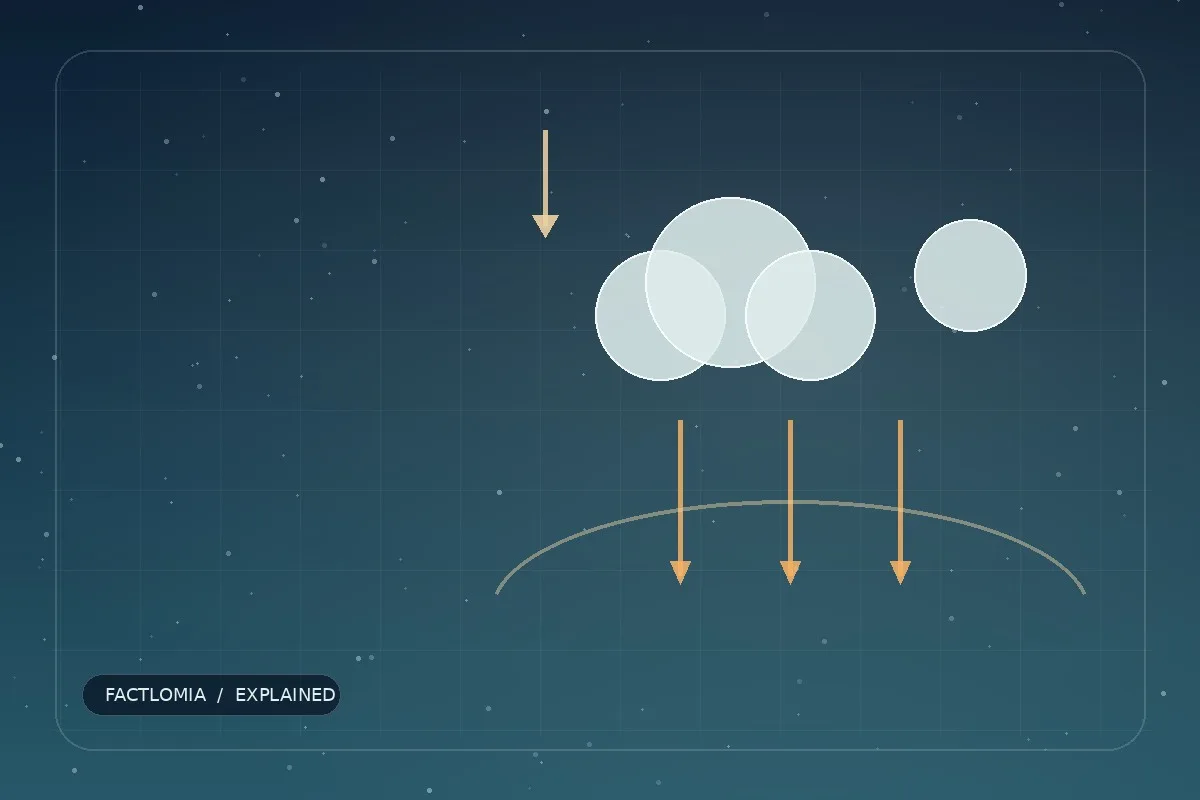
Clouds can cool Earth by reflecting sunlight and warm it by absorbing and re-emitting infrared heat. A recent study highlighted by NOAA found that cloud impacts in the tropical Pacific and Atlantic were 71 percent higher than previously thought, adding evidence that cloud feedbacks likely amplify warming. That percentage refers to modeled regional cloud impacts in the study; it is not a 71 percent increase in global warming.
Clouds can act in two directions
Bright low clouds often reflect incoming sunlight back to space, which has a cooling effect. High, thin clouds can trap some outgoing infrared radiation, which has a warming effect. The balance depends on cloud height, thickness, coverage, location and the wavelength of radiation being considered. That mix is why clouds remain an important part of climate-model uncertainty. [1]
What the new comparison says
NOAA’s November 2026 research highlight summarizes a study that found cloud impacts in the tropical Pacific and Atlantic were 71 percent higher than previously thought. The analysis supports the idea that cloud feedback in those regions amplifies warming rather than reducing it. Feedback means an initial warming changes cloud patterns, which can then alter how much energy Earth absorbs or loses. [1]
Why the percentage needs context
The figure is about regional cloud impacts in a particular scientific analysis, not a universal multiplier for all clouds or a direct measure of future temperature. Researchers compare observations and models to understand whether clouds respond to warming in ways that add or remove heat. Climate projections still rely on multiple lines of evidence, and cloud behavior varies by region and altitude. [1, 2]
FAQ: clouds and warming
Do all clouds warm the planet? No. Clouds can reflect sunlight and trap heat, with the balance depending on their properties and location.
Does 71 percent mean climate change speeds up by 71 percent? No. It describes a study’s regional cloud-impact comparison.
Are cloud feedbacks still uncertain? Yes. Scientists continue to refine observations and models.
Sources and evidence
- NOAA Climate.gov — News & Research Highlights, November 2026 ↗
Summary of the cloud-feedback finding and 71% regional figure.
- IPCC Sixth Assessment Report — Clouds and climate feedbacks ↗
Scientific context for cloud radiative effects and feedback uncertainty.
Sources consulted: 19 November 2026. Written with AI assistance and checked against the linked references; not independently reviewed by a subject specialist. Sources do not endorse this article. See our editorial policy.
Revision: Initial publication. Claims and stated limits checked against the linked official and research sources.