
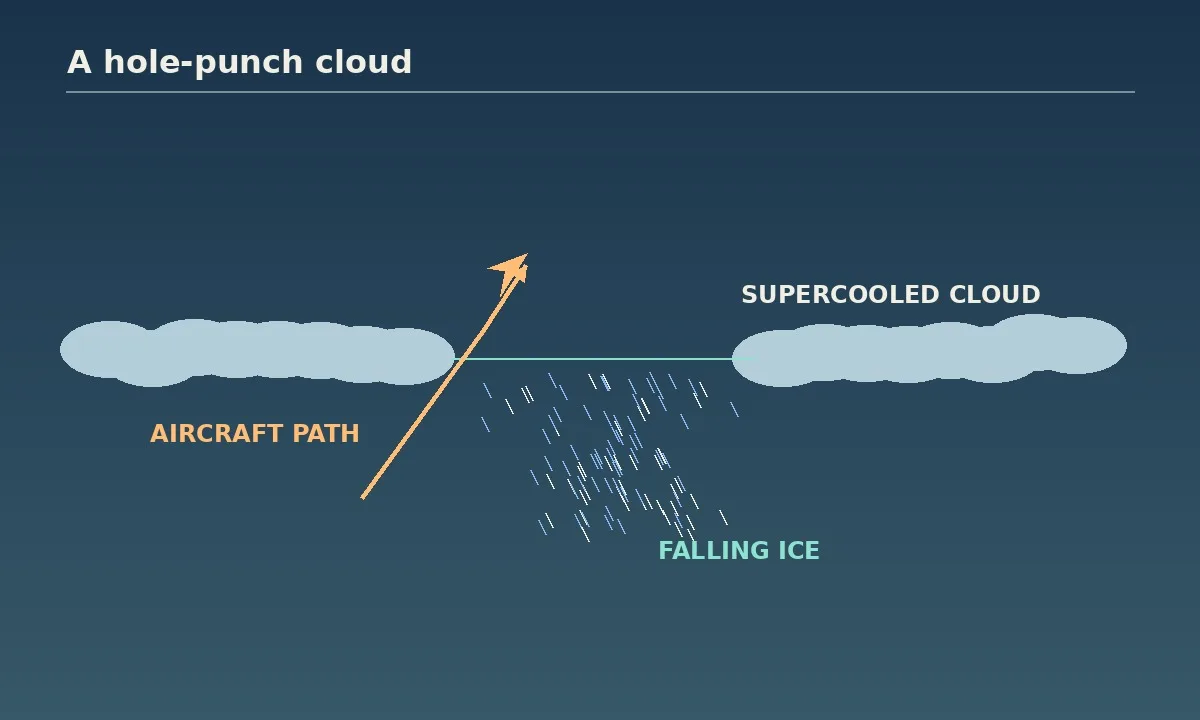
A hole-punch cloud forms when ice crystals start growing inside a layer of supercooled droplets. The crystals grow and fall, leaving a clear opening with wisps of ice beneath it. An aircraft can trigger the initial freezing.
The cloud contains liquid below freezing
Some midlevel cloud layers contain tiny liquid droplets even when the air temperature is below 32°F. These supercooled droplets can persist until something initiates freezing. A visible sheet of cloud can therefore hold liquid water even at an altitude where ice seems more likely. [1] [2]
How an aircraft can start the process
Air moving past wings or propeller blades can expand and cool briefly. In the right cloud layer that cooling can create ice crystals. As the crystals grow, nearby droplets evaporate and supply water vapor. The crystals then fall out of the layer, creating wisps below the widening opening. [1] [2]
The shape records the path
A plane that passes steeply through the layer can leave a round or oval opening. A shallower path can produce a long gap sometimes called a canal cloud. Wind and the growth of the hole change its appearance after the aircraft has gone. [2]
Frequently asked questions
Is the hole the same thing as a contrail?
A hole shows a gap in a cloud already present. A contrail is a line of newly formed ice crystals behind an aircraft.
What is the wispy tail called?
Falling precipitation that evaporates or sublimates before reaching the ground is called virga.
Sources and evidence
- NOAA NESDIS ↗
Cloud types, supercooling and appearance.
- NASA Earth Observatory ↗
Aircraft-triggered ice formation and satellite examples.
Sources consulted: 12 November 2026. Written with AI assistance and checked against the linked references; not independently reviewed by a subject specialist. Sources do not endorse this article. See our editorial policy.
Revision: Initial publication.