
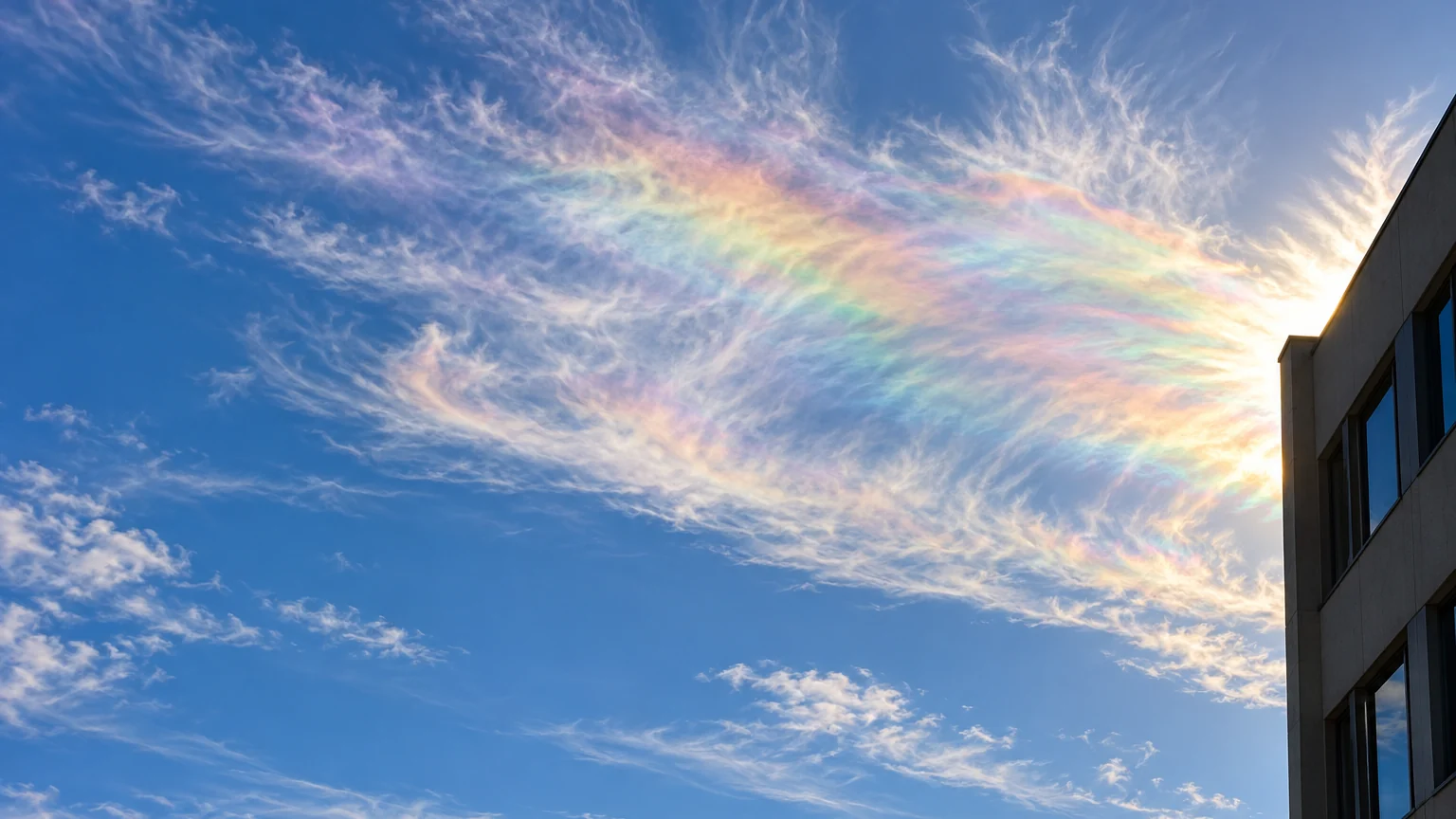
Some clouds show pastel rainbow colors because sunlight is diffracted by tiny water droplets or ice crystals in a thin cloud. This effect, called cloud iridescence, is easiest to see when particles are small and similar in size and the cloud is near the Sun. It differs from a rainbow, which forms in raindrops.
How cloud iridescence makes color
When sunlight encounters very small cloud particles, light waves bend and spread around them. Diffraction can separate white light into faint colors. If the droplets or crystals are similarly sized, the colors may form bands that follow the cloud’s outline. NOAA notes that semi-transparent clouds and clouds just forming are especially likely to show iridescence. [1]
Why it appears near the Sun
Iridescence often appears in thin clouds near the Sun or Moon, but the bright solar disk can overwhelm it. Never look directly at the Sun to find the colors. Use a building or other safe obstruction to block the disk and observe the nearby cloud. [2]
Is it the same as a rainbow?
No. Cloud iridescence mainly involves diffraction around tiny particles. A rainbow forms when sunlight refracts, reflects inside, and exits larger raindrops. Thin clouds can show several optical effects; compare this with how a rainbow forms and why halos surround the Moon.
Frequently asked questions
Frequently asked questions
Are rainbow clouds the same as rainbows?
No. Cloud iridescence is mainly diffraction around tiny cloud particles; rainbows form in raindrops.
Can cloud iridescence happen near the Moon?
Yes, though moonlit colors are usually much fainter than those seen in sunlight.
Is it a warning sign?
No. It is an optical effect and does not mean a storm or other hazard is certain.
Sources and evidence
- NOAA NESDIS — What Are Rainbow Clouds? ↗
Explains cloud iridescence and the role of tiny particles.
- World Meteorological Organization — Iridescence ↗
Defines cloud iridescence and its appearance.
- National Weather Service — Iridescence ↗
Describes diffraction by small cloud particles.
Sources consulted: 2026-10-18. Written with AI assistance and checked against the linked references; not independently reviewed by a subject specialist. Sources do not endorse this article. See our editorial policy.
Revision: Initial editorial draft prepared 18 October 2026; claims are tied to linked sources and retain stated limitations.