
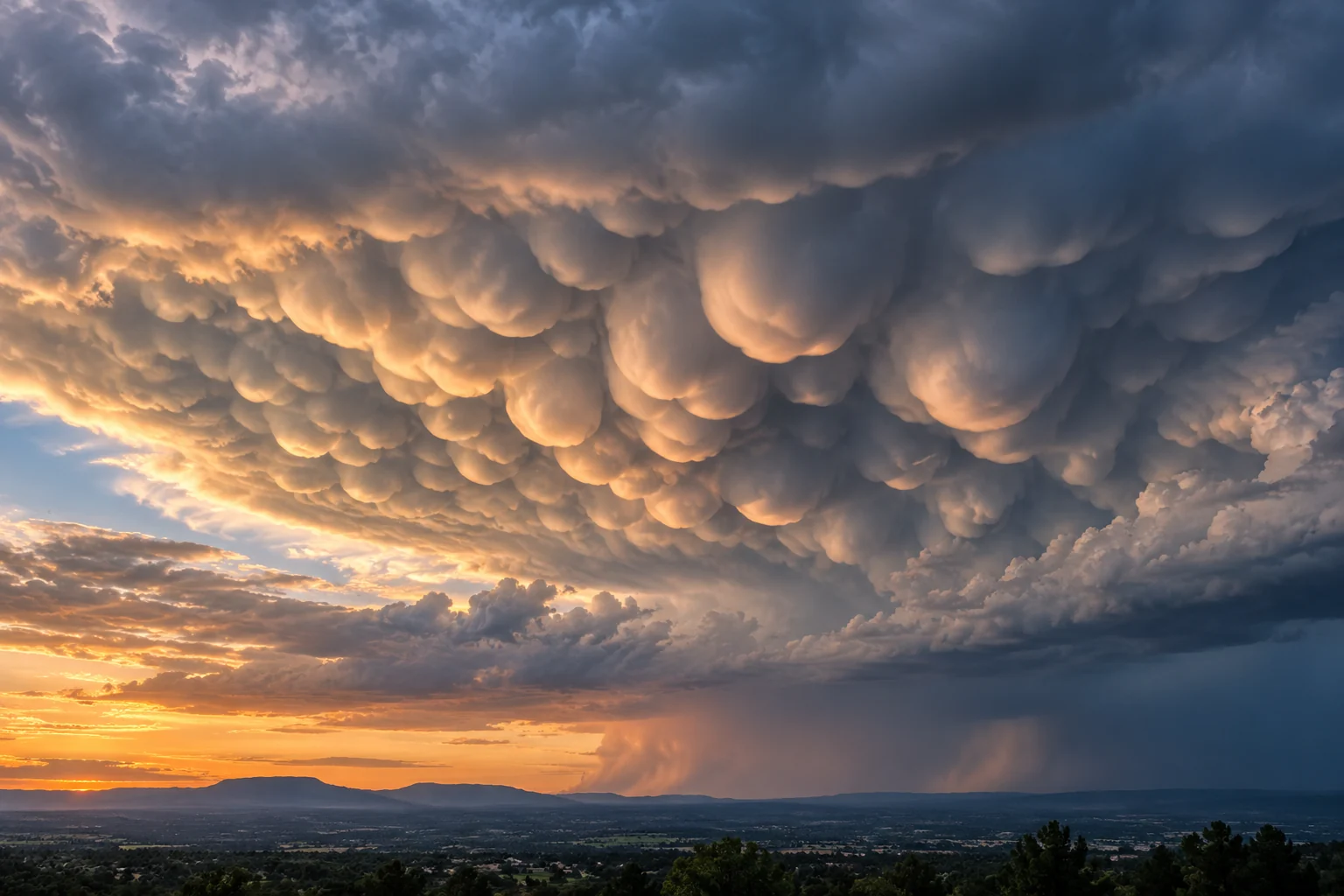
Mammatus clouds form rounded, pouch-like bulges beneath a cloud base, often under a thunderstorm anvil. Their exact formation can vary, but sinking air and evaporation near the cloud base are part of leading explanations. Mammatus are not tornado funnels, and seeing them does not by itself mean a tornado will form.
What mammatus clouds look like
Mammatus is a cloud feature, not a separate cloud genus. Rounded lobes hang from the underside of a cloud and may appear beneath several types, especially the flat anvil spreading from a thunderstorm. Low-angle sunlight can make the pouches look dramatic. [1]
How the pouches may form
There is no single explanation that accounts for every display. A leading account involves cloudy air descending into a drier layer. Evaporation cools the air, making it denser and helping shape pockets that sink below the cloud base. NASA describes mammatus as forming where sinking air is cooler than the surrounding air; researchers continue to study the details. [2]
Do mammatus clouds mean a tornado is coming?
No. Mammatus can accompany severe thunderstorms but can also appear with non-severe storms. They are not a reliable tornado warning. Use official alerts and storm reports, not a cloud shape alone. See other atmospheric displays in blue jets and red sprites and green skies before storms.
Frequently asked questions
Are mammatus clouds dangerous?
The shape itself is not hazardous. It can occur near thunderstorms, so check local alerts.
Do mammatus clouds cause tornadoes?
No. Mammatus are pouches under a cloud base, not tornadoes, and do not predict one by themselves.
Why do they look like bubbles?
Cloud-base processes create rounded lobes that bulge downward; details vary and remain under study.
Sources and evidence
- NOAA — Weather Glossary: Mammatus Clouds ↗
Defines mammatus and notes that they can accompany severe or non-severe storms.
- NASA — Mammatus Clouds over Oklahoma ↗
Describes cool sinking air and the cloud feature.
- National Weather Service — Tornado Look-alikes ↗
Distinguishes mammatus from tornado features.
Sources consulted: 2026-10-18. Written with AI assistance and checked against the linked references; not independently reviewed by a subject specialist. Sources do not endorse this article. See our editorial policy.
Revision: Initial editorial draft prepared 18 October 2026; claims are tied to linked sources and retain stated limitations.