
An early warning system can save lives by turning observations and forecasts into timely instructions people can act on. It needs more than a weather alert: risk knowledge, monitoring, clear communication and preparedness must work together. A new WMO–UNDRR report says 136 countries reported some multi-hazard warning capability by August 2026, but comprehensive coverage remains uneven.
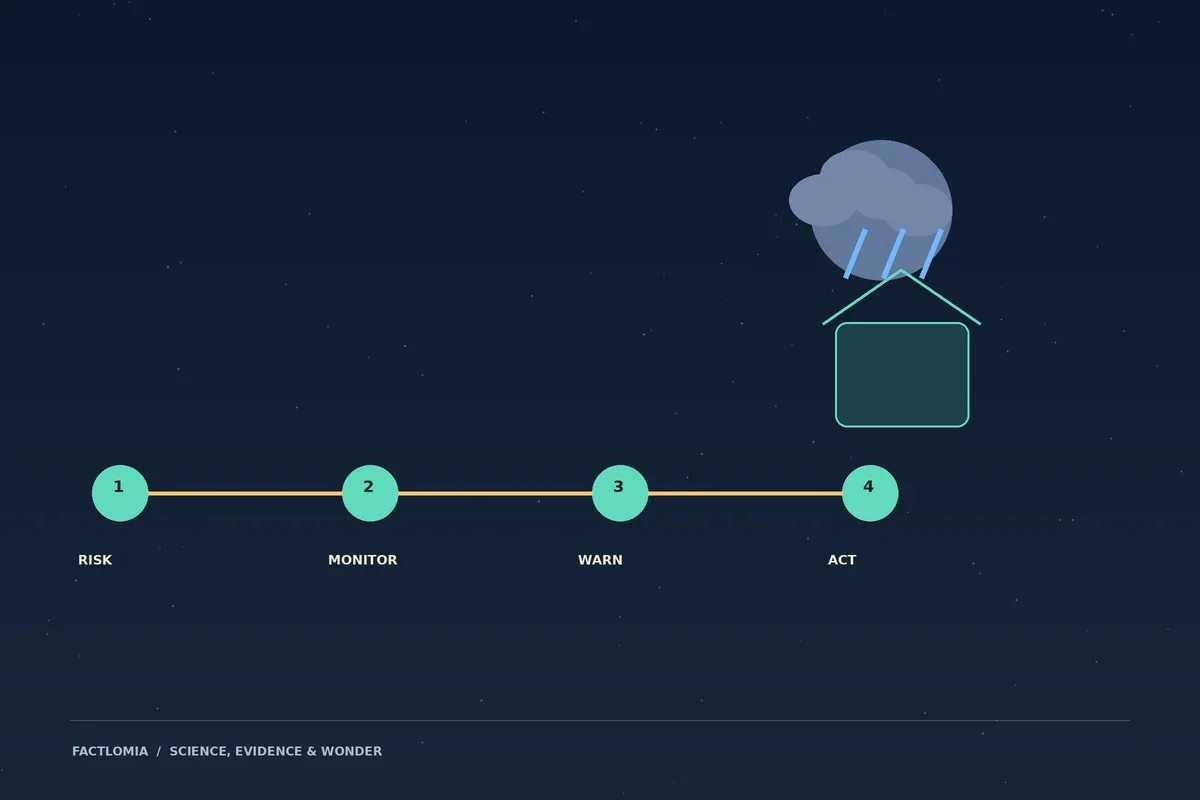
Four links connect a forecast to action
A warning system begins with understanding which people and places are exposed to hazards. Monitoring networks then detect changing conditions, while forecasting turns observations into estimates of risk. Authorities and trusted local channels must communicate the warning in language people can understand, and communities need plans to respond.
A missing link can weaken the whole chain. A precise forecast is of little use if it arrives too late, does not reach remote households, or gives no clear action to take. The WMO–UNDRR report assesses these connected capabilities rather than treating a siren or phone alert as a complete system. [1]
What the new global report found
The 2026 report says 136 countries—about 70%—reported some multi-hazard early warning capability as of August. That is a substantial increase since reporting began in 2015, but fewer than half of reporting countries showed capability across all four pillars. The report also identifies major gaps among countries and communities facing high disaster risk. [1]
In countries with more comprehensive warning systems, disaster-related mortality was reported to be 6.1 times lower and the number of people affected 3.2 times lower than in countries with limited-to-moderate systems. These are associations across country groups, not a guarantee that one warning system alone caused the difference. [2]
Warnings need to arrive with resources
People may need transport, shelters, accessible information, money, or help protecting livestock and equipment. The report notes that anticipatory-action frameworks are increasingly used to release support before a hazard hits. In 2025, 146 anticipatory-action activations across 54 countries directly reached 9.6 million people, backed by pre-arranged financing. [2]
Forecasts become protection when agencies, communities and funding are prepared before the emergency. That is why access and action matter as much as technical accuracy.
FAQ: disaster alerts
Is a phone alert enough? No. Alerts work best when they are trusted, accessible and linked to practical actions and response plans.
Do early warnings prevent every disaster loss? No, but timely, understandable warnings can help reduce exposure and improve preparation.
Sources and evidence
- WMO and UNDRR — Global Status of Multi-Hazard Early Warning Systems 2026 ↗
Report’s four-pillar framework and international coverage findings.
- WMO and UNDRR — Early warning protection expands worldwide ↗
Country coverage, mortality association and anticipatory action figures.
Sources consulted: 11 November 2026. Written with AI assistance and checked against the linked references; not independently reviewed by a subject specialist. Sources do not endorse this article. See our editorial policy.
Revision: Initial publication. Current claims and limits were checked against the linked research and institutional sources.