
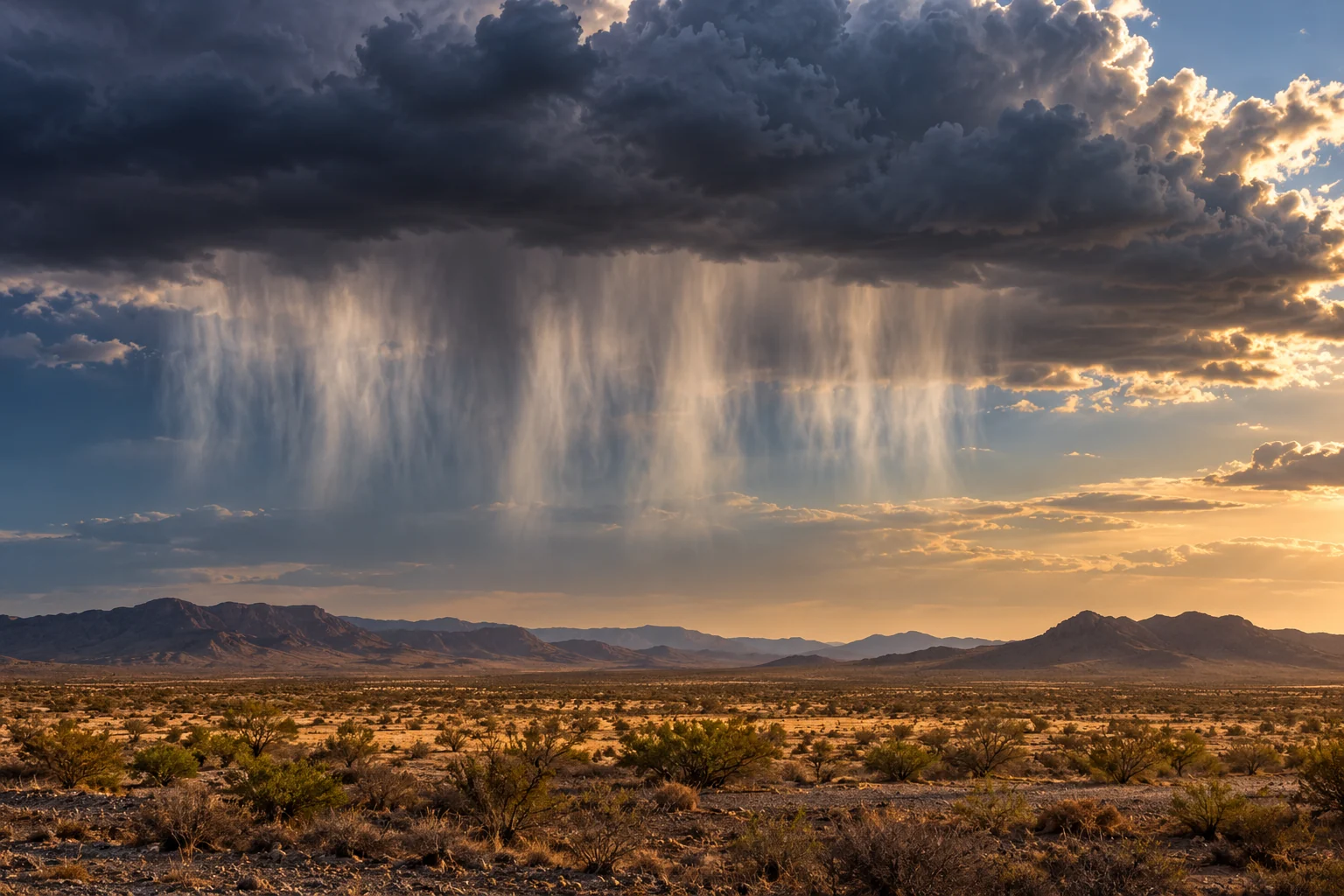
Virga is rain, snow, or other precipitation that falls from a cloud but evaporates or sublimates before reaching the ground. It appears as wisps or streaks beneath a cloud. The air below the cloud is often dry enough to absorb the falling moisture before it reaches the surface.
Why does precipitation disappear in midair?
As raindrops or snowflakes fall through dry air, some liquid water evaporates or ice changes directly into water vapor. This change of state takes energy from the surrounding air and cools it. If the dry layer is deep or precipitation is light, the particles can vanish before reaching the ground. The National Weather Service calls these streaks virga. [1]
Can virga affect the weather below it?
Virga is not a cloud type or a forecast by itself. Evaporation can cool air and contribute to a downdraft. In a thunderstorm, a strong downdraft may spread out at the surface as a downburst; not every virga shaft leads to one. The National Weather Service describes virga as common in dry regions, including parts of the western United States. [2]
How is virga different from rain?
Rain reaches the ground; virga does not. Radar may detect precipitation aloft even when no rain is falling at the observer’s location. For related explanations, read about raindrop speed and why rain can smell earthy.
Frequently asked questions
Frequently asked questions
Is virga dangerous?
Virga itself is not a warning. In a thunderstorm, evaporative cooling may contribute to strong downdrafts, so follow official weather alerts.
Can virga be snow?
Yes. Snow or ice particles can also evaporate or sublimate before reaching the ground.
Where is virga common?
It is often seen under clouds over dry regions, including the western United States, but can occur anywhere the lower air is dry.
Sources and evidence
- National Weather Service — Virga ↗
Defines virga as precipitation that evaporates before reaching the ground.
- National Weather Service — Virga Explained Graphically ↗
Shows how a dry layer can evaporate rain or snow.
- National Weather Service — Downbursts ↗
Explains evaporative cooling and dry downbursts.
Sources consulted: 2026-10-18. Written with AI assistance and checked against the linked references; not independently reviewed by a subject specialist. Sources do not endorse this article. See our editorial policy.
Revision: Initial editorial draft prepared 18 October 2026; claims are tied to linked sources and retain stated limitations.