
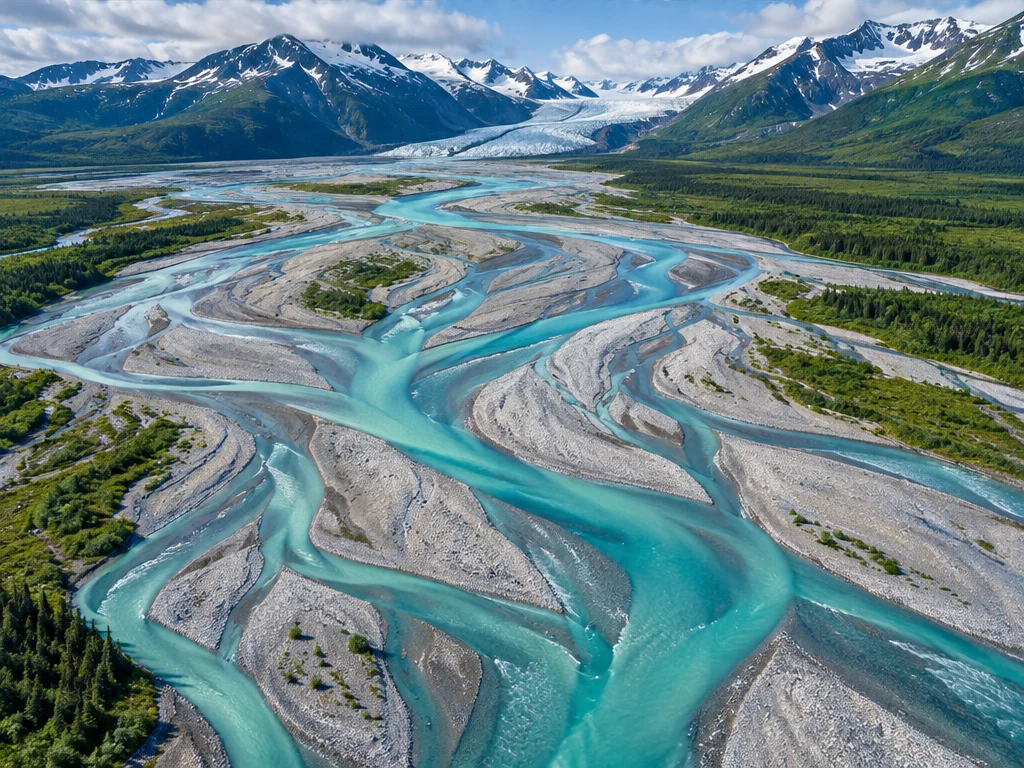
A braided river divides into several moving channels around bars of gravel or sand. The branches separate and rejoin downstream. Braiding often develops where a river receives a heavy supply of sediment and has space to shift across a broad bed.
How a gravel bar redirects the current
When a river carrying gravel loses the ability to move some of its load, sediment settles onto the bed. The deposit can grow as more material collects nearby. As it becomes shallower over the bar, water runs around its edges and divides into separate channels. The branches often come together just downstream. [1]
Why braided rivers are common near glaciers
Meltwater emerging from a glacier may carry large amounts of sand, gravel and rock flour. On a broad outwash plain, the stream can spread, deposit some of that load and cut new paths around it. Denali National Park in Alaska offers an example of this shifting landscape. [1] [2]
Why the pattern keeps changing
As discharge rises, flowing water can cover the bars, erode them or rebuild them in new places. When the river falls, the reshaped bars emerge and expose a different network of channels. An aerial photo captures one arrangement in a continually changing riverbed. [1]
Read also why two rivers can stay visibly separate after meeting.
Frequently asked questions
Is a braided river the same as a delta?
Braids can develop along a river’s course. A delta forms where a river deposits sediment as it enters a body of standing water.
Do all braided rivers come from glaciers?
Glacial rivers often braid, and abundant sediment can create the same pattern in other settings.
Sources and evidence
- National Park Service — Fluvial Features: Braided Stream ↗
Braided channel geometry, formation of gravel bars and the Denali example.
- National Park Service — Outwash Plains and Eskers ↗
The link between glacial meltwater and braided rivers on outwash plains.
Sources consulted: 28 November 2026. Written with AI assistance and checked against the linked references; not independently reviewed by a subject specialist. Sources do not endorse this article. See our editorial policy.
Revision: Initial publication.