
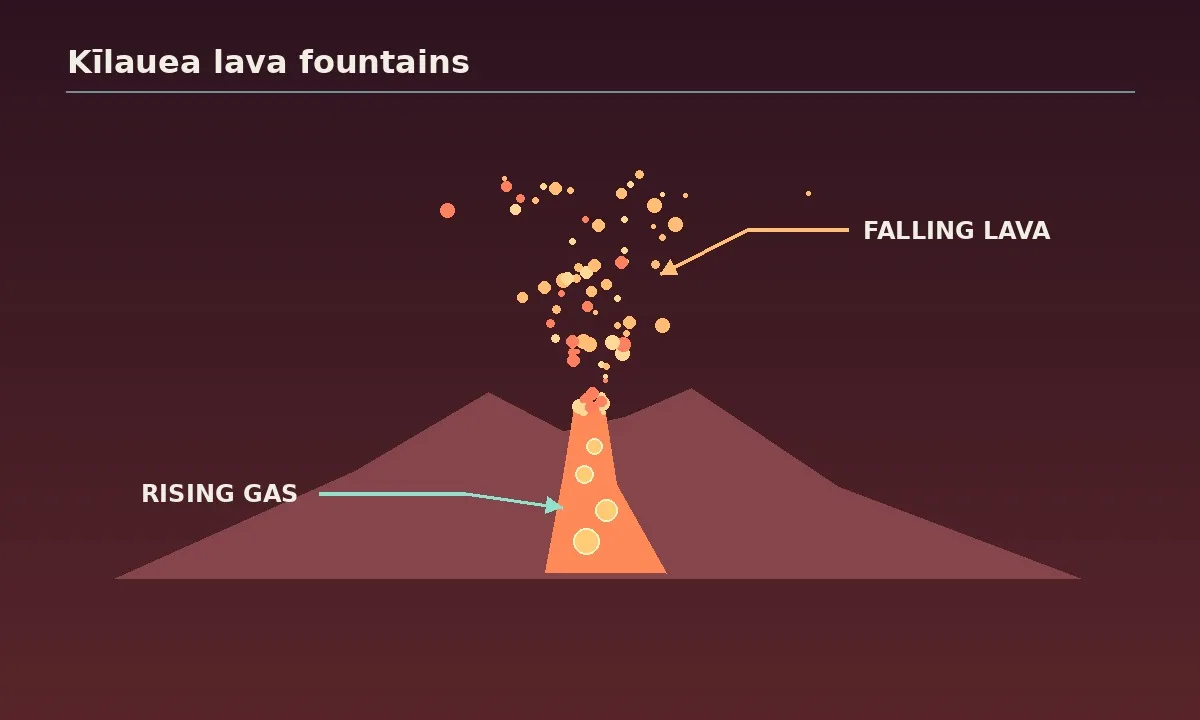
A Kīlauea lava fountain forms when expanding volcanic gas drives molten basalt upward through a vent. Episode 56 of the Halemaʻumaʻu summit eruption ended at 6:01 p.m. Hawaiʻi time on November 5, 2026.
From bubbles to a fountain
Deep underground, pressure keeps some gas dissolved in magma. As magma rises and pressure falls, gas comes out of solution. Growing bubbles carry and accelerate liquid lava toward the vent. At the surface the escaping gas can throw glowing droplets and blobs into the air. [3]
What happened in November?
Episode 56 began at 12:10 p.m. Hawaiʻi time on November 5 and ended at 6:01 p.m. that evening. USGS updates through November 11 described typical post-fountaining recovery; the visible surface fountain had stopped, while observations still found moving lava below the vent rims. These are dated observations, not a forecast of future activity. [1] [2] [4]
A pause can conceal motion below
The visible fountain depends on how much lava and gas are reaching the opening, how fast they move and the shape of the vent. A quiet view from the crater rim tells observers about the surface at that moment. USGS updates also draw on measurements and observations from inside the crater. [2]
Frequently asked questions
Is every glowing fragment ash?
Lava fountains can eject a range of sizes, from fine particles to much larger blobs of molten rock.
Where can I check whether the eruption is active today?
Use the live USGS update page. The November 5 observations describe one episode of an evolving eruption.
Sources and evidence
- USGS Hawaiian Volcano Observatory ↗
Timing, vent location and observations from episode 56.
- USGS Kīlauea volcano updates ↗
Post-episode observations and links to current conditions.
- USGS Hawaiian Volcano Observatory lava fountain analysis ↗
How magma properties and gas affect fountain height.
- USGS Volcano Notice, November 11, 2026 ↗
Post-episode tilt observations and recovery status reported after episode 56.
Sources consulted: 13 November 2026. Written with AI assistance and checked against the linked references; not independently reviewed by a subject specialist. Sources do not endorse this article. See our editorial policy.
Revision: Updated on 13 November 2026 to distinguish the November 5 eruption episode from the latest dated USGS status available in the cited notice.