
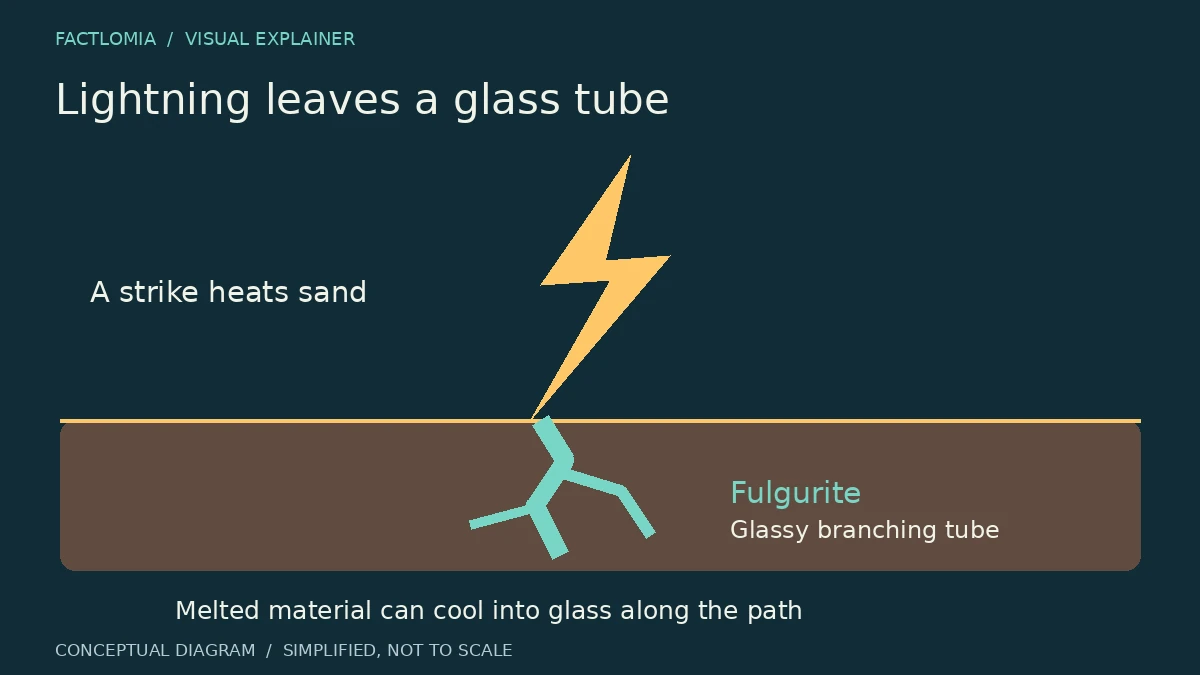
Lightning can melt and fuse mineral grains along its path through the ground. When the melted material cools, it can form natural glass called a fulgurite. In sandy ground, fulgurites often resemble fragile, branching tubes with a glassy interior and a rough exterior. They are traces of intense heating, rather than a preserved electrical bolt.
A brief burst of concentrated heat
A lightning discharge deposits energy along a narrow path. In suitable sand, this can heat the mineral grains enough to melt them. The surrounding grains may partly fuse while the material nearest the channel is more strongly transformed. [1]
Cooling preserves a branching path
As the molten material cools, it solidifies into glass. Sand fulgurites can have a hollow center and branches that follow the discharge through the ground. Their shape depends on the lightning path and ground conditions, so no two specimens need look alike. [2]
Natural glass does not have to look clear
A fulgurite is often rough, dark, and covered in attached grains. Its glassy inner surface may be easier to recognize than its exterior. A lightning strike can also form glassy coatings or veins on rock, rather than a long tube in loose sand. [2]
Why every strike leaves no obvious tube
Finding a fulgurite requires suitable material, enough concentrated energy, and preservation after formation. The tubes can break easily, and many remain buried. Their absence at the surface does not prove that an area has never been struck by lightning. [1]
Keep exploring: why cooling lava forms basalt columns.
Sources and evidence
- National Park Service — Fulgurites: The Power of Lightning ↗
Lightning heating and fusion of sand into natural glass.
- Utah Geological Survey — What Are Fulgurites? ↗
Sand and rock fulgurites, branching tubes, glassy interiors, and fragile structures.
Sources consulted: 2026-10-28. Written with AI assistance and checked against the linked references; not independently reviewed by a subject specialist. Sources do not endorse this article. See our editorial policy.
Revision: First published 28 October 2026. Sources checked and original explanatory graphic added.