
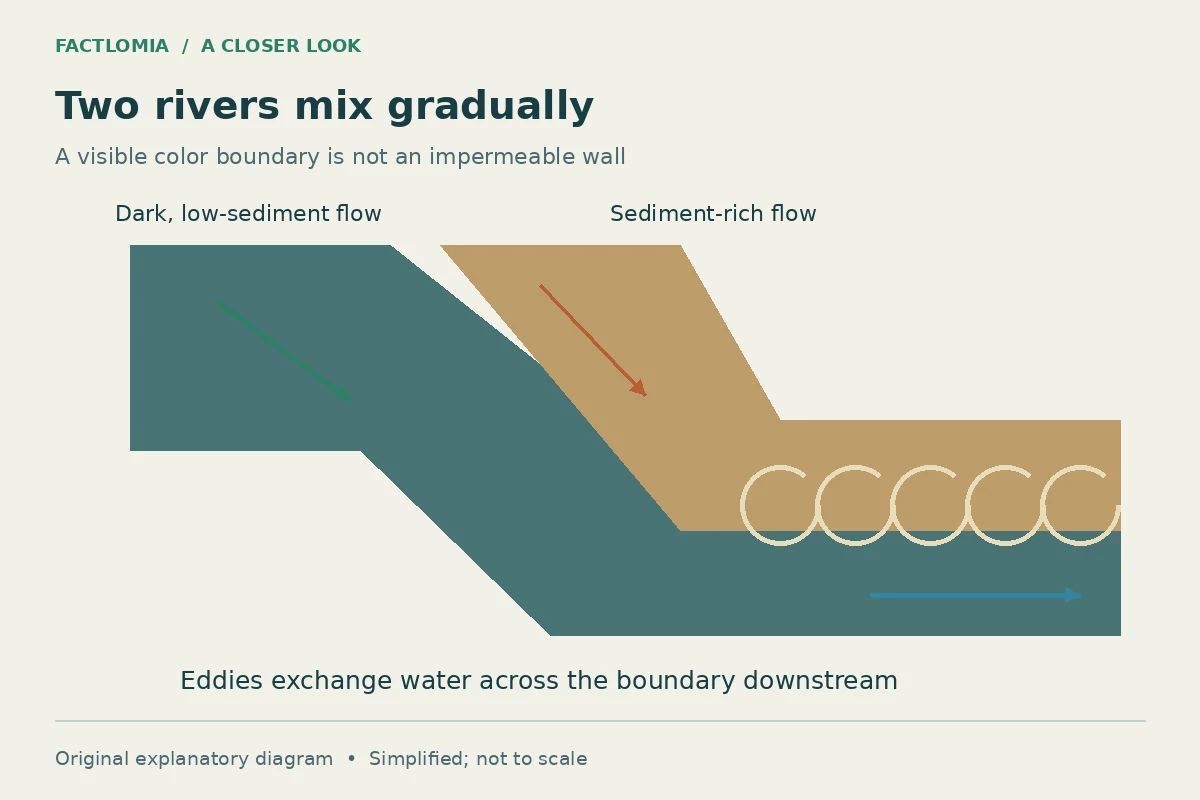
Two rivers can flow beside each other for a distance because mixing across their boundary takes time. Differences in sediment, dissolved material, temperature, and flow make the contrast visible and affect circulation. The water does mix; a sharp-looking line does not mean there is an invisible wall.
Why the colors can be so different
At Brazil’s Meeting of the Waters, the dark Rio Negro joins the tan Rio Solimões. NASA explains that the Negro’s tea-like color comes from decayed vegetation, while the Solimões carries abundant suspended sediment. Their visible colors therefore trace different material carried by the flows. Dark water is not automatically dirtier, and tan water is not automatically more polluted. [1]
Why the boundary survives downstream
Most of the water is moving along the channel rather than instantly crossing from one side to the other. Turbulent eddies transfer water and its contents across the interface. The flow speeds, channel shape, water depths, and density differences influence that exchange. Density matters, but it is not a universal explanation that prevents mixing: the river geometry and three-dimensional circulation matter too. [1], [2]
A visible line is not an impermeable barrier
The satellite image discussed by NASA shows irregular features along the contact zone, with eventual mixing driven by eddies. Even when a photograph seems to show two solid bands, exchange can be happening beneath the surface and at smaller scales. A single image cannot tell us the exact downstream distance required for complete mixing. [1], [2]
Is this the same as oil and water?
No. The two rivers are both water carrying different substances. They are not two immiscible liquids. A more useful comparison is two differently colored streams stirred together gradually while both continue moving forward. Mixing across a river differs from the seasonal vertical mixing described in why lakes turn over in fall. Color can also have several causes, as in why the ocean looks blue.
Sources and evidence
- NASA Earth Observatory — Meeting of the Waters ↗
Color sources and eventual turbulent mixing at the Negro–Solimões confluence.
- Ramón et al. — Mixing dynamics at a large river confluence ↗
Research on density contrasts and three-dimensional mixing dynamics.
Sources consulted: 2026-10-21. Written with AI assistance and checked against the linked references; not independently reviewed by a subject specialist. Sources do not endorse this article. See our editorial policy.
Revision: First published 21 October 2026. Source-linked explanation and original diagram.