
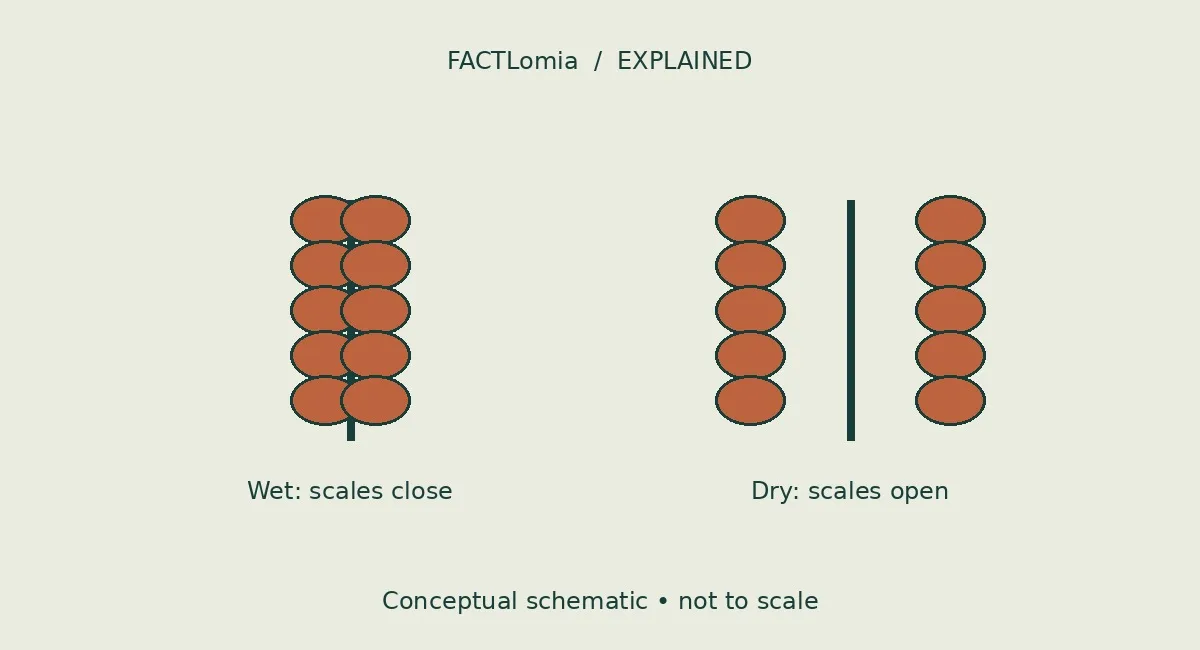
Many mature pine cones close when wet because their scales absorb water and change shape unevenly. This passive mechanical response can continue after a cone has fallen: it does not require muscles, nerves, or ongoing growth.
Moisture bends the scales
A cone scale contains tissues with different structures and responses to moisture. When one region changes dimensions more than another, the scale bends. Drying reverses much of that deformation, allowing the scales to spread. The familiar two-layer comparison is useful, but newer experiments show that the tissues interact in a more complicated way than a perfectly rigid layer attached to a swelling one. [1, 2]
Why closing can help seeds
Open scales give winged seeds a route out of the cone. Dry conditions generally favor wind dispersal, while wet scales close around the remaining seeds. That does not mean every cone follows the same schedule: species, maturity, resin seals, and previous drying all matter. A cone that stays shut may not simply be waiting for a lower humidity reading. [1]
Try a repeatable observation
Place a fallen, open cone in a shallow dish of water and photograph it before and after wetting. Then let it dry at room temperature and photograph it again. Compare the spacing of the scales rather than expecting an instant response. This is a demonstration of moisture-driven shape change, not evidence that the cone is alive or making a decision.
Can a dead cone still move?
Yes. Water absorption and loss can deform nonliving plant tissue. Movement alone is not a test for life.
Do all cones open in dry weather?
No. Species and maturity differ, and resin-sealed cones can require additional conditions before their first opening.
Keep exploring
Continue with How Do Plants Sense Gravity? and Do Plants Sleep at Night? Many Change Position on a Daily Clock.
Sources and evidence
- Royal Society — Hygromorphs ↗
Experiments and mechanics of moisture-driven cone movement.
- TU Darmstadt — New insights into cone scales ↗
Updated explanation of interacting tissues and passive actuation.
Sources consulted: 15 October 2026. Written with AI assistance and checked against the linked references; not independently reviewed by a subject specialist. Sources do not endorse this article. See our editorial policy.
Revision: Initial publication; factual claims checked against linked sources.