
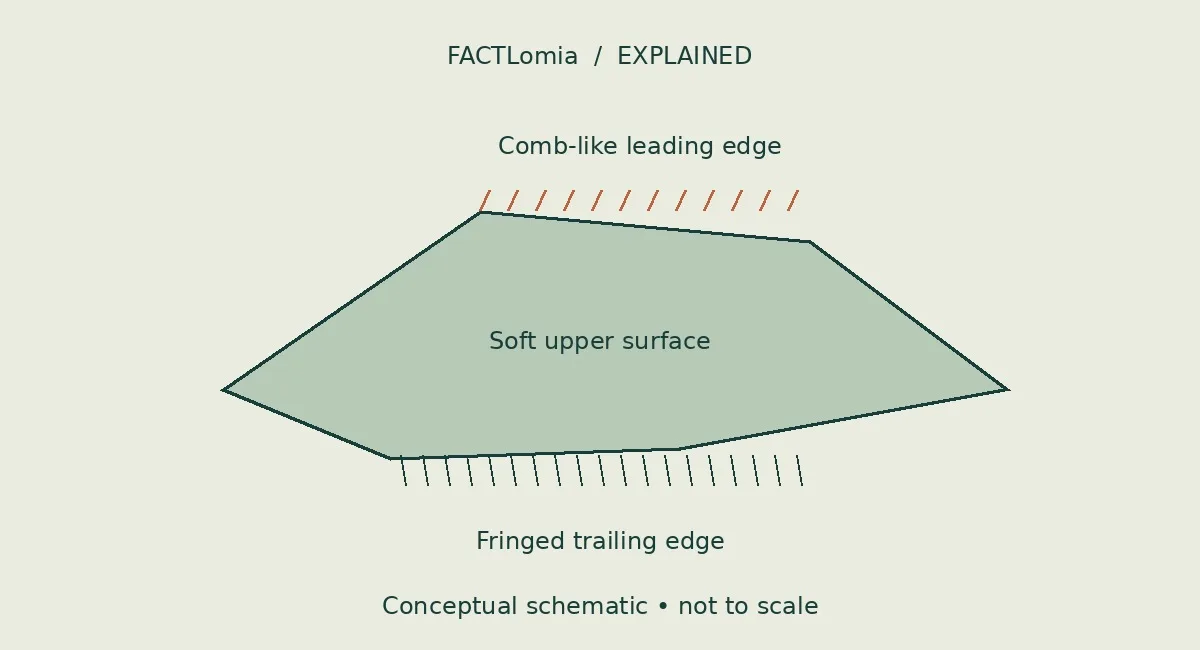
Some owls fly unusually quietly because their wings and feathers reduce several sources of sound. Comb-like leading edges, fringed trailing edges, and soft upper surfaces are associated with quiet flight. “Silent” is a comparison, not a claim that every owl makes zero sound at every speed.
Several features work at different places
A wing creates sound through interactions between moving air and its surface and edges. Owl feathers include serrations near the leading edge, a compliant fringed trailing edge, and a velvet-like surface. Researchers investigate how those features alter airflow and suppress noise, rather than treating the wing as a single sound-absorbing blanket. The contribution of each feature can depend on species and flight conditions. [1]
Quiet flight may help both hunter and listener
One hypothesis is stealth: a quieter owl gives prey less warning. Another is reduced self-masking: making less flight noise could help the owl hear faint prey sounds. These explanations are compatible, and a review cautions against assuming that every feather feature serves only one aerodynamic purpose. Evolutionary benefit and immediate physical mechanism are related but different questions. [2]
Why a video may exaggerate the silence
Imagine comparing a close microphone beside a flapping bird with one farther from a gliding bird. The sound levels would not isolate feather design. Fair comparisons require similar distances, speeds, and recording conditions. A striking clip can introduce the phenomenon, but it cannot show that the bird is literally inaudible to every listener.
Do all owls have equally quiet flight?
No. Feather specializations and hunting styles vary among owl species. A general statement about “owls” hides those differences. [2]
Are owls the only quiet-flying birds?
No. Comparative research discusses other birds with relatively quiet flight. Claims of absolute uniqueness need careful qualification. [2]
Can engineers copy the feathers?
Researchers test owl-inspired surfaces and edges for noise reduction. Translating a biological feature into a turbine or aircraft involves different speeds, structures and performance constraints. [3]
Keep exploring
Continue with How Do Noise-Canceling Headphones Reduce Sound? and How Do Bats Avoid Colliding With Each Other?.
Sources and evidence
- Royal Society — Features of owl wings that promote silent flight ↗
Feather morphology and proposed noise-reduction mechanisms.
- Integrative Organismal Biology — Evolution and ecology of silent flight ↗
Comparative evidence, stealth and self-masking hypotheses.
- University of Cambridge — Silent flights ↗
Research on engineered surfaces inspired by owl wings.
Sources consulted: 15 October 2026. Written with AI assistance and checked against the linked references; not independently reviewed by a subject specialist. Sources do not endorse this article. See our editorial policy.
Revision: Initial publication; factual claims checked against linked sources.