
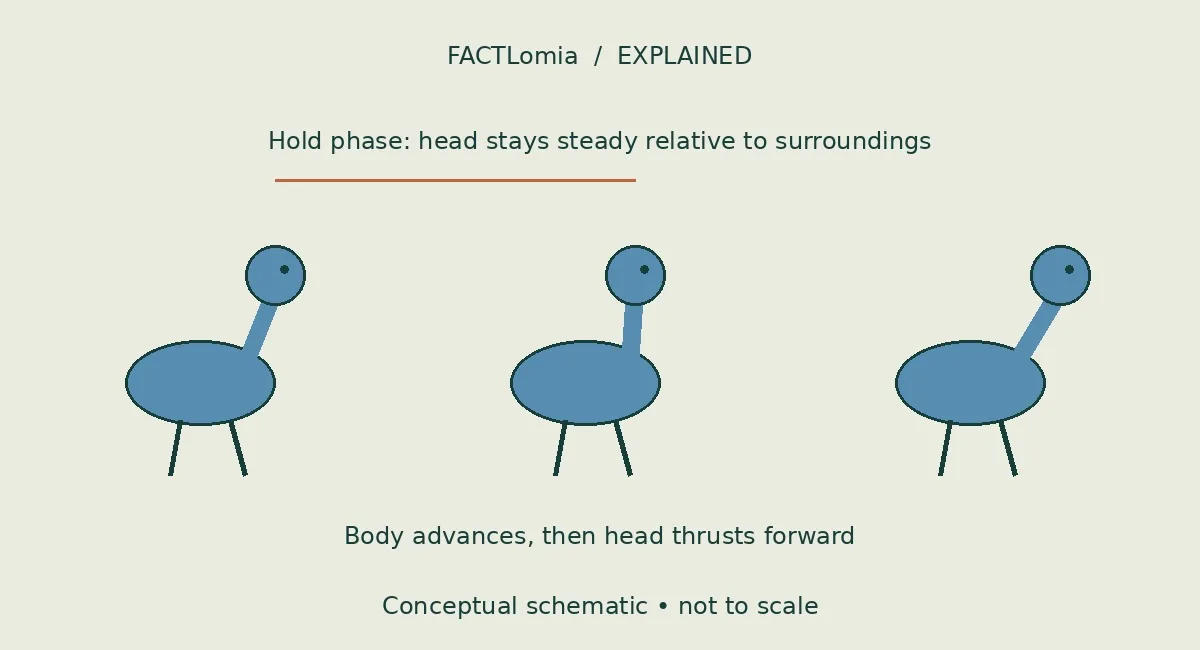
Pigeons bob their heads largely to stabilize their view while moving. What looks like continuous backward-and-forward motion includes a phase when the head stays nearly still relative to the surroundings as the body advances, followed by a quick forward thrust.
Watch the head relative to the ground
During the hold phase, the pigeon’s body catches up with the head. Relative to its body, the head seems to move backward; relative to the world, it remains much steadier. The next thrust moves the head to a new viewing position. Choosing the correct reference frame turns an apparently odd motion into a useful visual strategy. [1, 2]
A treadmill separates walking from visual motion
In classic treadmill work, pigeons could walk while their surroundings stayed comparatively stationary. The usual head-bobbing was reduced or absent under the appropriate conditions. That supports a role for visual information rather than a rigid mechanical link requiring the head to move with every footstep. Walking and head movement often occur together, but coincidence alone would not identify the cause. [1]
Film a pigeon without disturbing it
A short side-on video can make the hold phase easier to see. Choose a stationary landmark in the background and compare the head position from frame to frame. Keep your distance and let the bird walk normally. Moving the camera with the pigeon changes the reference frame and can hide the very pause you are trying to notice.
Is the head moving backward?
It moves backward relative to the advancing body during the hold phase, but stays nearly fixed relative to the surroundings. That distinction explains much of the illusion.
Do all birds do this?
No. Species differ in head-bobbing behavior. The broader differences involve locomotion, anatomy and visual strategies; one simple rule does not explain every bird. [1]
Is vision the only system that steadies the head?
No. Research on pigeon head stabilization also considers vestibular and other sensory feedback. The contribution depends on the type of movement being studied. [2]
Keep exploring
Continue with How Do Hummingbirds Hover in Midair? Their Wings Make Lift Twice and How Do Woodpeckers Peck Without Brain Damage?.
Sources and evidence
- Library of Congress — Why pigeons bob their heads ↗
Public question, hold/thrust phases and treadmill evidence.
- Frontiers in Neuroscience — Head stabilization in pigeons ↗
Experiments on visual and other feedback during head stabilization.
Sources consulted: 15 October 2026. Written with AI assistance and checked against the linked references; not independently reviewed by a subject specialist. Sources do not endorse this article. See our editorial policy.
Revision: Initial publication; factual claims checked against linked sources.