
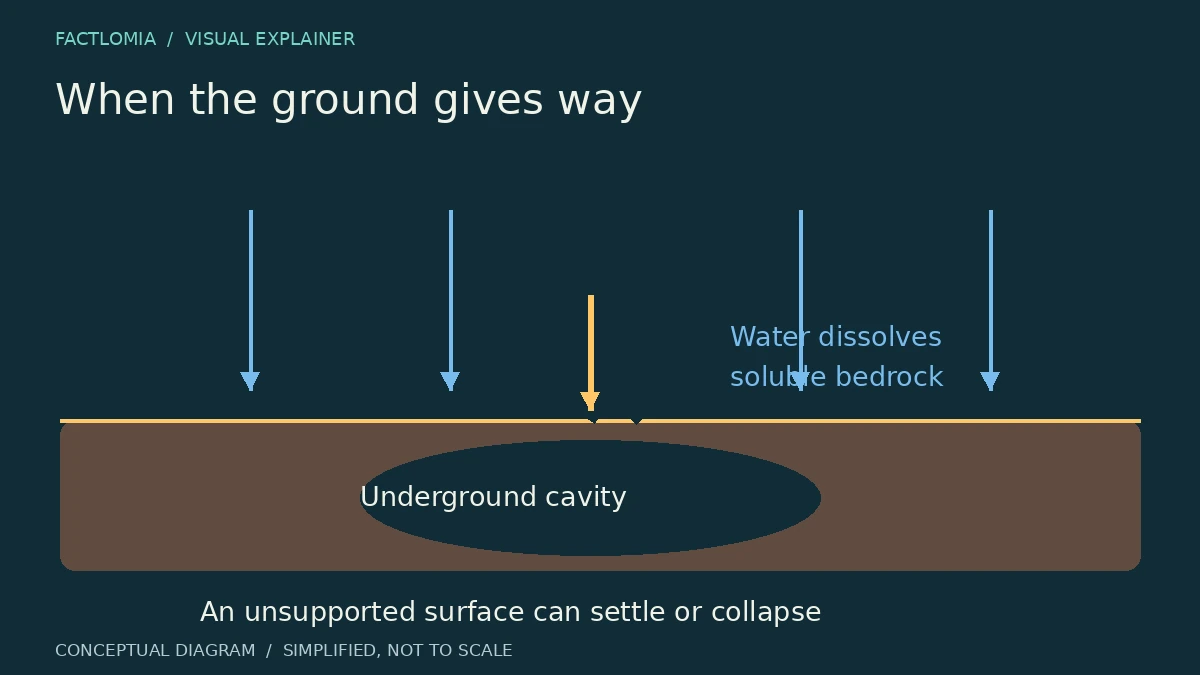
A sinkhole forms when the ground surface sinks into an underground opening or when the material supporting it is removed. In karst regions, groundwater dissolves rocks such as limestone, gypsum, or salt and creates cavities. Soil can slowly settle into openings, or a cavity roof can fail suddenly. Human activity, including groundwater pumping or changes in drainage, can also contribute in susceptible areas.
Water can dissolve rock below ground
Rainwater absorbs carbon dioxide from soil and becomes weakly acidic. As groundwater moves through soluble bedrock such as limestone, dolomite, gypsum, or salt, it enlarges cracks and may form underground openings. Landscapes shaped by this process are called karst. [1][2]
A cavity can undermine the surface
As an underground opening grows, soil or rock above it may gradually slump downward. In some places, loose sediment slowly filters into the opening and creates a shallow depression. Elsewhere, a stronger roof bridges the cavity for a time and then collapses when it can no longer support the load. The surface can look stable until that failure. [1]
Why some sinkholes appear suddenly
Cover-collapse sinkholes can develop quickly when a cavity roof fails beneath clay-rich sediment. Other sinkholes develop gradually and may go unnoticed. Lowering groundwater levels can remove some of the support supplied by water pressure, and construction or altered drainage can change stresses and water movement. These factors can trigger collapse where underground conditions are already vulnerable; they do not make every location equally susceptible. [1]
Not every round hole is the same
USGS defines a sinkhole as a depression with no natural external surface drainage. A steep-sided collapse hole, a shallow solution depression, and a ponded sinkhole can look very different. The shape alone does not reveal the cause. For another water-shaped landscape feature, read how cave formations grow.
Frequently asked questions
Do sinkholes happen only in Florida?
No. They are especially common where soluble rocks occur, including limestone, gypsum, and salt beds, in many regions.
Can heavy rain cause a sinkhole?
Water can dissolve rock and move sediment, while flooding or changed drainage may contribute in susceptible terrain. A single rainstorm does not mean a sinkhole will form everywhere.
Can people cause sinkholes?
Groundwater pumping, construction, and altered drainage can contribute to sinkholes where underground conditions are vulnerable.
Sources and evidence
- U.S. Geological Survey — Sinkholes ↗
Explains soluble bedrock, cavity formation, sinkhole types, and human contributions.
- U.S. Geological Survey — What Is a Sinkhole? ↗
Defines a sinkhole and describes karst terrain and groundwater dissolution.
Sources consulted: 2026-10-27. Written with AI assistance and checked against the linked references; not independently reviewed by a subject specialist. Sources do not endorse this article. See our editorial policy.
Revision: First published 27 October 2026. Original explanatory diagram; claims checked against linked sources.