
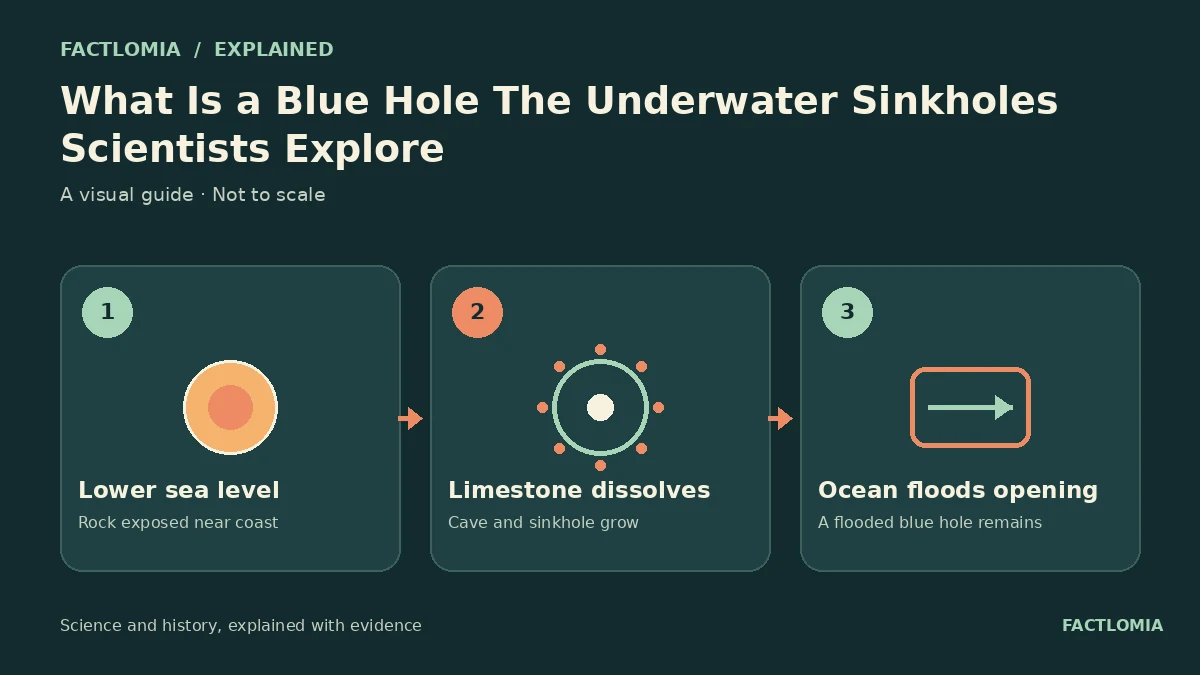
A blue hole is a deep, water-filled sinkhole or cave, often found in coastal or shallow marine areas. Many developed in limestone when lower sea levels exposed rock to rainwater, which slowly dissolved it. Rising seas later flooded the openings. Their depths and shapes vary, and some remain difficult to explore.
Limestone can dissolve underground
Rainwater absorbs carbon dioxide from air and soil and becomes mildly acidic. Over long periods, it can dissolve limestone and enlarge cracks into caves and sinkholes. During ice ages, global sea levels fell, exposing parts of today’s seabed. Some coastal cave systems formed or expanded during those lower sea levels. [1]
Rising seas flood the cave systems
When sea level rose, water filled many of those caves and sinkholes. From above, a deep opening can appear dark blue against brighter shallow water, giving the feature its name. A blue hole may include vertical shafts, overhangs, and connected passages; it is not necessarily one simple cylindrical pit. [2]
Why scientists explore them
Blue holes can preserve layers of sediment, freshwater, and marine conditions that help scientists study environmental history. They can also contain low-oxygen water and tight passages, making exploration technically challenging. NOAA expeditions have investigated blue holes in the Gulf of Mexico to map their structure and understand their ecology. [2]
Frequently asked questions
Are blue holes the same as sinkholes?
Many are underwater sinkholes or flooded cave systems, though their exact geology and shape vary.
Why does the water look dark blue?
A deep opening absorbs or scatters light differently from bright shallow surroundings, creating a strong color contrast.
Can people safely dive into a blue hole?
Some are extremely deep or complex. Exploration requires specialized training and equipment; many features are not suitable for recreational diving.
Sources and evidence
- NOAA Ocean Exploration — Scientists Explore Blue Holes ↗
Describes Gulf of Mexico blue-hole exploration and the challenges of studying them.
- NOAA Repository — Submarine Springs and Blue Holes ↗
Research record on underwater sinkholes, springs, and deep features.
- National Park Service — Karst Landscapes ↗
Explains limestone dissolution and cave formation in karst terrain.
Sources consulted: 4 November 2026. Written with AI assistance and checked against the linked references; not independently reviewed by a subject specialist. Sources do not endorse this article. See our editorial policy.
Revision: New explainer; notes that blue holes vary and that their exact formation histories differ.