
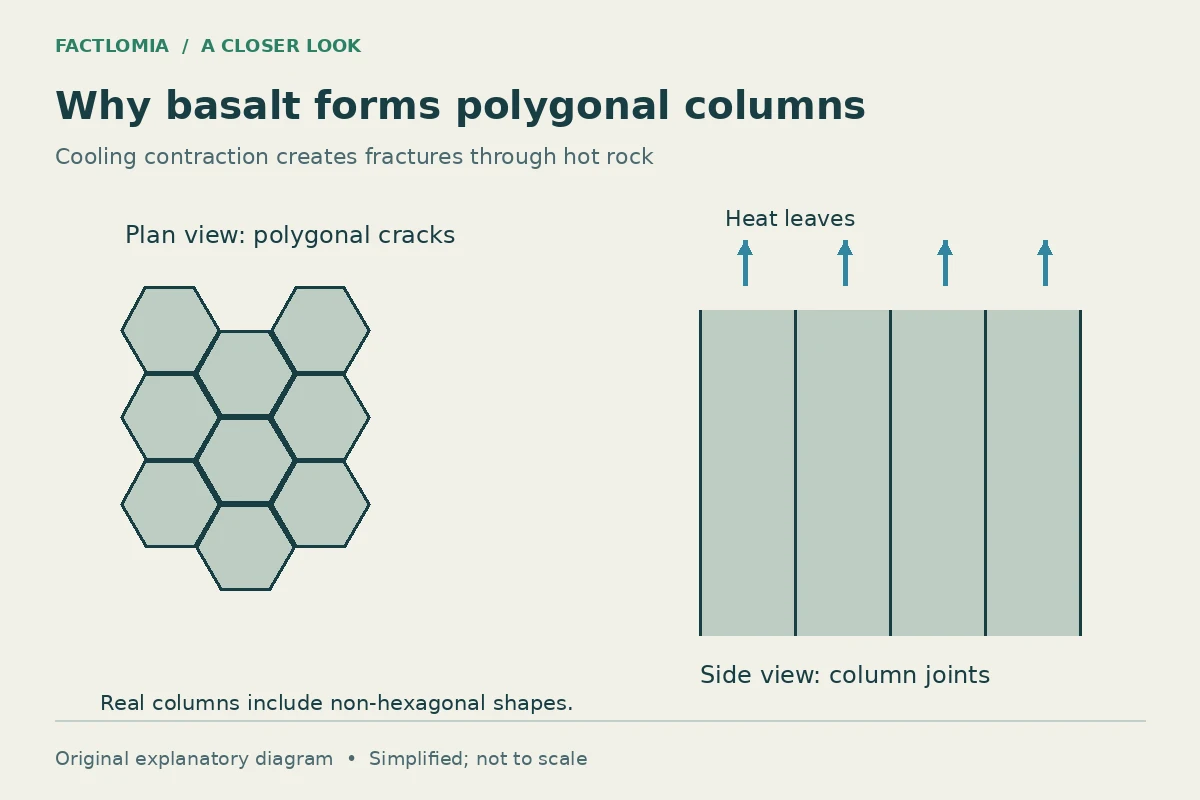
Basalt columns are often hexagonal because cooling rock contracts, building stresses that a network of cracks releases. Cracks meeting near 120-degree angles can develop into six-sided patterns. The columns are fractures in solidifying or already solid hot rock, not giant crystals growing into perfect hexagons.
Cooling creates the need to crack
As an igneous rock body loses heat, its volume decreases. Surrounding rock can constrain that shrinkage, producing tensile stress. Cracks relieve the stress and advance as cooling continues. The National Park Service calls the resulting pattern columnar jointing; it can form in other igneous rocks as well as basalt. [1]
Why six sides are common, not compulsory
Three-way crack junctions near 120 degrees can efficiently distribute contraction-related stress, favoring roughly hexagonal cells. Real rock is not a perfect geometric exercise: differences in cooling, composition, and crack development produce irregular polygons. Some columns have five, seven, or other numbers of sides. A photograph of a few hexagons should not be used to claim that every column at a site is six-sided. [1]
Why columns can tilt or curve
Cracks advance in relation to the direction that heat is leaving the rock. Columns tend to extend perpendicular to the principal cooling surfaces, so a change in those surfaces can change their orientation. Vertical columns are familiar where cooling proceeds from a roughly horizontal surface, but verticality is not a defining requirement. [1], [2]
Are the columns carved or crystalline?
The repeated geometry can look constructed, but cooling fracture provides a natural mechanism. Basalt contains mineral crystals, yet the giant columns are separated by joints rather than each being one mineral crystal. Laboratory work on cooling rock helps test the conditions under which cracks develop. For the broader volcanic setting, read why volcanoes erupt. A superficially similar polygon pattern has a different setting in salt flats.
Sources and evidence
- National Park Service — Columnar Jointing ↗
Contraction fractures, polygonal cross-sections, and cooling-surface orientation.
- University of Liverpool — How Giant’s Causeway formed ↗
Experiments investigating cracking during cooling of hot rock.
Sources consulted: 2026-10-21. Written with AI assistance and checked against the linked references; not independently reviewed by a subject specialist. Sources do not endorse this article. See our editorial policy.
Revision: First published 21 October 2026. Source-linked explanation and original diagram.